
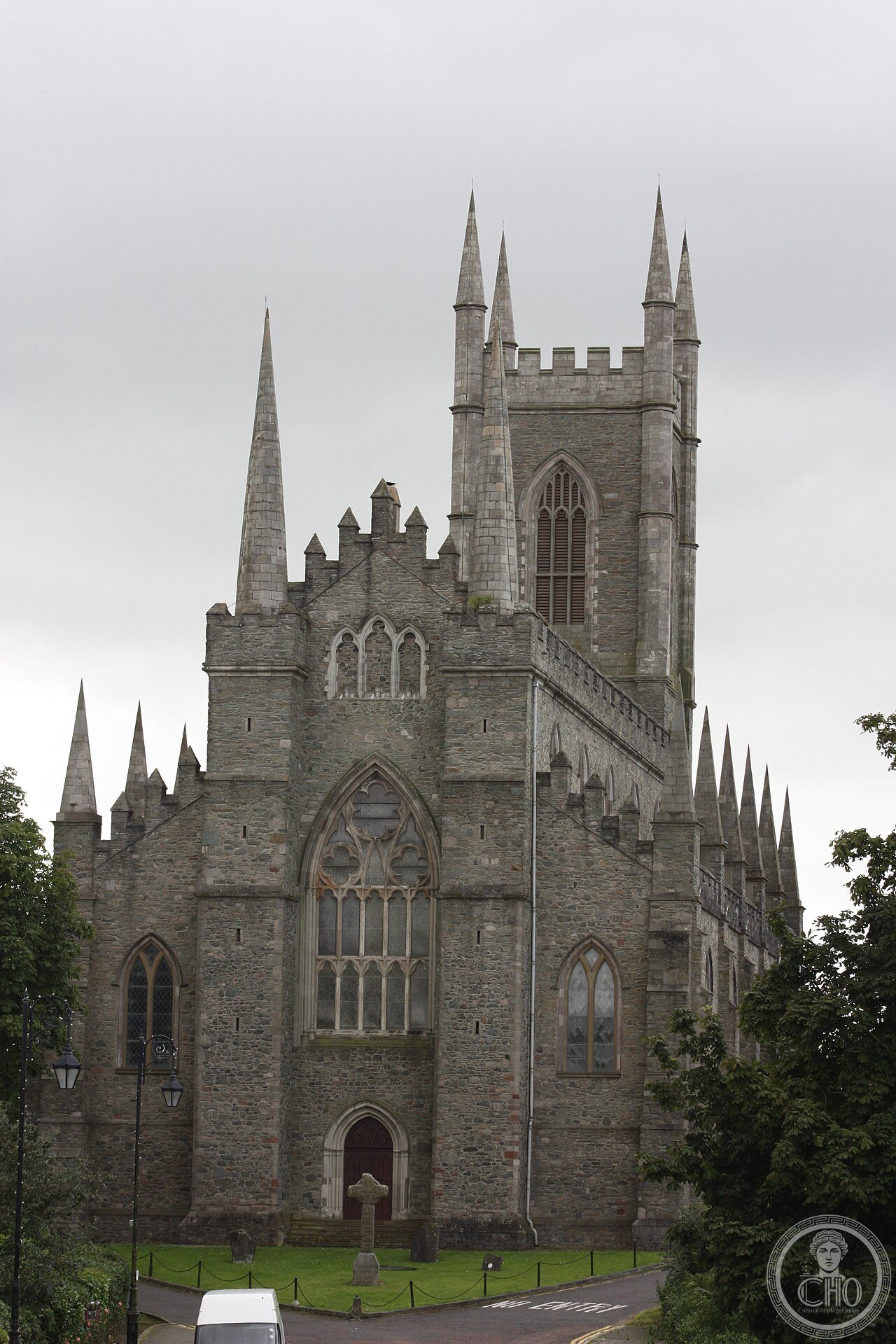
Secondo la tradizione, san Patrizio morì attorno al 461 e fu sepolto sulla collina di Downpatrick, nel cuore della regione dove aveva iniziato la sua missione. Nel corso dei secoli, si diffuse la convinzione che anche santa Brigida e san Colombano riposassero nella stessa tomba, ispirando il celebre distico: “A Down, tre santi riempiono una sola tomba: Patrizio, Brigida e Colombano.” Nel 1176, il barone normanno John de Courcy annunciò di aver ritrovato le reliquie dei tre santi proprio in questo luogo — una scoperta che gli servì anche a consolidare il proprio potere sull’Ulster orientale appena conquistato.
About Down Cathedral
According to tradition, Saint Patrick died around the year 461, and early accounts place his burial on the Hill of Down at Downpatrick, in the heart of the region where his mission in Ireland had first begun. A cathedral has stood on top of this hill since the 12th century, though the building has been rebuilt several times across the centuries, with the present structure dating largely from a restoration carried out in the 1790s. Over time, a further tradition developed holding that Saints Brigid and Columcille (Columba) were also buried alongside Patrick at the same site, giving rise to the famous couplet still recited today: “In Down, three saints one grave do fill, Patrick, Brigid and Columcille.” This tradition gained particular political significance in 1176, when the Anglo-Norman adventurer John de Courcy, who had conquered eastern Ulster in the 1170s, claimed to have discovered the relics of all three saints buried together at Downpatrick; historians widely understand de Courcy’s “discovery” as a deliberate strategy to promote Downpatrick as a major pilgrimage centre, thereby consolidating his own political and religious authority over his newly won territory. The great granite slab that today marks the traditional grave site is not itself ancient, but was placed there only in 1900, both to mark the traditional spot and to protect the ground from further erosion, after generations of pilgrims had worn away the earth and carried off soil as personal relics; the boulder bears the inscription of a Celtic cross alongside the simple carved name “Patrick.”
Key facts
- c. 461: traditional date of Saint Patrick’s death and burial at Downpatrick
- 12th century: a cathedral first established on the Hill of Down
- 1176: John de Courcy claims to discover the relics of Patrick, Brigid, and Columba together
- Tradition: “In Down, three saints one grave do fill”
- 1790s: the present cathedral building largely rebuilt
- 1900: the granite grave slab placed to protect the worn traditional burial spot
History
John de Courcy’s politically motivated 1176 “discovery” of three saints’ relics at a single site exemplifies a broader medieval pattern in which conquering lords actively promoted relic cults and pilgrimage traditions to legitimise and consolidate their rule over newly conquered territory — a strategy de Courcy pursued with particular success at Downpatrick, permanently binding the memory of Ireland’s three most venerated saints to a single physical location. The persistent popular tradition uniting Patrick, Brigid, and Columba in one grave, regardless of its questionable historical basis, has nonetheless shaped Irish religious memory and pilgrimage practice for over eight centuries, its enduring cultural power reflected in the still-recited traditional couplet.
The 1900 replacement of the worn traditional grave site with a protective granite slab reflects the practical challenges faced by long-venerated pilgrimage sites under sustained popular devotion, where the physical erosion caused by generations of pilgrims taking soil as relics eventually required deliberate intervention to preserve the site’s continued legibility and dignity.
What you see
The cathedral’s present form largely reflects its 1790s reconstruction, standing atop the historic Hill of Down overlooking Downpatrick and the surrounding County Down countryside. In the cathedral grounds, the granite grave slab, inscribed with a Celtic cross and the name “Patrick,” marks the traditional burial site of Ireland’s patron saint, remaining a significant point of pilgrimage and visitation to this day.
Practical information
- Opening hours: generally open daily with seasonal variation; check current hours before visiting; free admission
- Address: English Street, Downpatrick, County Down BT30 6AB, Northern Ireland
Getting there
Down Cathedral is located on the Hill of Down in the centre of Downpatrick, County Down, Northern Ireland, easily reachable on foot. GPS: 54.3276° N, -5.7217° E.
Nearby
- Saint Patrick Centre — a visitor centre dedicated to Saint Patrick’s life, nearby
- Downpatrick town centre — the surrounding historic town
- Struell Wells — a nearby holy well site associated with Saint Patrick
Sources
- Down Cathedral official site — “The historical burial place of Saint Patrick” (downcathedral.org)
- Atlas Obscura — “The Grave of St. Patrick in Downpatrick” (atlasobscura.com)
- National Churches Trust — “Sacred places of St Patrick” (nationalchurchestrust.org)
Find it on the map
See this place and what’s around it →📷 Become a Cultural Heritage Online photographer
Share your photos of places: they stay published under your name as the author. The more they're seen, the more you get noticed — and soon a contest will reward the most appreciated photos.
Log in or sign up free to add a photo