
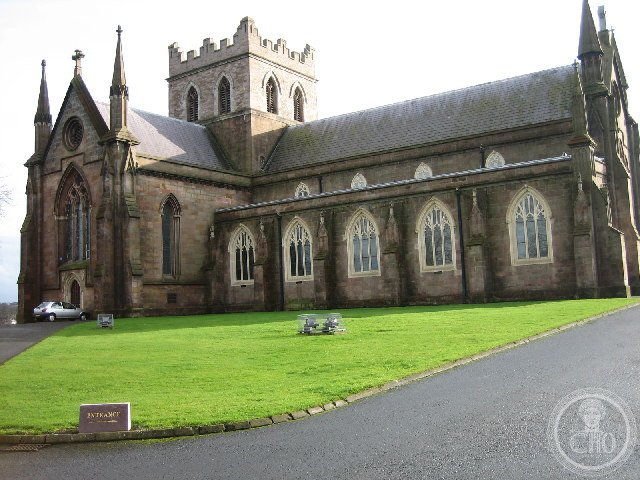
By tradition Saint Patrick founded a church on this hilltop around 445, choosing ground already sacred to pagan worship. In 1004 the High King Brian Boru came here on pilgrimage, recognised it as the head church of all Ireland and gave it a great weight of gold. When he fell at the Battle of Clontarf in 1014 — the victory that broke Viking power in Ireland — his body was buried here, in the cathedral he had honoured in life.
About St Patrick’s Cathedral, Armagh
According to tradition, a church was founded on this hilltop site around 445 by Saint Patrick himself, on ground evidence suggests had originally served as a pagan sanctuary before its Christian foundation. By the 7th century, the site had grown into the most important monastery and monastic school in the north of Ireland, with a wider monastic settlement developing around it over the following centuries. Patrick himself is said to have ordained that Armagh should hold pre-eminence over all the churches of Ireland, a claim to primacy that the see has retained, in one form or another, to the present day; this position was formally acknowledged by the wider Irish church at the Synod of Ráth Breasail in 1111, cementing Armagh’s status as the primatial see of Ireland. The cathedral’s significance to medieval Irish kingship is exemplified by the visit of Brian Boru, High King of Ireland, in 1004, when he formally acknowledged Armagh as the head cathedral of all Ireland and bestowed upon it a substantial gift of gold. Following Brian’s death at the Battle of Clontarf in 1014 — the decisive victory that broke the power of Viking rule in Ireland — his body was brought to Armagh and buried within the cathedral he had so publicly honoured a decade earlier. With the 16th-century Protestant Reformation, the cathedral was retained by the reformed Church of Ireland, becoming the seat of the Anglican Archbishop of Armagh, a role it continues to hold today. The building underwent substantial rebuilding between 1834 and 1840, overseen by Archbishop Lord John George Beresford and the architect Lewis Nockalls Cottingham, giving the cathedral much of its present external appearance while preserving the site’s continuous religious use across nearly sixteen centuries.
Key facts
- c. 445: church founded by Saint Patrick on a former pagan sanctuary site
- 7th century: Armagh becomes the leading monastery and school of northern Ireland
- 1004: Brian Boru visits, recognises Armagh’s primacy, and donates gold
- 1014: Brian Boru buried at Armagh after the Battle of Clontarf
- 1111: Armagh’s primacy over the Irish church formally confirmed at the Synod of Ráth Breasail
- 16th century: cathedral retained by the Church of Ireland after the Reformation
- 1834-1840: substantial rebuilding under Archbishop Beresford and architect Cottingham
History
Armagh’s formal recognition as the primatial see of Ireland, confirmed at the Synod of Ráth Breasail in 1111 but rooted in a tradition traced back to Patrick’s own foundation, makes the cathedral hill one of the most continuously significant single sites in the entire history of Irish Christianity, its ecclesiastical authority predating and outlasting the political kingdoms that rose and fell around it. Brian Boru’s burial here, immediately following his decisive 1014 victory at Clontarf that broke Viking military power in Ireland, ties the site directly to one of the most consequential turning points in early Irish political history, permanently linking Armagh’s religious primacy to the memory of Ireland’s most celebrated High King.
The cathedral’s retention by the Church of Ireland after the 16th-century Reformation, while the site’s founding association with Saint Patrick remained shared across Ireland’s Christian traditions, reflects the complex layered religious history of a site whose spiritual significance has outlasted successive changes in denominational control.
What you see
The cathedral’s present form largely reflects the substantial 1834-1840 rebuilding by Lewis Nockalls Cottingham, its hilltop position dominating views across the city of Armagh. Within the cathedral, memorials and monuments trace centuries of the see’s history, while the traditional site of Brian Boru’s grave remains marked and visited as one of the cathedral’s most historically significant features.
Practical information
- Opening hours: generally open daily with seasonal variation; check current hours before visiting; free admission
- Address: Vicars Hill, Armagh, County Armagh BT61 7ED, Northern Ireland
Getting there
St Patrick’s Cathedral is located on a hilltop in the centre of Armagh, Northern Ireland, easily reachable on foot. GPS: 54.3478° N, -6.6562° E.
Nearby
- St Patrick’s Cathedral (Roman Catholic) — the city’s second cathedral, on a neighbouring hill
- Armagh Public Library — a historic library near the cathedral
- Armagh city centre — the surrounding historic city
Sources
- Wikipedia — “St Patrick’s Cathedral, Armagh (Church of Ireland)” (en.wikipedia.org)
- Visit Armagh — “The Story Of St Patrick’s COI Cathedral” (visitarmagh.com)
- St Patrick’s Cathedral, Armagh official site — “Saint Patrick” (stpatricks-cathedral.org)
Find it on the map
See this place and what’s around it →📷 Become a Cultural Heritage Online photographer
Share your photos of places: they stay published under your name as the author. The more they're seen, the more you get noticed — and soon a contest will reward the most appreciated photos.
Log in or sign up free to add a photo