
Secondo la leggenda, il figlio dell’imperatore Teodosio, Arcadio, naufragò durante una tempesta al largo della costa dove oggi sorge il monastero. Fu ritrovato addormentato, sano e salvo, sotto un cespuglio di rovi non lontano dalla riva — ed è da quel roveto (in greco, batos) e dalla pianura (pedion) che il monastero prese il nome di Vatopedi. Oggi, secondo in ordine gerarchico tra i venti monasteri del Monte Athos, custodisce la Sacra Cintura della Theotokos, la sola reliquia sopravvissuta della vita terrena della Vergine Maria.
About Vatopedi Monastery
The re-establishment of Vatopedi Monastery is dated to between 972 and 985, according to historical sources testifying that the refoundation was carried out by three lords from Adrianople — Athanasios, Nikolaos, and Antonios — who had been students of Saint Athanasius the Athonite, the founder of Great Lavra and of organised Athonite monasticism itself. The monastery’s evocative name is explained by tradition through the legend of Arkadios, a son of the Byzantine Emperor Theodosios, who was travelling by sea toward Rome when his ship was caught in a storm near the shore where the monastery now stands and sank; Arkadios himself was found alive and unharmed, asleep beneath a thorny bush not far from the waterfront. Since the surrounding valley is thick with brambles and thorny briers, the monastery took the name Vatopedi — combining the Greek words for “bush” (vatos) and “plain” (pedion) — commemorating the prince’s miraculous survival. Vatopedi ranks second in the hierarchical order of Mount Athos’s twenty monasteries, immediately after Great Lavra, and remains one of the most significant centres of Orthodox spirituality anywhere on the peninsula. Among its most venerated treasures is the Holy Belt (Cincture) of the Theotokos, regarded by Orthodox tradition as the only relic to have survived from the earthly life of the Virgin Mary herself; according to tradition, the woollen belt, woven by the Mother of God with her own hands, was given by her to the Apostle Thomas following her Dormition and Assumption into heaven, and has since been preserved and venerated as one of the most sacred objects in the entire Orthodox world.
Key facts
- 972-985: monastery re-established by three students of Saint Athanasius the Athonite.
- Founding legend: Prince Arkadios’s shipwreck survival beneath a thorny bush.
- Name origin: “Vatopedi,” from Greek for “bush” and “plain”
- Hierarchical rank: second among the twenty monasteries of Mount Athos.
- The Holy Belt: traditionally the only surviving relic of the Virgin Mary’s earthly life.
- Origin of the relic: said to have been given by the Theotokos herself to the Apostle Thomas.
History
Vatopedi’s founding legend, linking the monastery’s very name to a miraculous shipwreck survival, situates the site within a broader Athonite tradition of foundation stories combining Byzantine imperial connections with tales of divine or providential intervention — a pattern echoed across several of the peninsula’s oldest monastic houses. The monastery’s status as custodian of the Holy Belt of the Theotokos gives Vatopedi an exceptional position within Orthodox devotional geography, since this single relic is regarded as uniquely connecting the physical world to the earthly life of the Virgin Mary in a way matched by no other surviving object.
Vatopedi’s re-foundation by three direct disciples of Saint Athanasius the Athonite ties the monastery closely to the very origins of organised Athonite monasticism established at Great Lavra just a decade or so earlier, situating Vatopedi’s early history within the first generation of monastic expansion that transformed Mount Athos from isolated hermit settlements into the coordinated monastic republic it remains today.
What you see
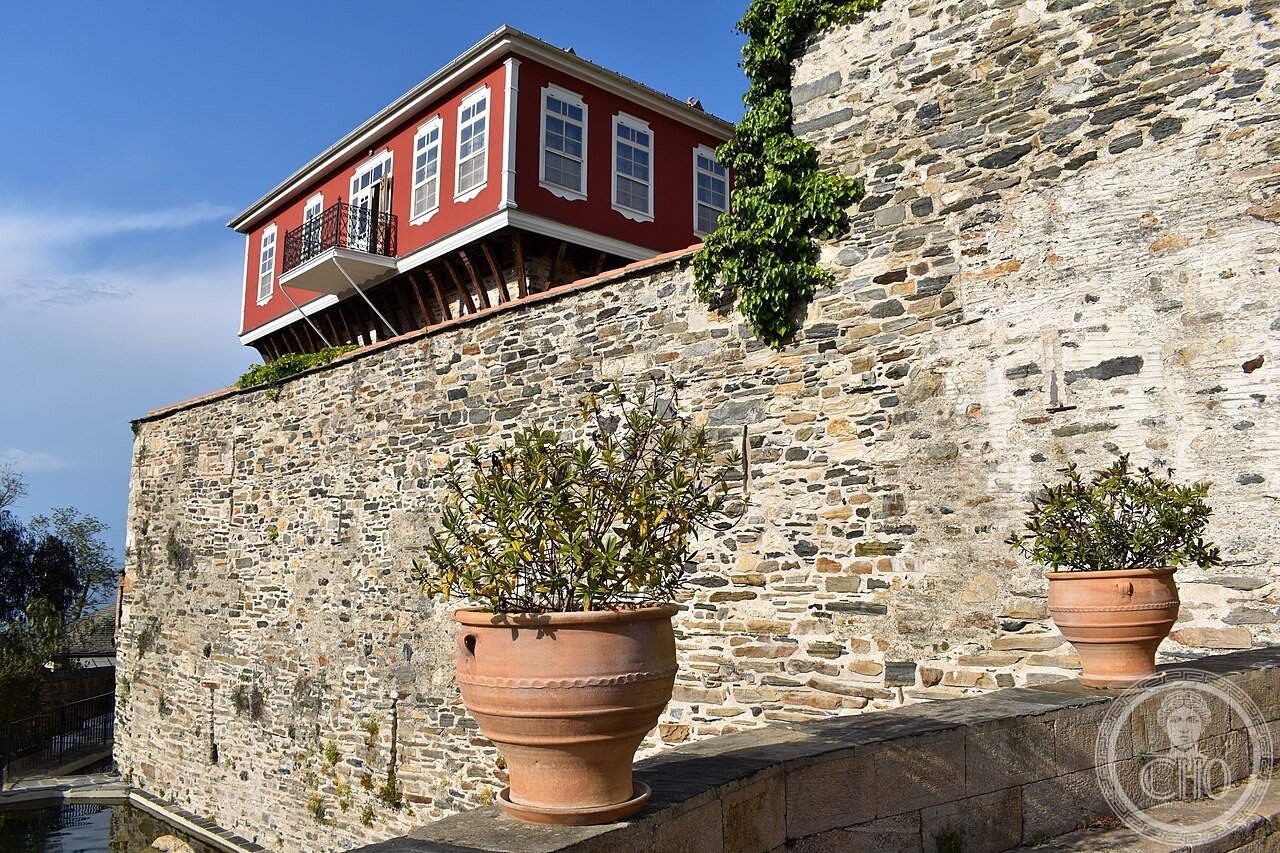
The monastery presents an extensive fortified complex, among the largest on Mount Athos, its katholikon (main church) and surrounding buildings reflecting centuries of continuous expansion and renovation. The reliquary chapel housing the Holy Belt of the Theotokos remains a principal focus of pilgrimage, alongside the monastery’s significant collection of icons, manuscripts, and other treasures accumulated across more than a millennium of continuous monastic life.
Practical information
- Opening hours: access restricted to male visitors with a special pilgrim permit (diamonitirion), issued by the Mount Athos administration.
- Address: Vatopedi, Mount Athos Autonomous Monastic State, Greece.
Getting there
Vatopedi Monastery is located on the northeastern coast of the Mount Athos peninsula in northern Greece, reachable only by boat and only with the required pilgrim permit. GPS: 40.3142° N, 24.2118° E.
Nearby
- Great Lavra — the oldest and first-ranked monastery of Mount Athos.
- Karyes — the administrative capital of the Mount Athos monastic state.
- Athonite Academy — a historic school adjoining the monastery.
Sources
- Wikipedia — “Vatopedi” and “Cincture of the Theotokos” (en.wikipedia.org).
- Holy Great Monastery of Vatopedi — “The Holy Belt of the Virgin Mary” (vatopedi.gr).
- Mount-Athos.org — “Vatopedi Monastery on Mount Athos” (mount-athos.org).
Find it on the map
See this place and what’s around it →📷 Become a Cultural Heritage Online photographer
Share your photos of places: they stay published under your name as the author. The more they're seen, the more you get noticed — and soon a contest will reward the most appreciated photos.
Log in or sign up free to add a photo