

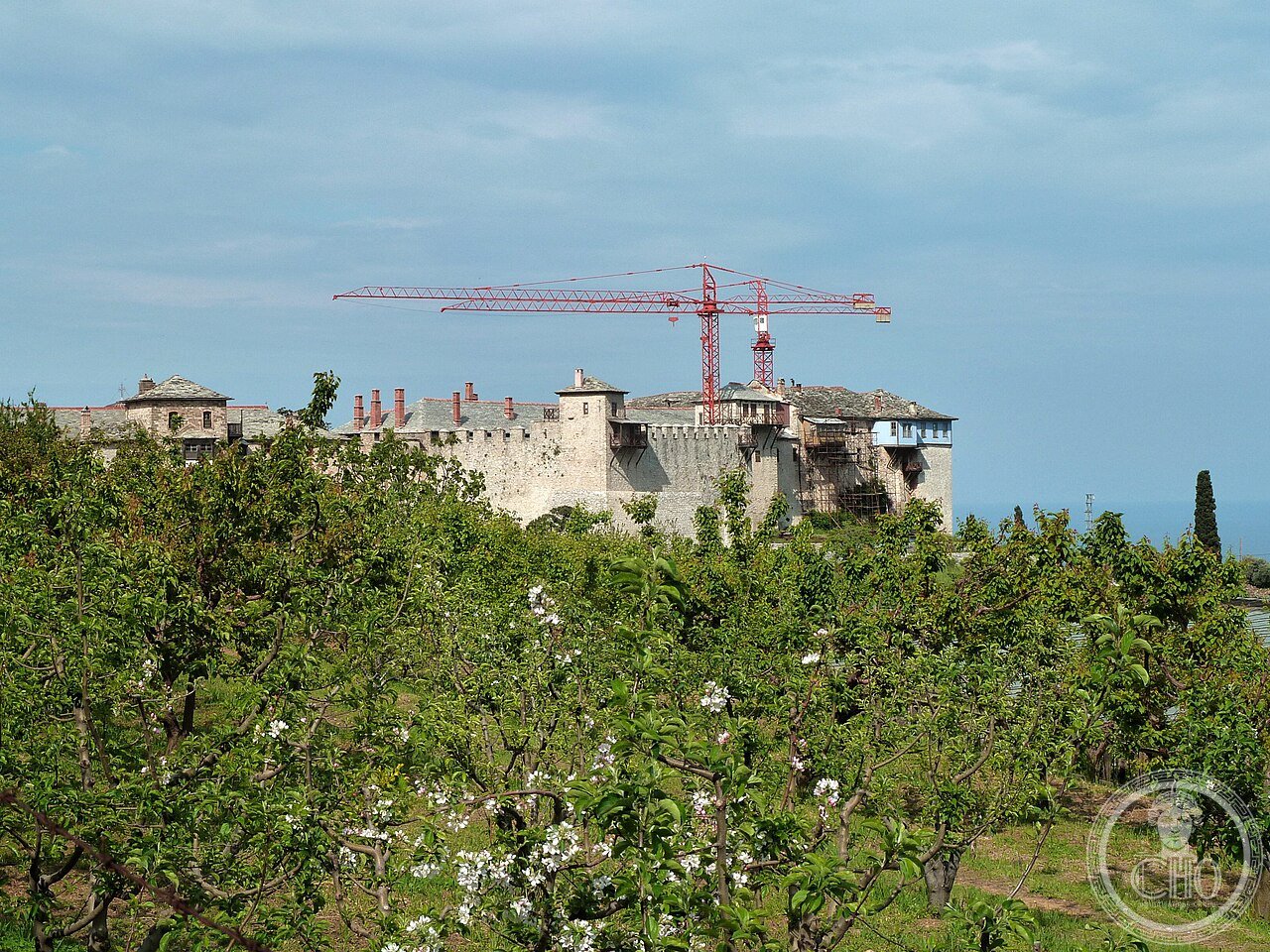
In 963, with the financial help of his friend the general Nikephoros Phokas — who would become emperor shortly afterwards — Saint Athanasius the Athonite founded the Great Lavra, the first and oldest of the twenty great monastic communities of Mount Athos, of which it remains the mother house to this day. Around the year 1000, by tradition, Athanasius climbed with six brothers onto the top of his own church to inspect the work: the dome collapsed without warning, and five of those present died instantly, the founder among them.
About Great Lavra
The Great Lavra (Megisti Lavra) was founded in 963 AD by Saint Athanasius the Athonite, and stands as the oldest and most prominent monastery among the entire monastic community of Mount Athos, its founding marking the beginning of organised, coenobitic monastic life on the peninsula. Athanasius’s foundation received crucial early support from his personal friend, the Byzantine general Nikephoros Phokas, who provided financial assistance for the monastery’s construction; when Nikephoros went on to become Byzantine Emperor shortly afterward, the Great Lavra was elevated to the status of a Royal Monastery and received rich imperial grants, cementing its position at the very top of the Athonite hierarchy. Athanasius is regarded as the founder of Athonite monasticism itself, and the Great Lavra remains ranked first in the hierarchical order of Mount Athos’s twenty monasteries, its triconch church plan later serving as the architectural model for virtually all subsequent Athonite churches, a design subsequently exported to Orthodox churches across northern Greece and the wider Balkans. Athanasius’s own death, around the year 1000, came in tragic circumstances directly connected to his monastic building work: according to tradition, the abbot climbed to the top of the church together with six of his brethren to inspect the ongoing construction, when the dome suddenly and unexpectedly collapsed; five of those present died instantly, Athanasius among them, having given his life quite literally to the completion of the church he had founded. Upon his death, Athanasius was glorified as a saint, with his feast day observed on 5 July. Today, the Great Lavra’s library preserves an extraordinary collection of some 2,046 manuscripts, 165 codices, and 30,000 printed books, making it one of the richest manuscript collections anywhere within the Orthodox monastic world.
Key facts
- 963: founded by Saint Athanasius the Athonite with support from Nikephoros Phokas
- Rank: first in hierarchical order among Mount Athos’s twenty monasteries, and its oldest
- c. 1000: Athanasius dies when the church dome collapses during an inspection
- 5 July: Saint Athanasius’s feast day
- Architectural legacy: the Lavra’s triconch church plan became the model for later Athonite churches
- Library: 2,046 manuscripts, 165 codices, and 30,000 printed books
- Status: the mother monastery of Mount Athos
History
Athanasius’s death while personally inspecting the construction of his own church situates his story within a poignant tradition of founder-martyrs whose own physical labour and oversight became inseparable from the monuments they built — a death that, rather than diminishing the monastery’s prestige, appears to have reinforced its sanctity, contributing directly to his subsequent glorification as a saint. The imperial patronage secured through Athanasius’s personal friendship with Nikephoros Phokas, who became Byzantine Emperor shortly after helping fund the monastery, illustrates the close and often personal ties between Byzantine political power and the early development of Mount Athos as a centre of Orthodox monasticism.
The Great Lavra’s triconch church plan, developed at the very founding of organised Athonite monasticism, went on to shape the architectural vocabulary of Orthodox monastery churches across an enormous geographic range, making this single foundational building project at Mount Athos a lasting influence on ecclesiastical architecture throughout the Balkans and northern Greece for centuries afterward.
What you see
The monastery’s austere exterior, largely unembellished, takes the form of a fortified small medieval town, enclosed within strong defensive walls studded with 15 towers; within and around these fortifications stand 37 chapels, numerous independent kellia (monastic cells), and three dependent sketes. The Katholikon (main church), rebuilt after the original dome’s collapse, preserves the triconch plan that became the model for all later Athonite church architecture.
Practical information
- Opening hours: access restricted to male visitors with a special pilgrim permit (diamonitirion), issued by the Mount Athos administration
- Address: Great Lavra, Mount Athos Autonomous Monastic State, Greece
Getting there
Great Lavra is located at the southeastern tip of the Mount Athos peninsula in northern Greece, reachable only by boat and only with the required pilgrim permit. GPS: 40.1708° N, 24.3832° E.
Nearby
- Mount Athos peak — the mountain summit overlooking the monastery
- Karyes — the administrative capital of the Mount Athos monastic state
- Other Athonite monasteries — the nineteen other great monasteries of Mount Athos
Sources
- Wikipedia — “Great Lavra” and “Athanasius the Athonite” (en.wikipedia.org)
- OrthodoxWiki — “Great Lavra (Athos)” and “Athanasius of Athos” (orthodoxwiki.org)
- Mount-Athos.org — “Great Lavra Monastery on Mount Athos” (mount-athos.org)
Find it on the map
See this place and what’s around it →📷 Become a Cultural Heritage Online photographer
Share your photos of places: they stay published under your name as the author. The more they're seen, the more you get noticed — and soon a contest will reward the most appreciated photos.
Log in or sign up free to add a photo