
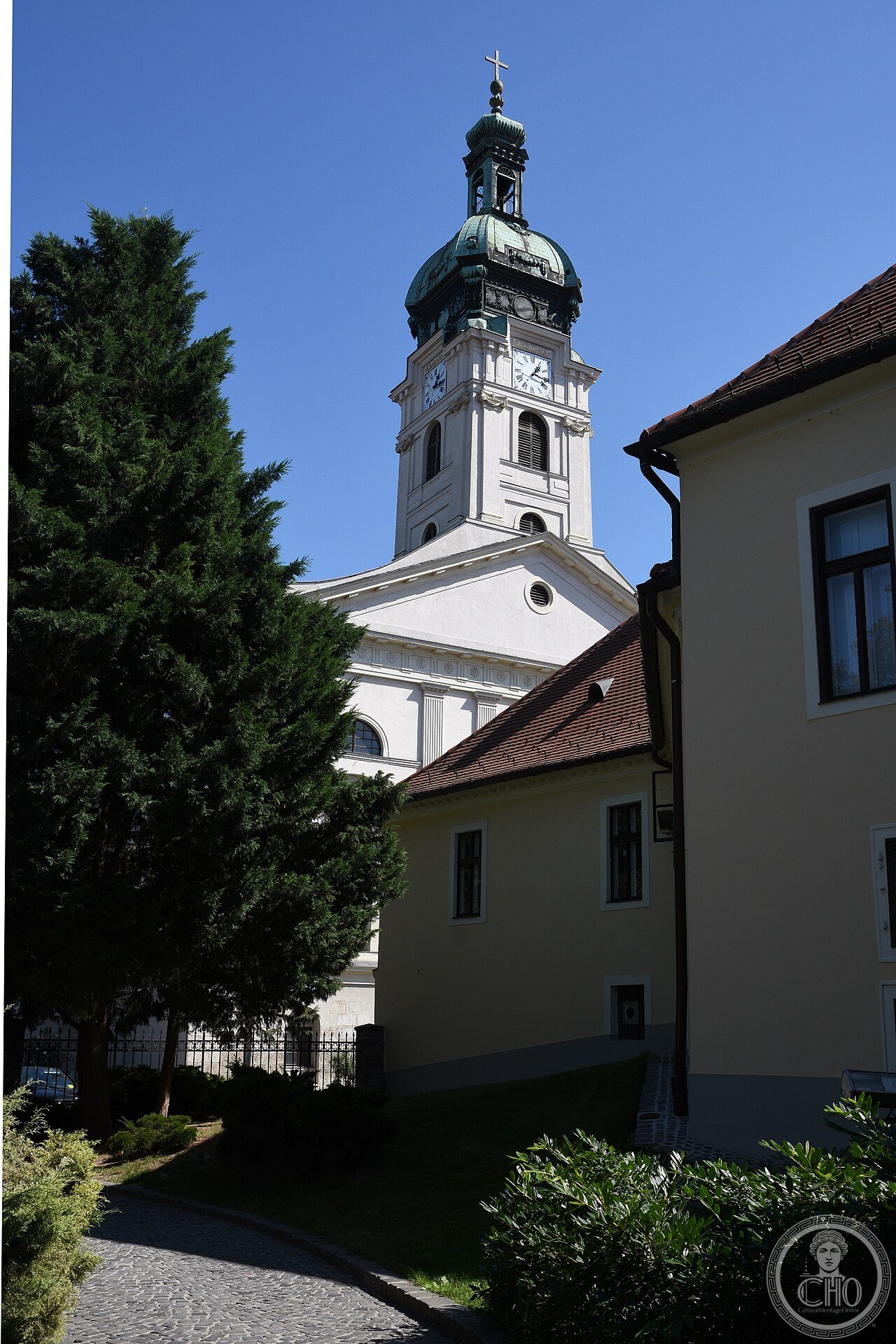
On 17 March 1697, Saint Patrick’s day, while thousands of the faithful crowded Győr Cathedral, an icon of the Virgin brought from Ireland in 1655 began to shed tears of blood before the eyes of the crowd. Several priests tried to wipe them away, but the weeping went on for about three hours, witnessed by hundreds of people — among them the captain general of the city, the bishop, Lutheran and Calvinist pastors and even a rabbi. In the Héderváry chapel, on the south side of the basilica, the reliquary of the skull of Saint Ladislaus is still kept, a masterpiece of twelfth-century goldsmithing.
About Győr Cathedral
Győr Cathedral was originally founded in the 11th century by King Saint Stephen I of Hungary, blending a heavy Romanesque foundation with what would later become a spectacular gilded Baroque interior. Following the destruction wrought by the Mongol invasion of the 13th century, the cathedral was reconstructed in Gothic style, including an elevated sanctuary and the addition of a crypt. The 16th century brought further turmoil: the cathedral suffered severe damage during Ottoman Turkish invasions, with one of its towers collapsing and the remaining tower later destroyed by lightning, while during the Ottoman occupation of Győr from 1594 to 1598 the building was repurposed as a fortress. In the early 17th century, Bishop George Draskovich commissioned the Italian architect Giovanni Battista Rava to oversee the cathedral’s reconstruction in early Baroque style, giving the building much of its present character. Among the cathedral’s most extraordinary treasures is a devotional icon of the Virgin Mary, brought to Győr from Ireland in 1655. On 17 March 1697 — Saint Patrick’s Day — as thousands of worshippers filled the cathedral, the image reportedly began to weep tears of blood; several priests attempted to wipe away the tears, but the phenomenon continued for roughly three hours, witnessed and attested to by hundreds of people, including the city’s Captain General, Count Seigebert Hester, the bishop himself, and — remarkably — Lutheran and Calvinist ministers and a Jewish rabbi, giving the reported miracle an unusually broad cross-confessional body of witnesses. The Héderváry Chapel on the basilica’s southern side houses another of Hungary’s most important national relics: the reliquary of Saint Ladislaus, an exquisite piece of 12th-century goldsmithing containing the saint’s skull, adorned with precious stones and intricate enamel work. In 1997, Pope John Paul II granted the cathedral the status of minor basilica.
Key facts
- 11th century: cathedral founded by King Stephen I
- 13th century: rebuilt in Gothic style after Mongol invasion damage
- 1594-1598: cathedral used as a fortress during Ottoman occupation
- 1655: the Marian icon arrives in Győr from Ireland
- 17 March 1697: the icon reportedly weeps blood for roughly three hours
- Héderváry Chapel: holds the 12th-century reliquary of Saint Ladislaus’s skull
- 1997: Pope John Paul II grants the cathedral minor basilica status
History
The 1697 weeping icon phenomenon, witnessed across confessional lines by Catholic, Lutheran, Calvinist, and Jewish observers alike, stands among the more remarkable documented instances of a claimed religious miracle attracting genuinely interfaith attestation in early modern Central Europe — a rarity in a period more often defined by confessional division following the Reformation and Counter-Reformation. The icon’s Irish origin, arriving in Hungary in 1655 amid the broader displacement of Irish Catholic clergy and relics during the Cromwellian period in Ireland, connects Győr Cathedral to a wider network of Irish Catholic exile and devotional transfer across 17th-century Catholic Europe.
The Héderváry Chapel’s 12th-century reliquary of Saint Ladislaus, containing the skull of one of medieval Hungary’s most venerated royal saints, situates the cathedral among the country’s most significant custodians of national dynastic and religious relics, comparable in importance to other major Hungarian ecclesiastical treasuries holding relics of the country’s early Christian kings.
What you see
The cathedral’s exterior reflects its early 17th-century Baroque reconstruction under Giovanni Battista Rava, layered over the surviving Romanesque and Gothic fabric beneath. Inside, the gilded Baroque decoration frames both the venerated weeping Madonna icon and the Héderváry Chapel’s reliquary of Saint Ladislaus, two of Hungary’s most significant devotional treasures housed within a single building.
Practical information
- Opening hours: generally open daily with seasonal variation; check current hours before visiting; free admission
- Address: Káptalandomb, 9021 Győr, Hungary
Getting there
Győr Cathedral is located on Chapter Hill (Káptalandomb) in the historic centre of Győr, western Hungary, easily reachable on foot. GPS: 47.6890° N, 17.6314° E.
Nearby
- Győr Baroque city centre — the historic district surrounding the cathedral
- Bishop’s Castle — the adjoining episcopal residence
- Rába and Mosoni-Duna rivers — the waterways framing Győr’s historic centre
Sources
- Wikipedia — “Cathedral Basilica of Győr” (en.wikipedia.org)
- Catholic Culture — “The Irish Madonna of Hungary” (catholicculture.org)
- The Catholic Travel Guide — “Cathedral of Our Lady of Gyor” (thecatholictravelguide.com)
Find it on the map
See this place and what’s around it →📷 Become a Cultural Heritage Online photographer
Share your photos of places: they stay published under your name as the author. The more they're seen, the more you get noticed — and soon a contest will reward the most appreciated photos.
Log in or sign up free to add a photo