
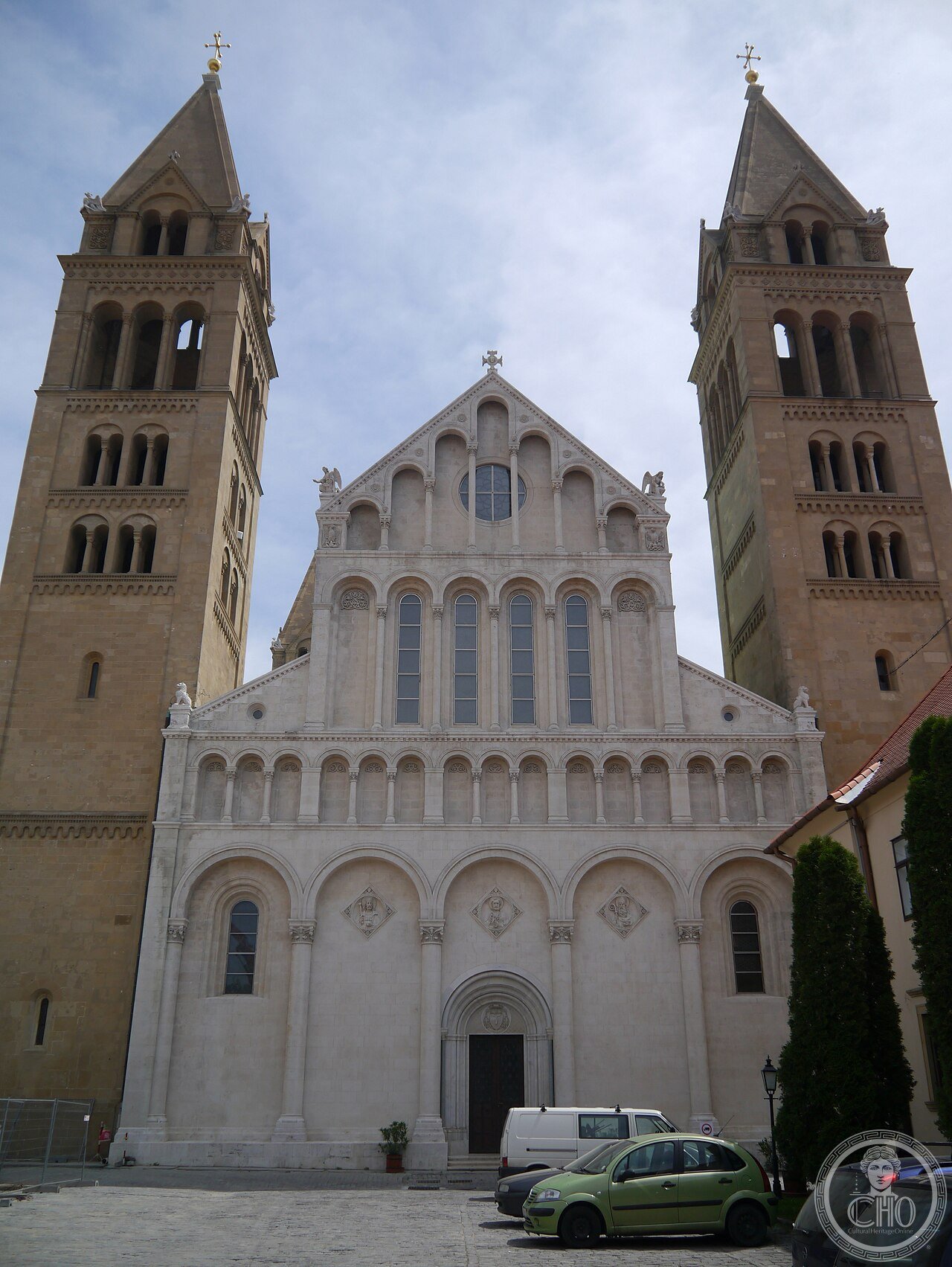
The foundations of Pécs Cathedral go back to Roman times, when the town was called Sopianae. A crypt of the 4th century still lies beneath the building, part of the Early Christian necropolis that is now UNESCO World Heritage. In 1009 Saint Stephen I, the first king of Hungary, founded the diocese here. After a great fire in 1064 the Romanesque basilica was rebuilt with the help of Italian architects. In the Middle Ages two lateral towers were added, and Pécs became the only Hungarian cathedral with four towers — the look it keeps today, after the Neo-Romanesque reconstruction of 1882-1891.
About Pécs Cathedral
The foundations of Pécs Cathedral date back to the Roman period, around the 4th century, when the town — then known as Sopianae — already possessed a cathedral with an underground crypt from that era, part of the same rich complex of decorated Early Christian burial chambers that today form the UNESCO-listed Early Christian Necropolis of Pécs. The Roman Catholic Diocese of Pécs was formally founded in 1009 by Stephen I, Hungary’s first king, and it was during his reign that the decision was made to modify the church’s construction, with the two western towers presumed to date from this same period. Following a major fire in 1064, the Romanesque basilica was rebuilt with the involvement of Italian architects, and during the Middle Ages the church was further enlarged with two additional lateral towers and Gothic chapels — a series of expansions that ultimately produced the four-towered Romanesque cathedral, making Pécs Cathedral unique among Hungarian churches as the only one in the country crowned by four principal towers. The cathedral’s present Neo-Romanesque appearance results from an extensive reconstruction carried out between 1882 and 1891, faithfully executed according to the plans of the Viennese architect Friedrich von Schmidt, whose intervention gave the building much of its current visual character while preserving the underlying medieval and Roman-era structure beneath.
Key facts
- 4th century: Roman-era crypt built beneath the site, part of the Sopianae necropolis.
- 1009: Diocese of Pécs founded by Stephen I, Hungary’s first king.
- 1064: Romanesque basilica rebuilt after a major fire, with Italian architects.
- Middle Ages: two lateral towers and Gothic chapels added.
- Unique feature: the only four-towered cathedral in Hungary.
- 1882-1891: Neo-Romanesque reconstruction by architect Friedrich von Schmidt.
- 2000: the underlying Early Christian Necropolis inscribed as UNESCO World Heritage.
History
The cathedral’s foundations resting directly upon a 4th-century Roman crypt make Pécs one of the few Hungarian cathedral sites with continuous religious use stretching back to Late Antiquity, its underlying Early Christian necropolis — richly decorated with murals of outstanding artistic quality — providing a direct physical link to the Roman provincial town of Sopianae that predates the Hungarian kingdom itself by centuries. Stephen I’s 1009 foundation of the diocese situates Pécs Cathedral within the wave of ecclesiastical institution-building that accompanied Hungary’s Christianisation, extending the newly formed kingdom’s religious infrastructure onto ground already sanctified by half a millennium of prior Christian burial practice.
The cathedral’s distinctive four-tower silhouette, unique among Hungarian churches, developed gradually across the medieval period before being definitively fixed by Friedrich von Schmidt’s late 19th-century Neo-Romanesque reconstruction — a restoration campaign that, like many of the era, sought to recover and stabilise an idealised Romanesque appearance for a building whose actual fabric spanned Roman, medieval, and early modern phases.
What you see
The cathedral’s four 60-metre towers remain its most distinctive and immediately recognisable feature, unmatched by any other church in Hungary. The Neo-Romanesque exterior, the result of the 1882-1891 reconstruction, presents a unified stylistic appearance despite the building’s much older and more layered underlying structure, including the 4th-century Roman crypt still preserved beneath the cathedral floor.
Practical information
- Opening hours: generally open daily with seasonal variation; check current hours before visiting; admission fee applies.
- Address: Dóm tér, 7621 Pécs, Hungary.
Getting there
Pécs Cathedral is located on Dóm tér (Cathedral Square) in the historic centre of Pécs, southern Hungary, easily reachable on foot. GPS: 46.0781° N, 18.2237° E.
Nearby
- Early Christian Necropolis of Pécs — the UNESCO-listed 4th-century burial complex, adjacent to the cathedral.
- Pécs historic centre — the surrounding old town.
- Mosque of Pasha Qasim — a former Ottoman mosque nearby, now a church.
Sources
- Wikipedia — “Pécs Cathedral” (en.wikipedia.org).
- UNESCO World Heritage Centre — “Early Christian Necropolis of Pécs (Sopianae)” (whc.unesco.org).
- pecs.website — “Cathedral of St. Peter and Paul” (pecs.website).
Find it on the map
See this place and what’s around it →📷 Become a Cultural Heritage Online photographer
Share your photos of places: they stay published under your name as the author. The more they're seen, the more you get noticed — and soon a contest will reward the most appreciated photos.
Log in or sign up free to add a photo