
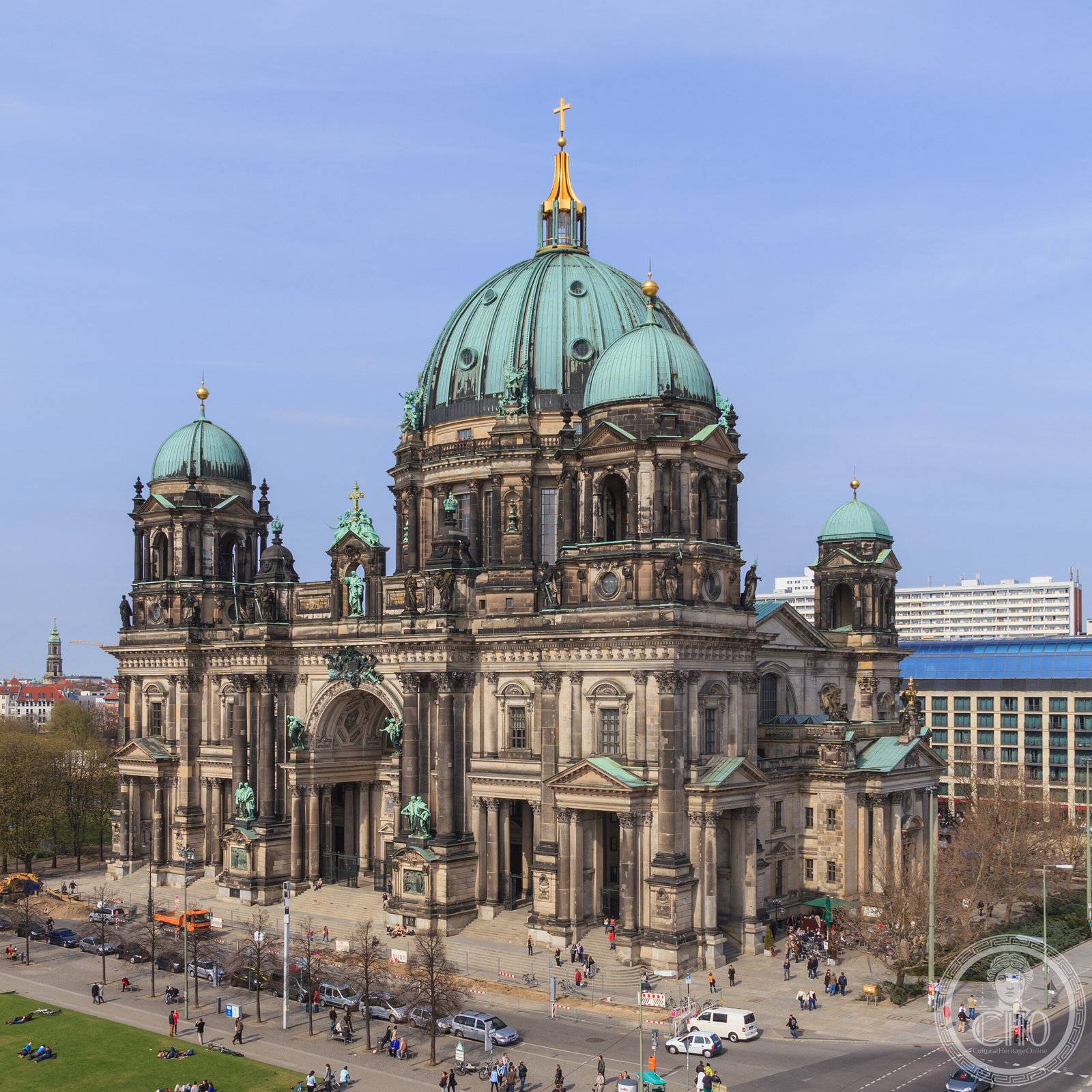
Berlin Cathedral (Berliner Dom) is the principal Protestant church of Germany and the court church of the Hohenzollern dynasty, standing on Museum Island in the Mitte district of Berlin. Rebuilt between 1894 and 1905 to designs by Julius Carl Raschdorff in an exuberant Italian High Renaissance and Baroque Revival style, the building’s central dome reaches 98 metres and shelters one of Europe’s most significant dynastic burial vaults, containing over 90 sarcophagi of the House of Hohenzollern spanning four centuries.
At a glance
- Type
- Protestant court cathedral and dynastic burial church
- Period
- Current building 1894–1905; earlier structures on the same site from 1451; restored 1975–2002 after WWII damage
- Style
- Italian Renaissance and Baroque Revival (Raschdorff)
- Location
- Am Lustgarten 1, Museum Island, Mitte, Berlin, Germany · 52.5174° N, 13.3936° E
Overview
The cathedral stands on the northern tip of Museum Island, facing the Lustgarten park and the Altes Museum across the open square. Its four corner towers frame a central copper dome crowned by a lantern and golden cross. The interior is richly decorated with mosaics, stained glass, and marble; the Hohenzollern crypt beneath the main floor is open to visitors and contains sarcophagi from the Great Elector Friedrich Wilhelm (d. 1688) to Kaiser Friedrich III (d. 1888). The Sauer organ (1905), with 7,269 pipes, is one of the largest in Germany.
History
A court chapel on Museum Island was first recorded in 1451 under the Hohenzollern Electors of Brandenburg. Karl Friedrich Schinkel redesigned the building in Neoclassical form in the 1820s, but Kaiser Wilhelm II found it insufficiently grand for the German imperial capital and commissioned a complete replacement. Julius Carl Raschdorff designed the present palatial structure; construction ran from 1894 to 1905 and the cathedral was consecrated in the presence of the Kaiser. Heavy bombing in 1944–45 destroyed the roof and collapsed the drum of the dome. Restoration began in East Berlin in 1975 and was completed only in 2002 after reunification.
What you see
The main nave — the Predigtkirche (preaching church) — seats over 1,500 and is crowned by the central dome decorated with mosaics of the Beatitudes. The Taufkirche (baptismal church) and Trauerkirche (memorial church) flank the nave. Visitors can climb the dome gallery for panoramic views across Museum Island and the city. The Hohenzollern crypt holds elaborate Renaissance and Baroque sarcophagi, including the ornate coffins of the Great Elector and his wife, designed by Andreas Schlüter. The Sauer organ dominates the west end of the nave and is regularly used for concerts.
Cultural significance
Berlin Cathedral is both an active place of Protestant worship and a state monument to the Prussian–German imperial identity. Its position at the heart of Museum Island — a UNESCO World Heritage Site since 1999 — makes it a focal point of the largest museum complex in Germany. The Hohenzollern crypt is a unique repository of dynastic history covering the era from the Reformation to the Empire’s collapse in 1918.
Practical information
- Address
- Am Lustgarten 1, 10178 Berlin, Germany
- Opening hours
- Mon–Sat 09:00–20:00, Sun 12:00–20:00 (Apr–Oct); reduced hours Nov–Mar
- Admission
- Paid entry required for nave and crypt; free during services
- Website
- Check official website for concert programme and current hours
Getting there
S-Bahn S3, S5, S7, S9 stop at Hackescher Markt, a seven-minute walk. U-Bahn U2 stops at Spittelmarkt or Märkisches Museum. Tram M1, 12 stop at Am Kupfergraben directly beside the cathedral. Bus 100, 200, TXL stop on Unter den Linden. The cathedral is in the centre of Museum Island, easily reached on foot from the TV Tower or Alexanderplatz.
Sources & resources
See the place
Find it on the map
See this place and what’s around it →📷 Become a Cultural Heritage Online photographer
Share your photos of places: they stay published under your name as the author. The more they're seen, the more you get noticed — and soon a contest will reward the most appreciated photos.
Log in or sign up free to add a photo