
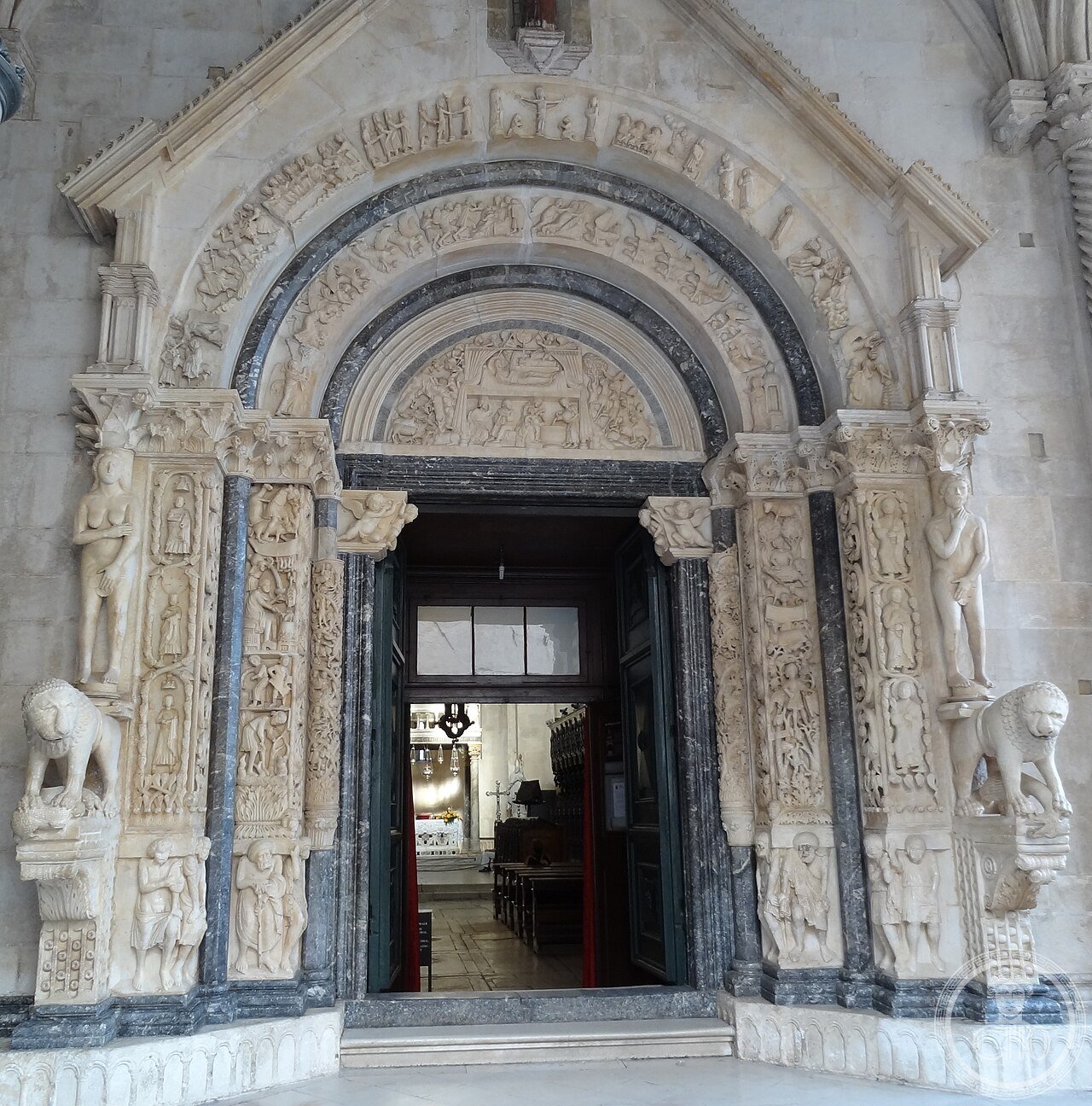
Sull’architrave del portale principale della cattedrale di Trogir, sotto le scene dell’Annunciazione, corre un’iscrizione firmata dallo scultore che lo realizzò: il maestro Radovan, che non esitò a definirsi “il migliore in quest’arte.” Completato e firmato nel 1240, il suo portale è considerato il più importante d’Europa medievale in questa parte del continente — e sceglie, unico caso tra i grandi portali del periodo, la Natività di Cristo come tema centrale della lunetta, al posto del più consueto Giudizio Universale.
About Trogir Cathedral
Construction of the Cathedral of Saint Lawrence in Trogir began in 1213 and was not fully completed until the 17th century, rising on the foundations of an earlier Early Christian cathedral that had been destroyed during a Saracen sack of the town in 1123. Master Radovan, regarded as the most important sculptor of Croatian medieval art, worked on the cathedral’s main west portal early in its construction; the portal was finished and signed in 1240, in an inscription running beneath the lunette and the reliefs of the Annunciation, in which Radovan describes himself as “the best of all in this art.” The portal’s sculptural programme takes up the traditional themes of Original Sin, represented by figures of Adam and Eve standing on the backs of two lions at the outer edges of the doorjambs, and of Redemption, expressed through the central motif of the Nativity carved into the portal’s lunette — a distinctive choice, since most major church portals of the period placed the Last Judgment rather than the Nativity at the centre of this prominent position. Radovan’s Portal remains widely regarded as the most important medieval portal anywhere in this part of Europe, and the cathedral as a whole forms the centrepiece of the historic town of Trogir, itself inscribed on the UNESCO World Heritage List for its exceptionally well-preserved Romanesque-Gothic urban structure.
Key facts
- 1123: earlier Early Christian cathedral destroyed in a Saracen sack of Trogir
- 1213: construction of the present cathedral begins
- 1240: Radovan’s Portal completed and signed
- 17th century: cathedral construction fully completed
- Portal iconography: Adam and Eve (Original Sin) and the Nativity (Redemption)
- Unique feature: Nativity, not the Last Judgment, as the lunette’s central theme
- Master Radovan: the most important sculptor of Croatian medieval art
History
Radovan’s decision to place the Nativity, rather than the more customary Last Judgment, at the centre of the portal’s lunette marks a notable iconographic departure from the standard programme of major European Romanesque and Gothic church portals of the period, distinguishing Trogir Cathedral’s entrance as a singular artistic statement within the broader medieval European tradition of monumental church sculpture. Radovan’s own self-inscribed claim to being “the best of all in this art,” carved directly into his completed work in 1240, stands among the more confident and unusually explicit artist signatures to survive from medieval European sculpture, offering a rare direct voice from an otherwise largely anonymous tradition of craftsmen.
The nearly four-century span of the cathedral’s construction, from 1213 to its 17th-century completion, situates the building within the long, cumulative building campaigns typical of major medieval European cathedrals, its Romanesque origins gradually overlaid with later Gothic and Renaissance elements as the project slowly advanced across generations.
What you see
Radovan’s Portal dominates the cathedral’s west facade, its sculptural programme including Adam and Eve standing on lions at the outer jambs and the Nativity scene carved into the lunette above, surrounded by figures from the wider Christian narrative. The cathedral’s tall bell tower, built in stages across several centuries, rises above the surrounding rooftops of Trogir’s historic centre, itself part of the UNESCO-listed Romanesque-Gothic old town.
Practical information
- Opening hours: generally open daily with seasonal variation; check current hours before visiting; admission fee applies
- Address: Trg Ivana Pavla II 10, 21220 Trogir, Croatia
Getting there
Trogir Cathedral is located in the main square of Trogir’s historic old town, easily reachable on foot. GPS: 43.5171° N, 16.2514° E.
Nearby
- Trogir Old Town — the UNESCO-listed historic centre surrounding the cathedral
- Kamerlengo Castle — the town’s medieval fortress, nearby
- Split — roughly 25 kilometres away, home to Diocletian’s Palace
Sources
- Wikipedia — “Trogir Cathedral” and “Radovan (master)” (en.wikipedia.org)
- Tourist Board Trogir — “St. Lawrence Cathedral throughout history” (visittrogir.hr)
- Split Excursions — “Radovan’s Portal” (split-excursions.com)
Find it on the map
See this place and what’s around it →📷 Become a Cultural Heritage Online photographer
Share your photos of places: they stay published under your name as the author. The more they're seen, the more you get noticed — and soon a contest will reward the most appreciated photos.
Log in or sign up free to add a photo