
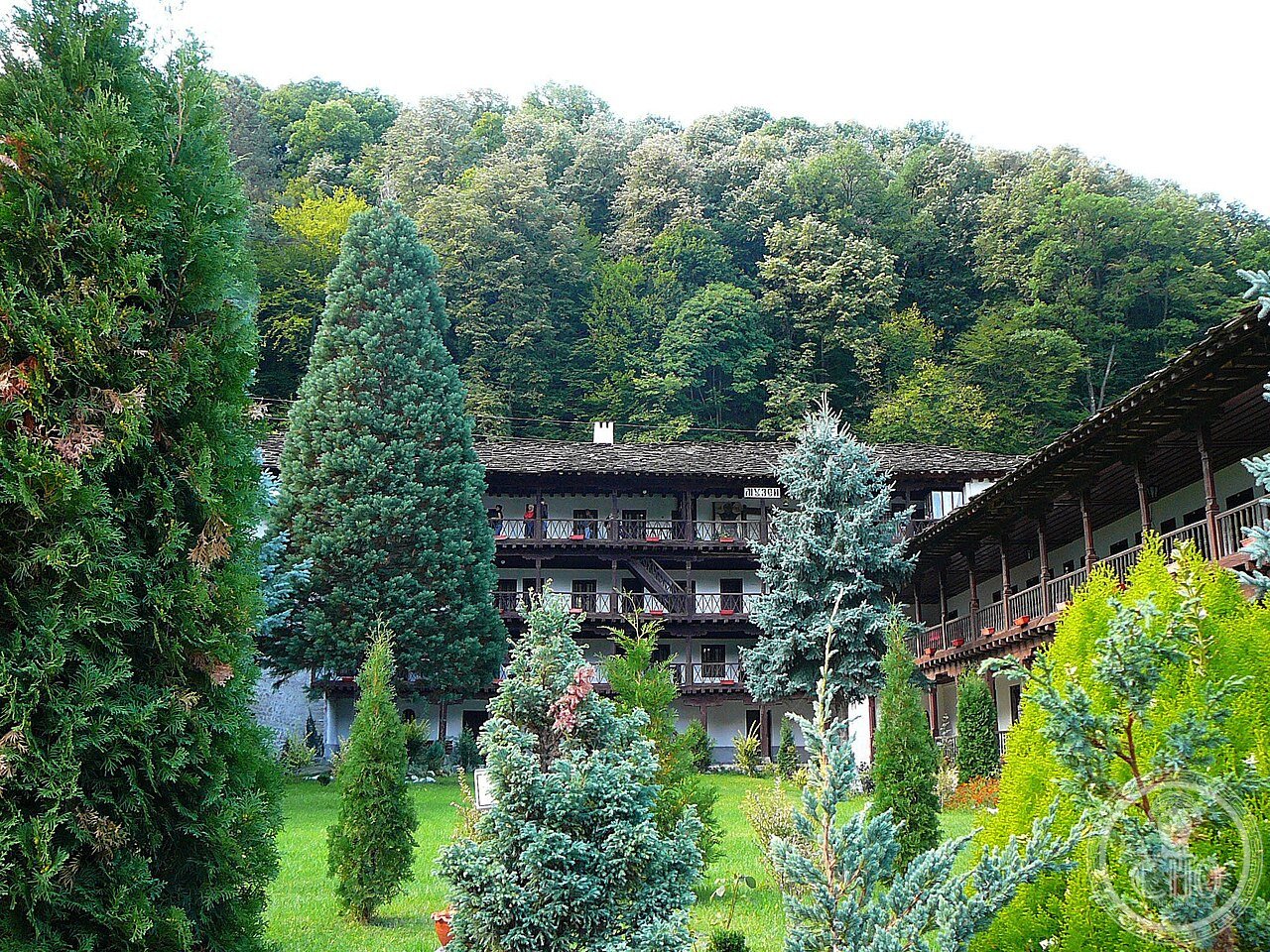
Attorno al 1600, alcuni eremiti provenienti dal Monte Athos fondarono questo monastero portando con sé una copia dell’icona miracolosa della “Vergine Tricherusa” (a tre mani). Due secoli e mezzo dopo, tra il 1847 e il 1849, il pittore Zahari Zograf ne affrescò le pareti interne ed esterne. E negli anni Settanta dell’Ottocento, il rivoluzionario bulgaro Vasil Levski si nascose per mesi in un vano segreto del monastero, oggi trasformato in museo, mentre organizzava la resistenza contro l’occupazione ottomana.
About Troyan Monastery
According to monastery chronicles, Troyan Monastery was founded around 1600 by hermits who had come from Mount Athos, though evidence suggests a hermit presence at the site may stretch back to the 13th or 14th century, not long after the fall of the Second Bulgarian Empire in 1396. The hermits who established the monastery in the early 17th century brought with them a copy of the venerated “Holy Virgin Troerouchitsa” — the Three-Handed Mother of God — an icon whose original, associated with Mount Athos’s Hilandar Monastery, was itself credited with miraculous power; the Troyan copy has been revered by pilgrims as miracle-working ever since. Between 1847 and 1849, the Bulgarian painter Zahari Zograf, a leading figure of the Samokov school of art and iconography, painted the frescoes of the monastery’s church, both inside and on its exterior walls, producing one of the most celebrated fresco cycles of the Bulgarian National Revival period. In the 1870s, during the final years of Ottoman rule over Bulgaria, the revolutionary Vasil Levski — a central figure in the Bulgarian national liberation movement — used a concealed hiding place within the monastery while organising resistance networks; that hiding place survives today as part of a small museum dedicated to his activities at the site. Troyan Monastery, also known as the Dormition Monastery for its dedication to the Assumption of the Virgin Mary, is recognised as the third largest monastery in Bulgaria, after Rila and Bachkovo.
Key facts
- 13th-14th century: possible earlier hermit presence at the site
- c. 1600: monastery founded by hermits arriving from Mount Athos
- Three-Handed Virgin icon: a venerated copy of the Hilandar Monastery original, brought by the founders
- 1847-1849: Zahari Zograf paints the church’s interior and exterior frescoes
- 1870s: Vasil Levski hides at the monastery while organising revolutionary resistance
- Rank: Bulgaria’s third largest monastery, after Rila and Bachkovo
History
Zahari Zograf’s mid-19th-century fresco campaign at Troyan places the monastery among the key surviving monuments of the Bulgarian National Revival, a period in which church art and architecture became closely tied to a broader movement of cultural and eventual political reawakening under continued Ottoman rule. Vasil Levski’s use of the monastery as a hiding place in the following decades extends that same thread directly into Bulgaria’s armed revolutionary movement, making Troyan a site associated with both the artistic and the political dimensions of 19th-century Bulgarian national revival.
The monastery’s veneration of its Three-Handed Virgin icon, copied from the venerated original at Mount Athos’s Hilandar Monastery, situates Troyan within a broader network of Orthodox devotional exchange linking Bulgarian monastic life to the wider Athonite monastic tradition across the Balkans.
What you see
The monastery’s church is enclosed by a covered arcade, or chalcidicum, typical of Bulgarian monastic architecture, its walls covered both inside and out with Zahari Zograf’s mid-19th-century frescoes. Within the church, the venerated copy of the Three-Handed Virgin icon remains a central object of pilgrimage. The museum housing Vasil Levski’s concealed hiding place preserves the small secret space used during his revolutionary activity in the 1870s.
Practical information
- Opening hours: generally open daily with seasonal variation; check current hours before visiting; free admission to the monastery grounds
- Address: Oreshak, Troyan Municipality, Lovech Province, Bulgaria
Getting there
Troyan Monastery is located near the village of Oreshak, close to the town of Troyan, in the Balkan Mountains of central Bulgaria. GPS: 42.8617° N, 24.7807° E.
Nearby
- Oreshak — the neighbouring village, known for traditional crafts
- Troyan — the nearest town, in the Balkan Mountains
- Troyan Pass — a historic mountain route through the Balkan range, nearby
Sources
- Wikipedia — “Troyan Monastery” (en.wikipedia.org)
- OrthodoxWiki — “Dormition Monastery (Troyan, Bulgaria)” (orthodoxwiki.org)
- Bulgaria Monasteries — “Stauropegial Troyan monastery” (bulgariamonasteries.com)
Find it on the map
See this place and what’s around it →📷 Become a Cultural Heritage Online photographer
Share your photos of places: they stay published under your name as the author. The more they're seen, the more you get noticed — and soon a contest will reward the most appreciated photos.
Log in or sign up free to add a photo