

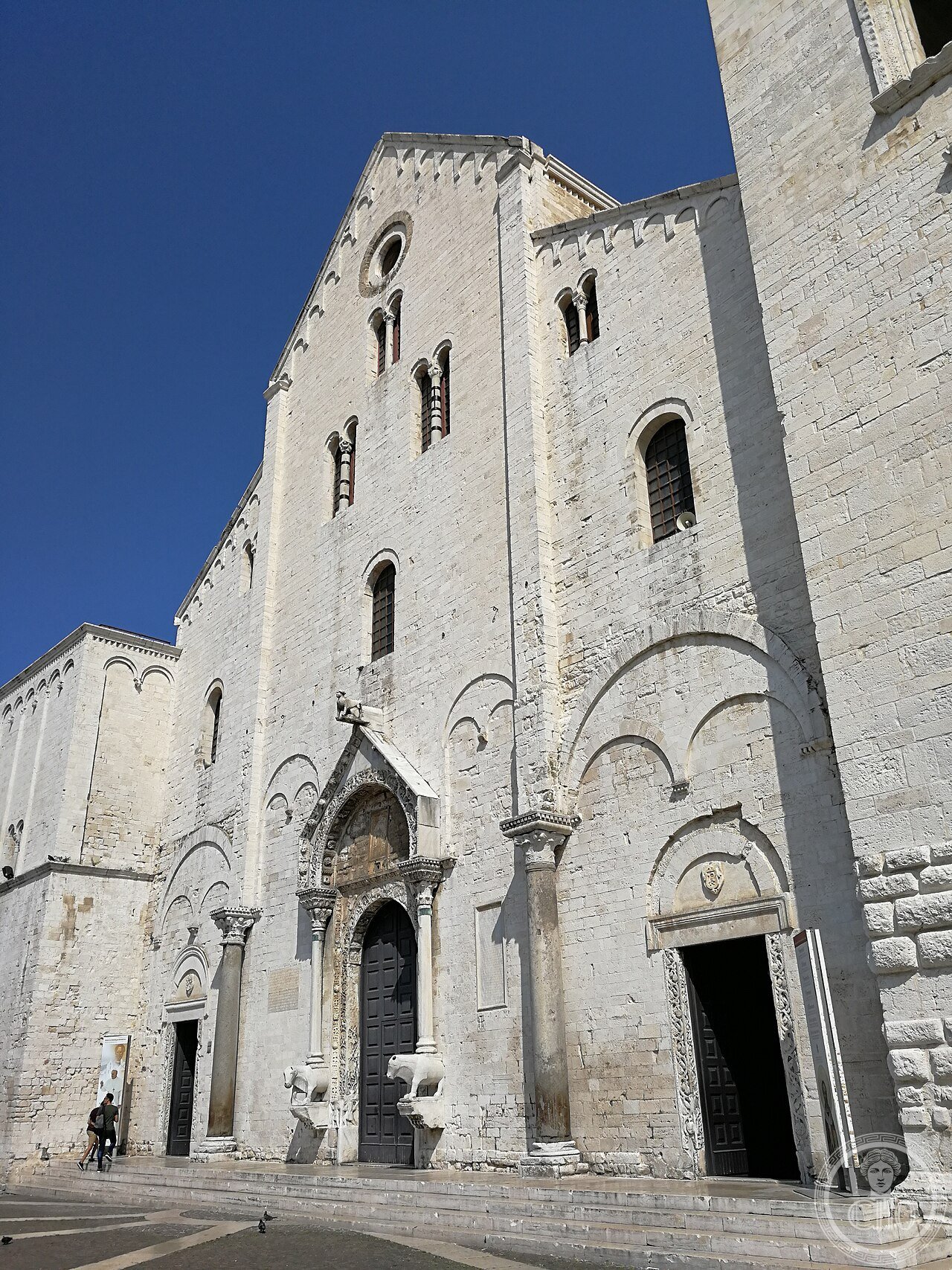
In April 1087, 62 sailors from Bari carried off the relics of Saint Nicholas of Myra from the Anatolian city, by then fallen to the Seljuks, getting ahead of a Venetian expedition after the same prize. The Benedictine abbot Elias had the basilica that still holds them built on that spot. In 1098 Pope Urban II presided there over a council with 185 Catholic and Orthodox bishops; in 1966 an Orthodox chapel was opened there. That bishop of Myra, famous for his secret gifts to the poor, would become centuries later, by way of the Dutch Sinterklaas, Father Christmas.
About the Basilica of Saint Nicholas
In April 1087, around 62 sailors from Bari seized the relics of Saint Nicholas of Myra from the Anatolian city, then under Seljuk occupation, narrowly beating a rival Venetian expedition aiming to claim the same relics; the sailors arrived back in Bari with the relics on 9 May 1087 amid great public celebration. The relics were entrusted to the Benedictine abbot Elia, who began construction of a basilica on the site of the former palace of the Byzantine catapan to house them; the crypt was completed within two years, and Pope Urban II, escorted by Norman knights ruling Puglia, placed the relics beneath the altar there in 1089, where they remain today. Construction of the wider basilica continued in phases from 1087 until its official consecration in 1197. In October 1098, during the First Crusade, Urban II convened the Council of Bari at the basilica, attended by 185 Catholic and Orthodox bishops, at which Anselm of Canterbury argued for the Western Church’s positions on the filioque clause and the use of unleavened bread in the Eucharist — though the council ultimately failed to secure the hoped-for reconciliation between the two churches. Despite that theological impasse, the basilica itself became a rare site of enduring ecumenical devotion, venerated by both Catholic and Orthodox pilgrims alike; in 1966, an Orthodox chapel was formally established within one side of the crypt to provide space for Orthodox liturgy. Since shortly after Nicholas’s death, his relics have been associated with a mysterious liquid known as the “manna” or myron of Saint Nicholas, considered miraculous by the faithful; it is officially collected each year on 9 May, the feast of the translation of the relics, by the basilica’s rector in the presence of clergy and a pontifical delegate, with drops distributed in bottled holy water to pilgrims throughout the year. Nicholas’s historical reputation for secret gift-giving — most famously providing dowries so that three poor sisters would not be sold into servitude — made him the patron saint of children and, via the Dutch figure of Sinterklaas, the direct historical and folkloric ancestor of the modern Santa Claus.
Key facts
- April-9 May 1087: Barian sailors bring Saint Nicholas’s relics from Myra to Bari.
- 1089: Pope Urban II places the relics beneath the crypt altar.
- 1087-1197: basilica built in phases, officially consecrated in 1197.
- October 1098: Council of Bari held at the basilica, with 185 Catholic and Orthodox bishops.
- 1966: an Orthodox chapel established within the crypt.
- 9 May each year: the miraculous “manna” of Saint Nicholas ceremonially collected.
- Legacy: Nicholas’s gift-giving reputation gave rise, via Sinterklaas, to Santa Claus.
History
The 1087 relic translation, carried out in direct competition with a rival Venetian expedition, situates the basilica’s very foundation within the broader medieval Italian maritime rivalry for prestige, pilgrimage revenue, and sacred relics that also drove Venice’s own later acquisition of Saint Mark’s relics — Bari’s success here gave the city an enduring religious and economic importance disproportionate to its size. The Council of Bari’s failure to resolve the filioque dispute between the Latin and Greek churches, despite direct theological engagement from a figure as significant as Anselm of Canterbury, nonetheless left the basilica itself as one of the very few sites where Catholic and Orthodox devotion to a single saint continued largely undivided, culminating in the formal establishment of an Orthodox chapel within the crypt in 1966.
The transformation of the historical Bishop of Myra into the modern figure of Santa Claus, via the Dutch Sinterklaas tradition carried to America by Dutch colonists, means that the basilica in Bari remains, in a very direct sense, the burial site of the real historical figure behind one of the world’s most widely recognised modern folkloric characters.
What you see
The basilica’s austere white tripartite façade, enlivened by a succession of small blind arches leading up to the main portal’s tympanum, is considered one of the defining examples of Apulian Romanesque architecture, a style that influenced numerous later churches across the region. The crypt beneath the main altar holds Saint Nicholas’s relics, alongside the Orthodox chapel established in 1966, while the basilica’s interior preserves medieval artworks including a notable 12th-century episcopal throne.
Practical information
- Opening hours: generally open daily with seasonal variation; check current hours before visiting; free admission.
- Address: Largo Abate Elia 13, 70122 Bari, Italy.
Getting there
The Basilica of Saint Nicholas is located in Bari’s old town (Bari Vecchia), easily reachable on foot from the city centre. GPS: 41.1303° N, 16.8702° E.
Nearby
- Bari Cathedral — the city’s cathedral, a short walk away in the old town.
- Bari Vecchia — the historic old town surrounding the basilica.
- Castello Svevo — the Swabian castle of Bari, nearby.
Sources
- Wikipedia — “Basilica of Saint Nicholas, Bari” and “Council of Bari” (en.wikipedia.org).
- Basilica San Nicola — official site, “La Manna di San Nicola” (basilicasannicola.it).
- St. Nicholas Center — “Ecumenical Saint” (stnicholascenter.org).
Find it on the map
See this place and what’s around it →📷 Become a Cultural Heritage Online photographer
Share your photos of places: they stay published under your name as the author. The more they're seen, the more you get noticed — and soon a contest will reward the most appreciated photos.
Log in or sign up free to add a photo