

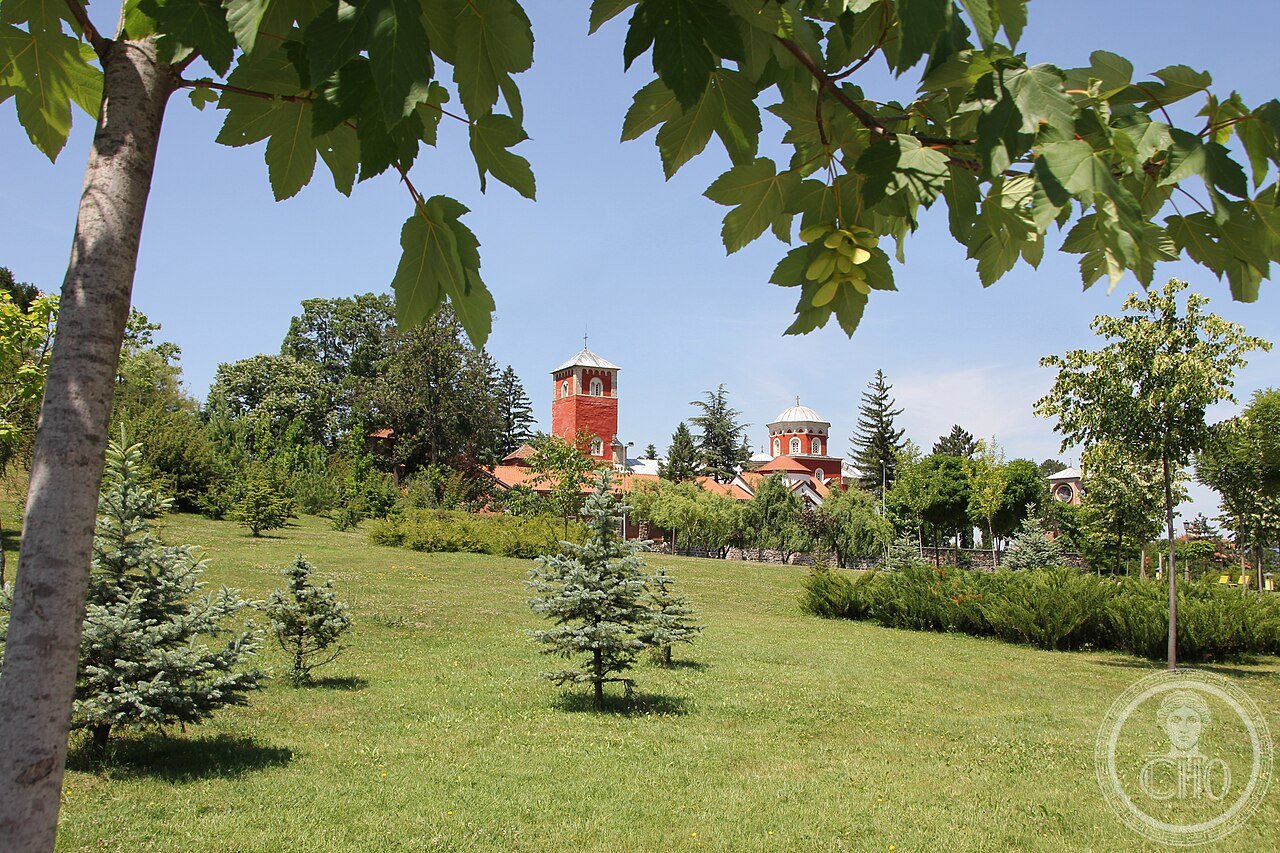
No medieval Serbian sovereign was considered a true king until he had been anointed at Žiča: here Stefan the First-Crowned was crowned in 1217, and after him at least five more kings of the Nemanjić dynasty — Radoslav, Vladislav, Uroš, Dragutin and Milutin. Saint Sava, the first Serbian archbishop, ordered the monastery walls to be painted a vivid red, as a witness that the sanctuary stood on the blood of the Serbian martyrs.
About Žiča Monastery
Žiča Monastery, together with its Church of the Holy Dormition, was built between 1208 and 1230 by Stefan the First-Crowned, the first King of Serbia, and Saint Sava, the first Serbian Archbishop, with the assistance of Greek master builders working in the Raška architectural style. In 1219, the Serbian Church gained autocephaly, recognised by Emperor Theodore I Laskaris and Patriarch Manuel I of Constantinople, and Archimandrite Sava was consecrated as the first Serbian Archbishop; Žiča served as the seat of the Serbian Archbishopric from 1219 to 1253. At a church council held on Ascension Day in 1221, Sava delivered his programmatic Sermon on True Faith, and Stefan Nemanjić was crowned king at Žiča — the first in a tradition holding that no Serbian king was considered truly legitimate until anointed there, regardless of where an initial coronation ceremony might have taken place. Over the following decades, at least five further kings of the powerful Nemanjić dynasty — Radoslav, Vladislav, Uroš, Dragutin, and Milutin — were crowned at Žiča, until 1253. Before departing for the Holy Land in 1229, Saint Sava also presided over the ceremonial transfer of the relics of Stefan the First-Crowned from Studenica, where he had first been buried, to Žiča. The monastery’s exterior walls were ordered painted in a striking bright red by Saint Sava himself, a colour said to testify that the shrine stood upon the blood of Serbian martyrs, giving Žiča its immediately recognisable and unusual appearance among Serbian Orthodox monasteries.
Key facts
- 1208-1230: built by Stefan the First-Crowned and Saint Sava in Raška style
- 1219: Serbian Church gains autocephaly; Sava becomes first Serbian Archbishop
- 1219-1253: Žiča serves as the seat of the Serbian Archbishopric
- 1221: Stefan Nemanjić crowned king; Sava delivers the Sermon on True Faith
- Coronation church: at least six Serbian kings crowned or anointed at Žiča by 1253
- 1229: Sava transfers Stefan the First-Crowned’s relics from Studenica to Žiča
- The red walls: painted by Saint Sava’s order, commemorating Serbian martyrs
History
Žiča’s role as the mandatory coronation site of the early Nemanjić dynasty, formalised through Sava’s own theological and political authority as first Serbian Archbishop, made the monastery a foundational institution of medieval Serbian statehood — comparable in constitutional importance to royal coronation churches elsewhere in medieval Europe, but distinguished by its direct link to the establishment of an autocephalous national church in the same period. The transfer of Stefan the First-Crowned’s relics from Studenica to Žiča in 1229 reinforced the monastery’s status as a dynastic and spiritual centre, tying the physical remains of Serbia’s first king to the very church where his successors would be crowned.
The distinctive red-painted walls, a deliberate and unusual choice among Orthodox monastic architecture, gave Žiča a permanent visual identity tied directly to the memory of Serbian martyrdom — a symbolic statement embedded into the building’s very fabric rather than left to later commemorative tradition or added decoration.
What you see
The Church of the Holy Dormition, built in the Raška architectural style characteristic of early Nemanjić-era Serbian monasteries, presents the monastery’s most striking feature: exterior walls painted a vivid red, unusual among Serbian Orthodox foundations. The church’s interior preserves medieval frescoes from the monastery’s early centuries, though later damage and restoration campaigns have altered portions of the original decorative programme across its long history.
Practical information
- Opening hours: generally open daily with seasonal variation; check current hours before visiting; free admission
- Address: Žiča, near Kraljevo, Raška District, Serbia
Getting there
Žiča Monastery is located a short distance from Kraljevo in central Serbia, reachable by road. GPS: 43.6956° N, 20.6459° E.
Nearby
- Kraljevo — the nearest city, a short distance from the monastery
- Studenica Monastery — the UNESCO-listed monastery where Stefan the First-Crowned was originally buried
- Maglič Fortress — a medieval Serbian fortress in the same region
Sources
- Wikipedia — “Žiča” and “Saint Sava” (en.wikipedia.org)
- Žiča Monastery official site — “The Establishment, Organization and Later Life of the Archbishopric Seat” (zica.org.rs)
- Natania Travel — “Žiča, the Serbian monastery colored in red” (nataniatravel.com)
Find it on the map
See this place and what’s around it →📷 Become a Cultural Heritage Online photographer
Share your photos of places: they stay published under your name as the author. The more they're seen, the more you get noticed — and soon a contest will reward the most appreciated photos.
Log in or sign up free to add a photo