
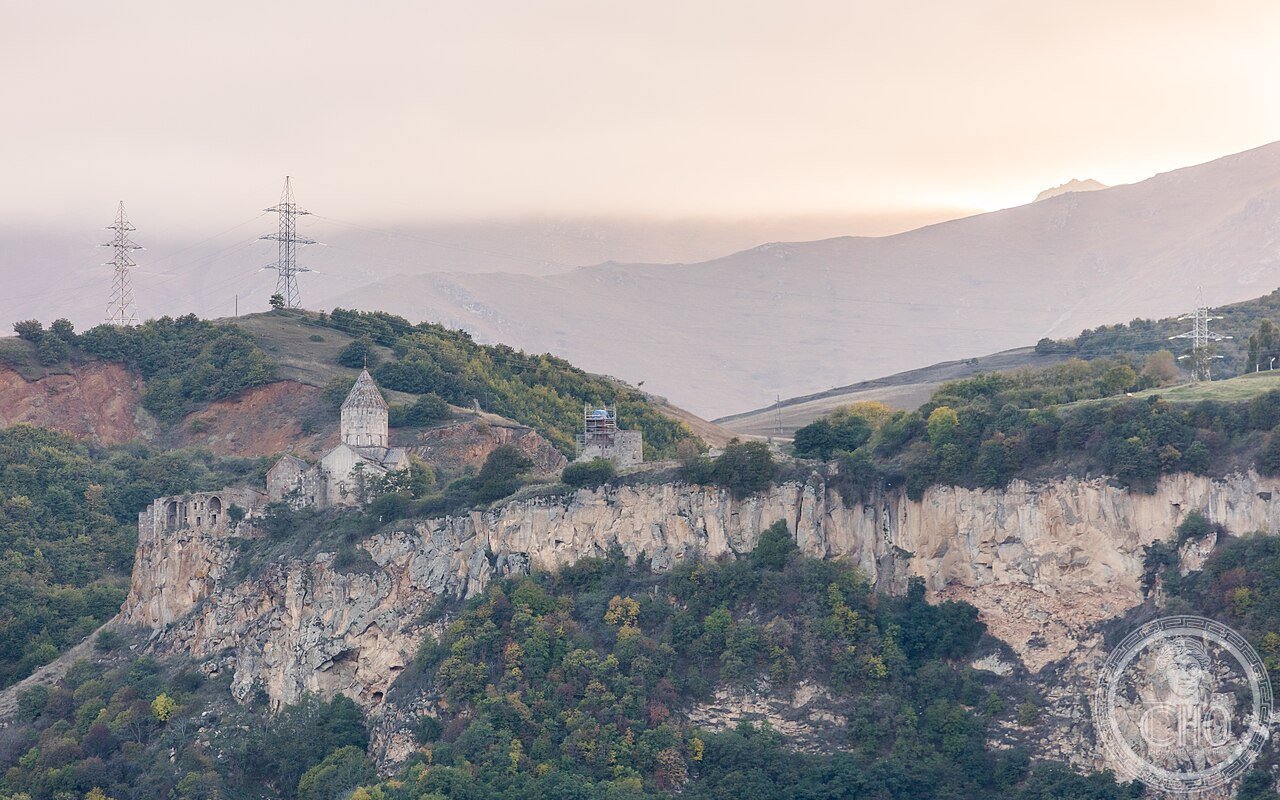
All’inizio dell’XI secolo, il monastero di Tatev ospitava circa mille monaci e un gran numero di artigiani. Nei secoli successivi divenne sede di una delle più importanti università medievali armene, dove insegnò il teologo Grigor Tatevatsi. Davanti all’ingresso meridionale della chiesa si erge ancora oggi la colonna Gavazan, costruita attorno al 906: la sua base mobile la fa oscillare a ogni scossa di terremoto, funzionando come un sismografo naturale che da oltre mille anni non è mai crollato.
About Tatev Monastery
Tatev Monastery, perched on a large basalt plateau above the Vorotan Gorge in Armenia’s Syunik Province, became the seat of the bishop of Syunik in the 9th century, with the historian Stepanos Orbelian recording the construction of a new church near an older one in 848, funded by Prince Philip of Syunik. By the beginning of the 11th century the monastery had grown into a major religious and economic centre, hosting around 1,000 monks alongside a substantial community of artisans. Its greatest intellectual flourishing came in the 14th and 15th centuries, when Tatev hosted one of the most important medieval Armenian universities, a school that advanced the study of science, philosophy, and theology, and drove significant developments in manuscript reproduction and miniature painting. Among its most celebrated scholars was Grigor Tatevatsi — Gregory of Tatev (1346-1409/1410) — an Armenian philosopher, theologian, and saint of the Armenian Apostolic Church, educated at the monasteries of Tatev and Metzop, whose teaching there helped train generations of clergy, philosophers, and artists. In front of the church’s southern entrance stands the Gavazan, a slender stone pillar built around 906 AD and dedicated to the Holy Trinity, whose uniquely engineered movable base allows it to sway in response to ground tremors — a design most commonly interpreted as an early medieval seismograph, alerting the monastery to earthquakes and tectonic activity in the region for over eleven centuries without ever collapsing. Today the monastery is also connected to the surrounding valley by the Wings of Tatev, a 5.7-kilometre reversible cableway that holds the record as the longest non-stop double-track cable car built in a single section anywhere in the world.
Key facts
- 9th century: Tatev becomes the seat of the bishop of Syunik
- 848: a new church built near the older one, funded by Prince Philip of Syunik
- c. 906: the Gavazan swinging pillar built, dedicated to the Holy Trinity
- Early 11th century: around 1,000 monks and numerous artisans resident at the monastery
- 14th-15th centuries: University of Tatev flourishes, training Gregory of Tatev among others
- 1346-1409/1410: lifetime of Grigor Tatevatsi, the monastery’s most celebrated scholar
- Wings of Tatev: a 5.7-kilometre reversible cableway, the longest single-section double-track cable car in the world
History
The University of Tatev’s 14th- and 15th-century flourishing, producing scholars of the calibre of Grigor Tatevatsi, positions the monastery among the most significant centres of medieval Armenian intellectual life, comparable in regional importance to other great monastic universities of the medieval world, at a time when Armenia itself faced repeated political upheaval. The Gavazan pillar’s engineered ability to sway rather than fracture during seismic activity represents a remarkably sophisticated piece of medieval structural engineering, whose exact mechanism continues to draw modern scholarly interest even as it has protected the monument itself for well over a millennium.
The monastery’s dramatic and remote plateau location above the Vorotan Gorge, historically reachable only by a difficult mountain route, contributed to its historic role as a place of refuge and learning relatively insulated from the political instability of the surrounding region — a remoteness only recently offset by the construction of the Wings of Tatev cableway, which has transformed accessibility to the site in the 21st century.
What you see
The monastery complex includes the Church of Saints Paul and Peter, the older Church of the Virgin, and the chapel of Saint Gregory, arranged within a fortified precinct on the basalt plateau. The Gavazan swinging pillar stands before the southern entrance, its slender stone shaft rising from a specially engineered movable base. The surrounding defensive walls and monastic buildings reflect Tatev’s historic role as both a spiritual and a fortified centre, overlooking the dramatic drop into the Vorotan Gorge below.
Practical information
- Opening hours: generally open daily with seasonal variation; check current hours before visiting; free admission to the monastery grounds
- Address: Tatev, Syunik Province, Armenia
Getting there
Tatev Monastery is located in southeastern Armenia’s Syunik Province, reachable by road or via the Wings of Tatev cableway from Halidzor. GPS: 39.3794° N, 46.2501° E.
Nearby
- Wings of Tatev cableway — connecting the monastery to Halidzor across the Vorotan Gorge
- Vorotan Gorge — the dramatic canyon overlooked by the monastery
- Goris — the nearest town, a base for visiting the region
Sources
- Wikipedia — “Tatev Monastery,” “Gregory of Tatev,” and “Wings of Tatev” (en.wikipedia.org)
- Ancient Origins — “Understanding the Swinging Seismographic Gavazan Column at Tatev Monastery” (ancient-origins.net)
- Advantour — “Tatev Monastery, Armenia” (advantour.com)
Find it on the map
See this place and what’s around it →📷 Become a Cultural Heritage Online photographer
Share your photos of places: they stay published under your name as the author. The more they're seen, the more you get noticed — and soon a contest will reward the most appreciated photos.
Log in or sign up free to add a photo