
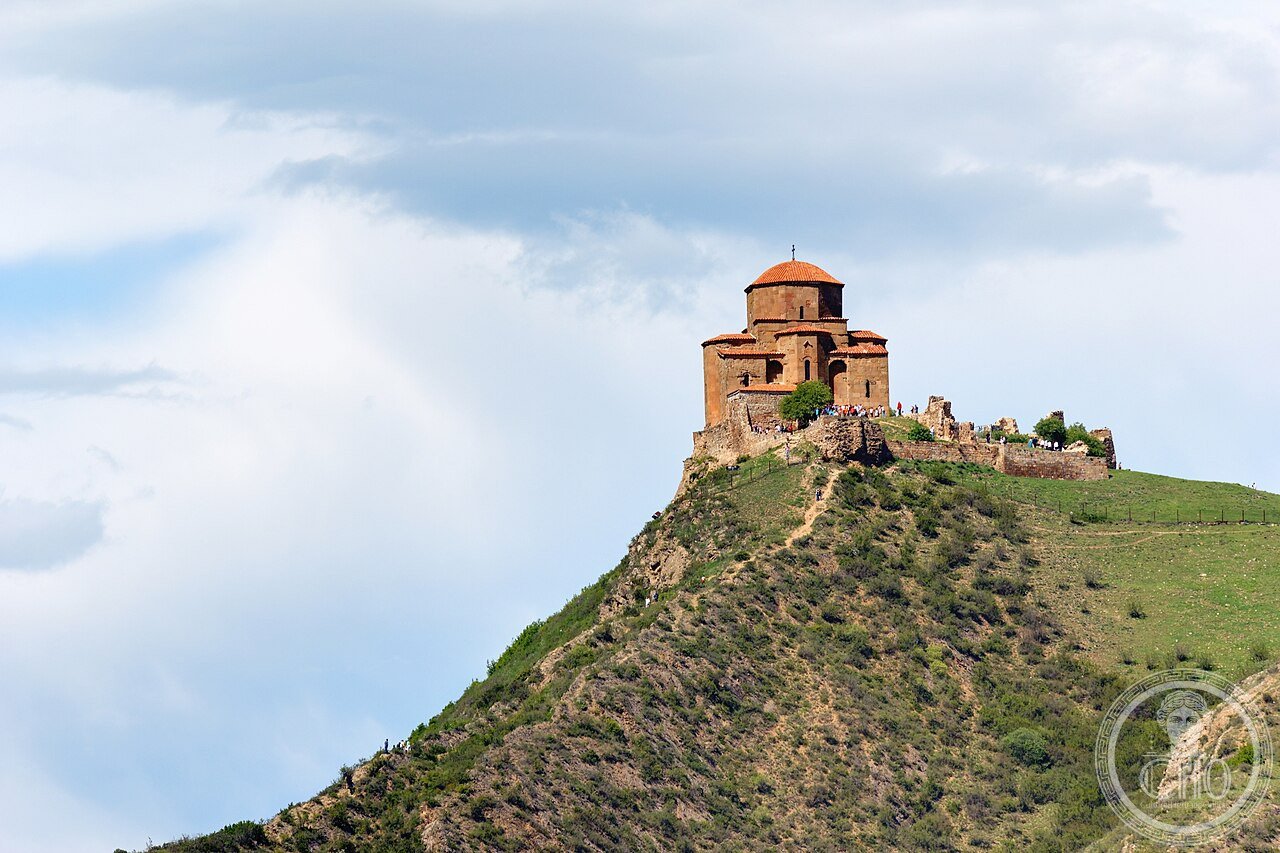
Nel IV secolo, santa Nino — l’evangelizzatrice che convertì la Georgia al cristianesimo — eresse una grande croce di legno sulla sommità di una rupe, nel punto esatto dove sorgeva un tempio pagano, appena sopra la confluenza dei fiumi Mtkvari e Aragvi. Si diceva che quella croce operasse miracoli, e attirasse pellegrini da tutto il Caucaso. Due secoli dopo, attorno a quella stessa croce, fu costruita una delle prime chiese a pianta tetraconca sopravvissute al mondo.
About Jvari Monastery
In the 4th century, Saint Nino, the woman credited with converting King Mirian III of Iberia (ancient Georgia) to Christianity, erected a large wooden cross on a rocky hilltop overlooking Mtskheta, on the site of a former pagan temple, at the confluence of the Mtkvari and Aragvi rivers. The cross was said to work miracles and drew pilgrims from across the Caucasus region. Around 545, under the ruler Guaram I, a first small church — the “Small Church of Jvari” — was built to shelter the cross, but its limited capacity soon proved insufficient for the growing numbers of pilgrims, leading to the construction of a much larger structure, the “Great Church of Jvari,” between 590 and 605 under Stepanoz I. This larger church, built as a tetraconch — a circular plan with four apses and four corner niches — is among the earliest surviving examples of that architectural form anywhere, and went on to serve as an influential model for later Georgian and Armenian church design. At the centre of the church, the foundation on which Saint Nino’s original wooden cross once stood can still be seen today. Jvari Monastery was inscribed as part of the Historical Monuments of Mtskheta UNESCO World Heritage Site in 1994, recognising the exceptional density and significance of medieval Georgian ecclesiastical architecture concentrated in and around the ancient former capital.
Key facts
- 4th century: Saint Nino erects a miraculous wooden cross on the hilltop site
- c. 545: the “Small Church of Jvari” built under Guaram I to shelter the cross
- 590-605: the larger “Great Church of Jvari” built under Stepanoz I
- Architectural form: one of the earliest surviving tetraconch church plans
- Influence: a model for later Georgian and Armenian ecclesiastical architecture
- 1994: inscribed as part of the UNESCO Historical Monuments of Mtskheta
History
The site’s transition from a pagan temple to the location of Saint Nino’s miraculous cross, and finally to a fully developed tetraconch church over roughly two and a half centuries, traces the physical Christianisation of a single sacred hilltop across the entire formative period of Georgian Christianity. Jvari’s status as one of the earliest surviving tetraconch churches gives it exceptional architectural historical importance beyond Georgia itself, since its centrally planned form — radiating symmetrically from the very spot marked by Saint Nino’s cross — directly shaped the design vocabulary of numerous later churches across the wider Caucasus region.
The monastery’s dramatic hilltop position, overlooking the confluence of two rivers and the ancient capital of Mtskheta below, reinforced its symbolic status as a site of pilgrimage visible from across the valley, a visual and spiritual dominance that has endured essentially unchanged for over fourteen centuries.
What you see
The Great Church of Jvari presents a compact tetraconch plan, its four semicircular apses and corner niches creating a centralised, symmetrical volume topped by a drum and conical dome typical of early Georgian church architecture. At the centre of the interior, the base on which Saint Nino’s original wooden cross once stood remains visible, marking the site’s continuous sacred function since the 4th century. The exterior stonework preserves carved reliefs characteristic of early medieval Georgian ecclesiastical sculpture.
Practical information
- Opening hours: generally open daily with seasonal variation; check current hours before visiting; free admission
- Address: Jvari, Mtskheta Municipality, Mtskheta-Mtianeti, Georgia
Getting there
Jvari Monastery is located on a hilltop above Mtskheta, roughly 20 kilometres north of Tbilisi, reachable by road. GPS: 41.8383° N, 44.7335° E.
Nearby
- Svetitskhoveli Cathedral — the major cathedral in Mtskheta below, visible from the monastery’s hilltop
- Samtavro Monastery — another historic Mtskheta church, in the town below
- Tbilisi — Georgia’s capital, roughly 20 kilometres away
Sources
- Wikipedia — “Jvari Monastery” (en.wikipedia.org)
- Advantour — “Jvari, Mtskheta” (advantour.com)
- UNESCO World Heritage Centre — “Historical Monuments of Mtskheta” (whc.unesco.org)
Find it on the map
See this place and what’s around it →📷 Become a Cultural Heritage Online photographer
Share your photos of places: they stay published under your name as the author. The more they're seen, the more you get noticed — and soon a contest will reward the most appreciated photos.
Log in or sign up free to add a photo