
Sopra le colonne delle navate corre un fregio a mosaico con 265 medaglioni dorati: i ritratti di tutti i papi, da san Pietro fino a oggi, una serie iniziata nel V secolo sotto Leone Magno. Secondo un’antica leggenda legata alla profezia di san Malachia, quando gli spazi rimasti liberi per i futuri pontefici si esauriranno, sarà la fine della Chiesa. Ne restano appena sei.
About the Basilica of Saint Paul Outside the Walls
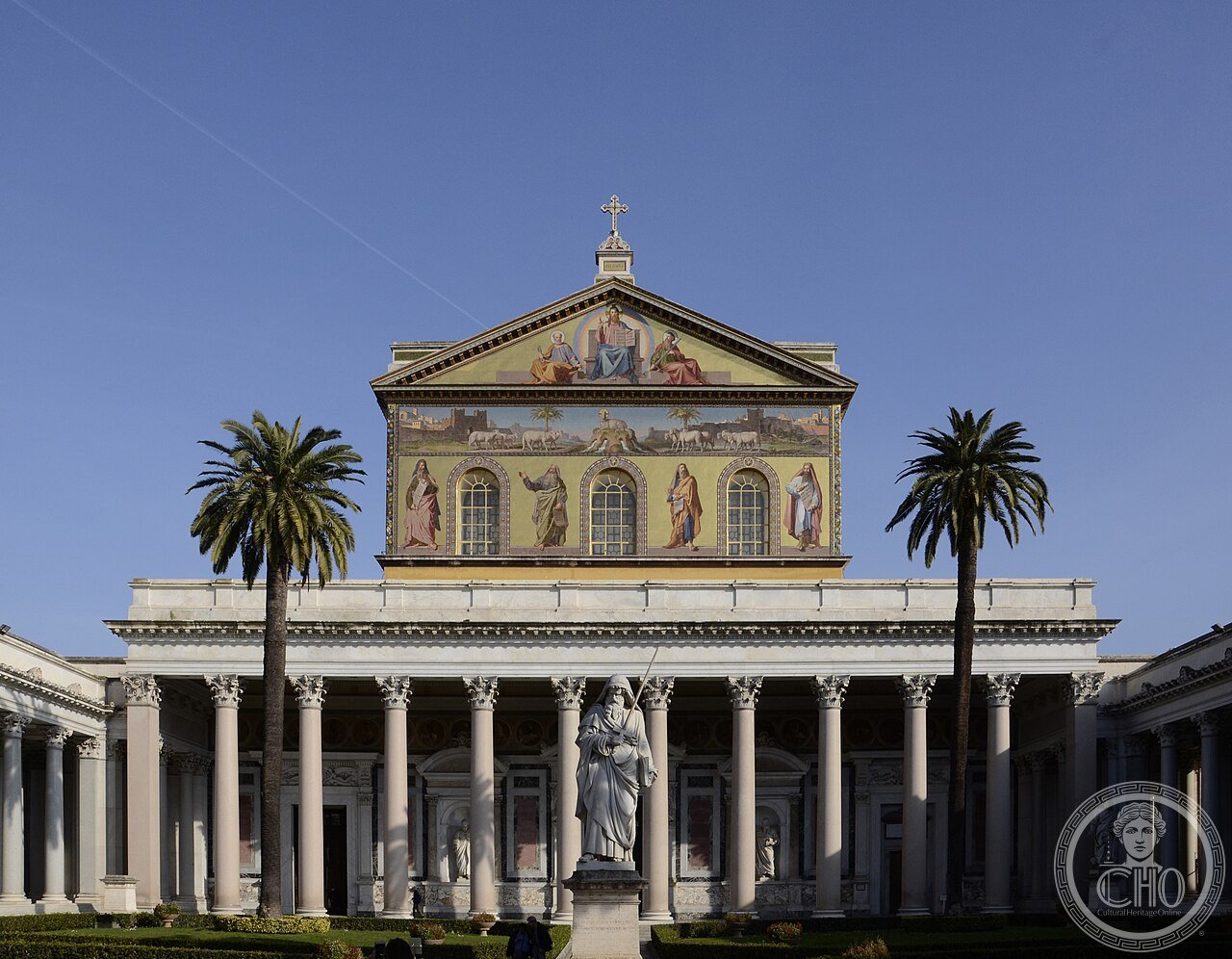
The first basilica dedicated to the Apostle Paul was erected by the Christian emperor Constantine, who built a commemorative sanctuary directly over Paul’s tomb, roughly four kilometres outside Rome’s city walls; this Constantinian basilica was consecrated by Pope Sylvester in 324. It was later entirely rebuilt on a much larger scale between 384 and 395 under the emperors Valentinian, Theodosius, and Arcadius, expanded into a five-nave structure with 80 columns and a larger quadriportico, and consecrated by Pope Siricius in 390. This vast late-antique basilica survived largely intact for over fourteen centuries, until disaster struck on the night between 15 and 16 July 1823: a fire reduced much of the ancient Theodosian structure to ruins within hours. Pope Pius VII, gravely ill at the time, was never informed of the catastrophe and died a month later without ever learning that his basilica had burned. Reconstruction of the “new basilica” began under Pope Leo XII, who issued the encyclical “Ad plurimas” on 25 January 1825, inviting bishops across the Catholic world to collect donations from the faithful to fund the rebuilding — the single largest public works project undertaken in Rome throughout the entire 19th century. The rebuilt transept was inaugurated in 1840, and the completed church was consecrated by Pope Pius IX on 10 December 1854. Above the nave’s columns runs a band of large gilded mosaic medallions, nearly two metres in diameter, depicting every pope from Saint Peter to the present day — a series begun under Pope Leo the Great (440-461) in the 5th century and continued as recently as 1847 under Pius IX, with modern portraits based on authentic documentary sources. An old legend, tracing its roots to the so-called Prophecy of the Popes attributed to Saint Malachy, holds that once the remaining empty spaces for future popes’ portraits are filled, the Church — or the world itself — will come to an end; as recently as Pope Francis’s own portrait completing one side aisle, only around six empty spaces remained.
Key facts
- 324: first basilica over Paul’s tomb consecrated by Pope Sylvester
- 384-395/390: rebuilt on a much larger scale, consecrated by Pope Siricius
- 15-16 July 1823: a catastrophic fire destroys most of the ancient basilica
- 25 January 1825: Pope Leo XII issues “Ad plurimas,” launching global fundraising for reconstruction
- 1840/1854: transept inaugurated; basilica consecrated by Pius IX on 10 December 1854
- Papal medallions: 265 gilded mosaic portraits of every pope, begun under Leo the Great in the 5th century
- Legend: only a handful of empty spaces remain for future popes’ portraits
History
The poignant detail of Pope Pius VII dying without ever learning that his own basilica had burned to the ground gives the 1823 disaster a particular historical resonance, as the reconstruction that followed became one of the defining religious and civic projects of 19th-century Rome, drawing donations from Catholics worldwide in response to Leo XII’s 1825 appeal. The continuity of the papal medallion series, begun in the 5th century under Leo the Great and still being added to in the 21st century, gives the basilica an unbroken visual record of the papacy spanning nearly the entirety of Christian history within a single decorative scheme.
The persistent popular legend linking the medallions’ remaining empty spaces to the Prophecy of the Popes attributed to Saint Malachy — and by extension to the end of the Church or the world itself — reflects how a purely decorative architectural feature can accumulate genuine eschatological significance in popular religious imagination over centuries, regardless of its origins as a straightforward, ongoing commemorative project rather than any deliberate prophetic design.
What you see
The reconstructed basilica preserves the five-nave, 80-column plan of its late-antique predecessor, its scale reflecting the ambition of the 19th-century rebuilding project. Above the nave’s columns, the band of 265 gilded mosaic papal medallions, each nearly two metres in diameter, runs the full length of the church, continuing to the present day. The apse mosaic and other surviving decorative elements connect the current structure to its ancient and medieval origins despite the 1823 fire’s destruction.
Practical information
- Opening hours: generally open daily; check current hours before visiting; free admission
- Address: Piazzale San Paolo 1, 00146 Roma, Italy
Getting there
The Basilica of Saint Paul Outside the Walls is reachable by metro (San Paolo station, Line B) in the Ostiense district of Rome. GPS: 41.8587° N, 12.4768° E.
Nearby
- Abbey of the Tre Fontane — the traditional site of Saint Paul’s martyrdom, nearby
- Ostiense district — the surrounding neighbourhood of Rome
- Centrale Montemartini — a museum of classical sculpture in a former power plant, nearby
Sources
- Wikipedia — “Basilica di San Paolo fuori le mura” (it.wikipedia.org)
- ACI Stampa — “La basilica di San Paolo, l’incendio e la ricostruzione sulla tomba dell’Apostolo” (acistampa.com)
- Vatican.va — “Basilica Papale – San Paolo fuori le Mura” (vatican.va)
Find it on the map
See this place and what’s around it →Historical events at this place (1)
📷 Become a Cultural Heritage Online photographer
Share your photos of places: they stay published under your name as the author. The more they're seen, the more you get noticed — and soon a contest will reward the most appreciated photos.
Log in or sign up free to add a photo