
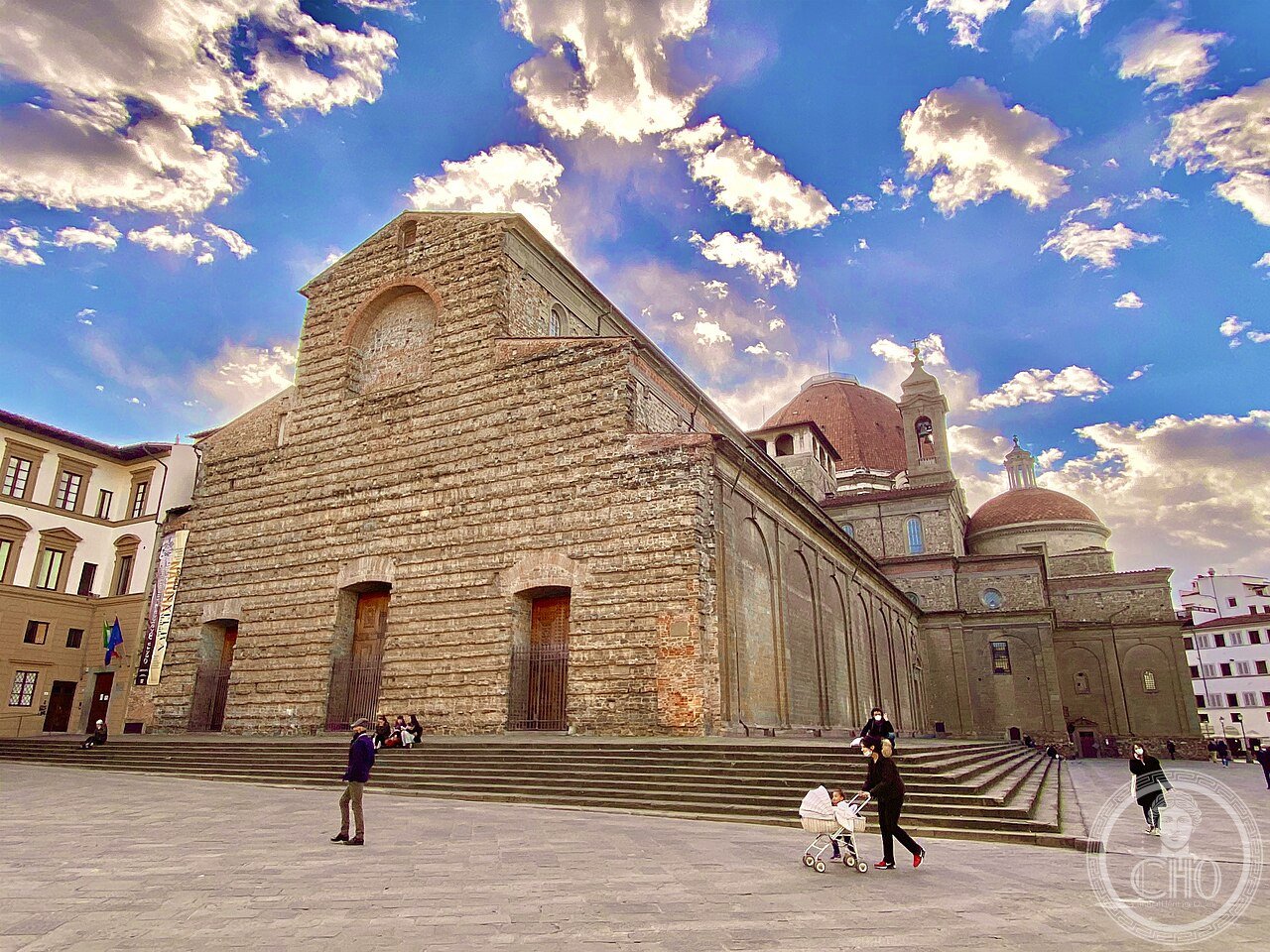
In 1518 Pope Leo X, a Medici, commissioned Michelangelo to design a marble facade for the family church. The artist built a wooden model of a classical front, perfectly proportioned, but technical and financial troubles meant it was never executed. Five hundred years on, the basilica that holds the tombs of Cosimo the Elder and Lorenzo the Magnificent still shows the bare brick of a facade that remains, literally, unfinished.
About the Basilica of San Lorenzo
San Lorenzo is among the churches that contend for the title of oldest in Florence: according to tradition, it was founded in the 4th century atop a rise near the course of the Mugnone stream (later diverted), thanks to a donation by Giuliana, a matron of Jewish origin, and was consecrated in 393 as Florence’s own cathedral, dedicated to the martyr Lawrence, with Saint Ambrose and San Zanobi reportedly present. San Lorenzo served as Florence’s cathedral for roughly three centuries before that status passed to Santa Reparata, when Bishop San Zanobi’s remains were solemnly transferred there. The basilica as it stands today results from a radical Renaissance rebuilding begun in 1418, when Prior Matteo Dolfini obtained permission to demolish surrounding houses to enlarge the church; a solemn ceremony on 10 August 1421 blessed the start of the new works, with Filippo Brunelleschi commissioned as architect and the Medici family — beginning with Giovanni di Bicci de’ Medici — financing the reconstruction. Following Dolfini’s death in 1421, Cosimo de’ Medici took over funding the project around 1441; the main altar was consecrated in 1461, and Brunelleschi directed the vast building site until his own death in 1446, with construction continuing under his design thereafter. In 1518, Pope Leo X — himself a Medici — commissioned Michelangelo to design a marble facade for the family church; Michelangelo produced a wooden model of a classically proportioned facade, but the work was never carried out, defeated by technical and financial difficulties, leaving the basilica’s facade in its present unfinished, bare-brick state to this day. Cosimo the Elder was buried beneath the high altar, while Lorenzo the Magnificent and his brother Giuliano were eventually entombed in Michelangelo’s own Sagrestia Nuova (New Sacristy), built in stages between 1521 and 1534 as part of the wider Medici Chapels project intended to provide fitting burial space for a family whose rank was steadily rising. Beyond the unbuilt facade and the New Sacristy, Michelangelo also designed the Biblioteca Medicea Laurenziana, commissioned by Pope Clement VII, another Medici pope, to house the family’s celebrated manuscript collection.
Key facts
- 4th century/393: founded and consecrated as Florence’s first cathedral
- 10 August 1421: Brunelleschi’s Renaissance rebuilding formally begins, funded by the Medici
- 1461: main altar consecrated
- 1518: Pope Leo X commissions Michelangelo to design a marble facade — never built
- 1521-1534: Michelangelo builds the Sagrestia Nuova, housing Medici tombs
- Burials: Cosimo the Elder beneath the high altar; Lorenzo the Magnificent and Giuliano in the New Sacristy
- Biblioteca Medicea Laurenziana: also designed by Michelangelo, commissioned by Pope Clement VII
History
The Medici family’s centuries-long investment in San Lorenzo — from Giovanni di Bicci’s initial funding of Brunelleschi’s 15th-century rebuilding through to two Medici popes commissioning Michelangelo’s unbuilt facade and completed New Sacristy — transforms the church into a direct architectural record of the family’s own rising political and ecclesiastical fortunes, tracking their ascent from wealthy bankers to Grand Dukes of Tuscany and Popes of Rome. The facade’s remarkable five-century incompleteness, despite Michelangelo’s own detailed wooden model for a fully realised classical design, stands as one of the most famous unfinished commissions in the entire history of Renaissance architecture — a wealthy, powerful patron family simply never resolved the financial and technical obstacles that stood in the way.
The burial of Cosimo the Elder beneath the high altar and Lorenzo the Magnificent within Michelangelo’s own New Sacristy situates San Lorenzo as the Medici family’s principal dynastic mausoleum, its funerary function as central to the church’s identity as its role as an active place of worship — a pattern echoing similar dynastic churches elsewhere in Europe, but distinguished here by the direct involvement of Michelangelo himself in designing the family’s own tombs.
What you see
The bare-brick, unfinished facade remains the basilica’s most immediately striking exterior feature, a stark contrast to the harmonious classical interior Brunelleschi designed according to precise proportional relationships. Inside, the Sagrestia Nuova, built by Michelangelo between 1521 and 1534, houses the Medici tombs within its complex triumphal-arch and apse-like spatial arrangement, itself derived from Brunelleschi’s earlier Old Sacristy design but reworked into more elaborate forms. The adjoining Biblioteca Medicea Laurenziana, also by Michelangelo, preserves the Medici family’s manuscript collection within its own celebrated Mannerist architectural setting.
Practical information
- Opening hours: generally open daily with seasonal variation; check current hours before visiting; admission fee applies
- Address: Piazza San Lorenzo, 50123 Firenze, Italy
Getting there
The Basilica of San Lorenzo is reachable on foot within the historic centre of Florence, near the Mercato Centrale. GPS: 43.7750° N, 11.2540° E.
Nearby
- Mercato Centrale — Florence’s historic central market, adjacent to the basilica
- Palazzo Medici Riccardi — the original Medici family residence, nearby
- Florence Cathedral — the city’s main cathedral, within walking distance
Sources
- Wikipedia — “Basilica di San Lorenzo (Firenze)” (it.wikipedia.org)
- San Lorenzo Firenze — official site, “La Basilica di San Lorenzo” (sanlorenzofirenze.it)
- Dovevado.net — “Basilica di San Lorenzo a Firenze: la chiesa dei Medici” (dovevado.net)
Find it on the map
See this place and what’s around it →📷 Become a Cultural Heritage Online photographer
Share your photos of places: they stay published under your name as the author. The more they're seen, the more you get noticed — and soon a contest will reward the most appreciated photos.
Log in or sign up free to add a photo