
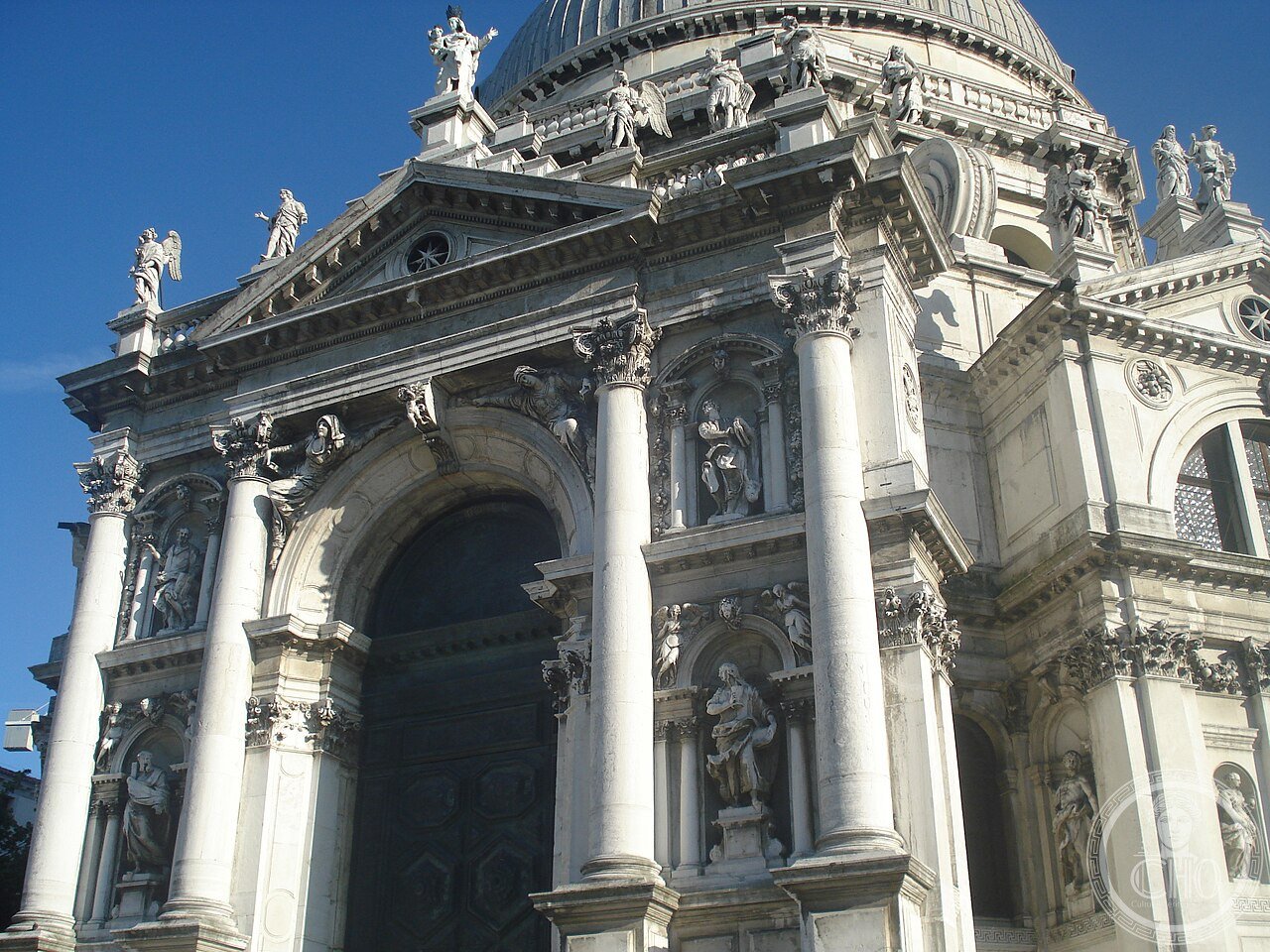
In 1630 the plague killed some 46,000 Venetians — nearly a third of the city — in little more than a year. On 22 October 1630 the patriarch Giovanni Tiepolo pronounced the solemn vow of the Republic: if the contagion ceased, Venice would raise to the Virgin a church of extraordinary beauty. Fifty-six years of work, from 1631 to 1687, were needed to discharge that vow. Still today, every 21 November, Venetians cross a bridge of boats over the Grand Canal to reach it in procession.
About Santa Maria della Salute
In 1630, a devastating plague swept through Venice, killing an estimated 46,000 people — nearly a third of the city’s population — in little more than a year. In response, the Venetian Senate made a collective act of faith: a solemn vow that if the contagion ceased, the Republic would erect an extraordinarily beautiful votive church in honour of the Virgin Mary. On 22 October 1630, Patriarch Giovanni Tiepolo formally pronounced the vow to build and dedicate a church to “Santa Maria della Salute.” The Venetian government held a design competition among the city’s architects, and on 13 June 1631 a formal vote (or “ballottazione”) between two competing proposals gave the commission to Baldassare Longhena, by a margin of 66 votes to 39 over the rival design by Fracao and Rubertini. Construction began that same year on the site of a demolished religious complex near the Punta della Dogana, with Longhena conceiving the building’s form as a crown dedicated to the Virgin. The church would become the most important work of its architect’s career and one of the finest expressions of Venetian Baroque architecture, its octagonal central plan — surrounded by radiating chapels, a double-apsed presbytery, and a rectangular choir — symbolising salvation and drawing on the Marian devotional concept of “Stella Maris,” Star of the Sea. After 56 years of construction, Patriarch Alvise Sagredo blessed the completed basilica on 9 November 1687. The high altar houses a venerated Byzantine icon known as the Madonna della Salute or Mesopanditissa (“mediator of peace”), brought from Crete by the Venetian commander Francesco Morosini in 1670, after Venice had ceded the island to the Ottoman Empire. The church’s sacristy and interior preserve significant paintings by Titian, including his Descent of the Holy Spirit, and Tintoretto’s Wedding Feast at Cana. Every year on 21 November, the Festa della Madonna della Salute sees Venetians cross a temporary floating bridge, historically built of boats, from San Marco across the Grand Canal to pray at the basilica — a tradition unbroken since the church’s construction, commemorating the very vow that brought it into being.
Key facts
- 1630: plague kills an estimated 46,000 Venetians, about a third of the population.
- 22 October 1630: Patriarch Giovanni Tiepolo pronounces the Republic’s votive pledge.
- 13 June 1631: Baldassare Longhena wins the design competition, 66 votes to 39.
- 1631-1687: 56 years of construction.
- 9 November 1687: basilica blessed by Patriarch Alvise Sagredo.
- 1670: the Byzantine icon “Mesopanditissa” brought from Crete by Francesco Morosini.
- Artworks: paintings by Titian and Tintoretto preserved in the sacristy and interior.
- 21 November each year: the Festa della Madonna della Salute, with its floating bridge across the Grand Canal.
History
The scale of Venice’s 1630 plague, killing roughly a third of the city’s entire population within about a year, gives the Republic’s votive pledge a weight of genuine civic desperation rather than routine religious ceremony — the resulting 56-year construction of Longhena’s basilica represents one of the most sustained architectural commitments any early modern European state made in direct response to a demographic catastrophe. The competitive selection of Longhena’s design by a relatively narrow 66-to-39 vote situates the basilica’s now-iconic silhouette as a genuinely contested outcome rather than an inevitable choice, one that nonetheless went on to define Venice’s skyline for the following four centuries.
The 1670 arrival of the Mesopanditissa icon from Crete, brought by Francesco Morosini in the immediate aftermath of Venice’s loss of the island to the Ottomans, connects the basilica’s devotional life directly to the Republic’s broader geopolitical retreat in the eastern Mediterranean during this period — a sacred image relocated westward as Venetian territorial power contracted. The unbroken continuation of the annual 21 November pilgrimage across a temporary floating bridge, maintained since the basilica’s construction, remains one of Venice’s most distinctive surviving devotional traditions, directly reenacting the same votive act that brought the church into being nearly four centuries ago.
What you see
Longhena’s octagonal central plan, crowned by its distinctive dome and surrounded by radiating chapels, remains one of the defining silhouettes of the Venetian skyline, viewed from across the Grand Canal at the Punta della Dogana. Inside, the high altar houses the venerated Byzantine icon of the Madonna della Salute, while the sacristy and surrounding chapels preserve major paintings by Titian, including his Descent of the Holy Spirit, and Tintoretto’s Wedding Feast at Cana.
Practical information
- Opening hours: generally open daily with seasonal variation; check current hours before visiting; free admission (fee for sacristy).
- Address: Campo de la Salute, Dorsoduro, 30123 Venezia, Italy.
Getting there
Santa Maria della Salute is reachable by vaporetto or on foot within the Dorsoduro district of Venice, at the mouth of the Grand Canal. GPS: 45.4306° N, 12.3347° E.
Nearby
- Punta della Dogana — the former customs house, now a contemporary art museum, adjacent to the basilica.
- Peggy Guggenheim Collection — a major modern art museum, nearby in Dorsoduro.
- Grand Canal — Venice’s main waterway, facing the basilica’s steps.
Sources
- Wikipedia — “Basilica di Santa Maria della Salute” (it.wikipedia.org).
- Paesionline — “Santa Maria della Salute – Venezia” (paesionline.it).
- artèpassione — “Arte del contagio. Venezia, la peste del 1630 e la basilica della Salute” (artepassioneblog.wordpress.com).
Find it on the map
See this place and what’s around it →
📷 Become a Cultural Heritage Online photographer
Share your photos of places: they stay published under your name as the author. The more they're seen, the more you get noticed — and soon a contest will reward the most appreciated photos.
Log in or sign up free to add a photo