
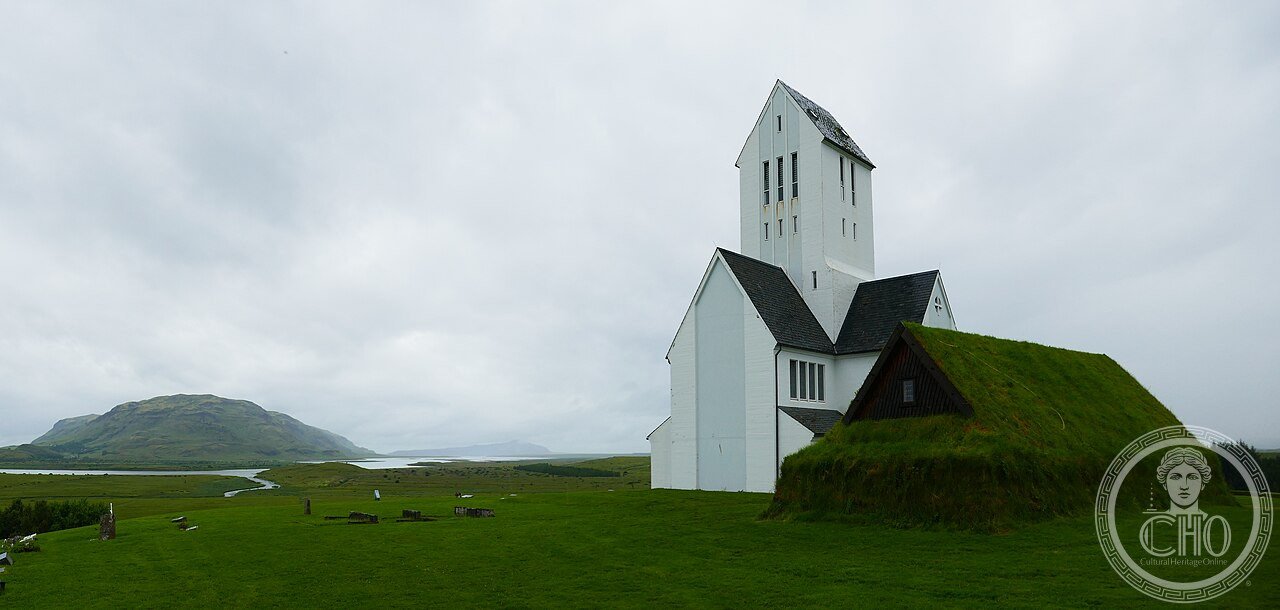
All’alba del 7 novembre 1550, i due figli del vescovo Jón Arason furono decapitati a Skálholt; subito dopo toccò allo stesso energico prelato sessantenne, giustiziato senza processo in base a un decreto danese che lo aveva dichiarato fuorilegge. Con la sua morte, l’ultima resistenza cattolica in Islanda si spense: il paese non avrebbe avuto un altro vescovo cattolico per quasi quattro secoli.
About Skálholt Cathedral
Skálholt became the episcopal see of all Iceland in 1056, when Ísleifur Gissurarson was ordained the country’s first bishop; a second Icelandic diocese was later established at Hólar in 1106. Iceland’s first formal school, Skálholtsskóli, was founded at Skálholt in the same year as the bishopric to educate clergy, and for the following eight centuries the site functioned as one of the two most important religious, political, and cultural centres in the country, hosting not only the bishop’s residence and cathedral but also a school, farming operations, a smithy, and, throughout the Catholic era, a monastery. A succession of large wooden cathedral churches, built with timber imported from Norway, stood on the site over the centuries — Bishop Klængur had the first major medieval church constructed in the mid-12th century, and churches of comparable scale, some considerably larger than the present building, continued to be rebuilt there through the 17th century. The Reformation reached its violent culmination at Skálholt on 7 November 1550, when Jón Arason, bishop of the northern see of Hólar and the last Catholic bishop in Iceland, was executed there together with his two sons; having resisted the Danish crown’s imposition of Lutheranism for over a decade after his fellow bishop Ögmundur had been deported in 1541, Arason and his sons were declared outlaws by Danish decree and beheaded without trial, an event that cemented Lutheranism’s dominance in Iceland for nearly four centuries. The diocese’s importance waned over the following centuries, hastened by earthquakes, volcanic eruptions, and other 18th-century disasters, and the episcopal see and school were eventually transferred to Reykjavík; the Diocese of Skálholt itself was formally dissolved in 1801, later re-established as a suffragan diocese in 1909. Archaeological excavations ahead of the construction of the present cathedral uncovered a stone sarcophagus believed to hold the remains of Páll Jónsson, Bishop of Skálholt, who died in 1211 — one of nine successive churches known to have stood on the exact same site across the thousand years since the diocese’s founding. The current cathedral was built between 1956 and 1963 to mark the 900th anniversary of the diocese’s establishment, with its cornerstone laid in 1956 by Bishop Sigurbjörn Einarsson and its consecration completed in 1963.
Key facts
- 1056: Ísleifur Gissurarson ordained Iceland’s first bishop, establishing the see at Skálholt
- 1056: Iceland’s first school, Skálholtsskóli, founded at the same site
- 1106: a second Icelandic diocese established at Hólar
- Nine churches: successive wooden cathedrals stood on the same site across a thousand years
- 7 November 1550: Bishop Jón Arason and his two sons beheaded at Skálholt, ending Catholic resistance in Iceland
- 1801: Diocese of Skálholt formally dissolved; re-established as suffragan diocese in 1909
- 1956-1963: present cathedral built to mark the diocese’s 900th anniversary
History
Jón Arason’s execution at Skálholt in 1550 — beheaded alongside his two sons without trial, on the basis of a Danish outlawry decree rather than any formal legal proceeding — marks one of the most consequential single events in Icelandic religious history, decisively ending organised Catholic resistance to the Danish crown’s Lutheran Reformation and inaugurating nearly four centuries during which Iceland had no Catholic bishop at all. That the execution took place specifically at Skálholt, the country’s senior episcopal seat, rather than at Arason’s own northern diocese of Hólar, underscores the symbolic importance of asserting Lutheran authority at the very heart of Iceland’s traditional ecclesiastical power.
The discovery of Bishop Páll Jónsson’s sarcophagus during excavations for the present 1956-1963 cathedral, on a site that had already hosted eight previous churches across the preceding nine centuries, gives Skálholt an archaeological continuity matched by few other single sites in Iceland — each successive rebuilding, whether prompted by fire, structural failure, or simple obsolescence, layering new construction directly atop nearly a millennium of continuous ecclesiastical use.
What you see
The present cathedral, built 1956-1963 in a restrained modern style to mark 900 years since the diocese’s founding, measures around 30 metres in length — considerably smaller than several of its medieval predecessors, some of which reached 50 metres. Beneath the building, the excavated stone sarcophagus attributed to Bishop Páll Jónsson (d. 1211) remains a significant archaeological feature, alongside the accumulated remains of the site’s eight earlier churches.
Practical information
- Opening hours: generally open daily with seasonal variation; check current hours before visiting; free admission
- Address: Skálholtskirkja, Skálholt, 806 Bláskógabyggð, Iceland
Getting there
Skálholt is reachable by car from Selfoss (approximately 40 minutes) in South Iceland, along the Golden Circle route. GPS: 64.1253° N, -20.5241° E.
Nearby
- Þingvellir National Park — the historic site of Iceland’s parliament, within the Golden Circle route
- Geysir — the geothermal field giving its name to geysers worldwide, nearby
- Selfoss — approximately 40 minutes away; the regional centre of South Iceland
Sources
- Wikipedia — “Skálholt Cathedral” and “Jón Arason” (en.wikipedia.org)
- Skálholt official site — “History” (english.skalholt.is)
- Executed Today — “1550: Jon Arason, the last Catholic bishop of Iceland” (executedtoday.com)
Find it on the map
See this place and what’s around it →📷 Become a Cultural Heritage Online photographer
Share your photos of places: they stay published under your name as the author. The more they're seen, the more you get noticed — and soon a contest will reward the most appreciated photos.
Log in or sign up free to add a photo