
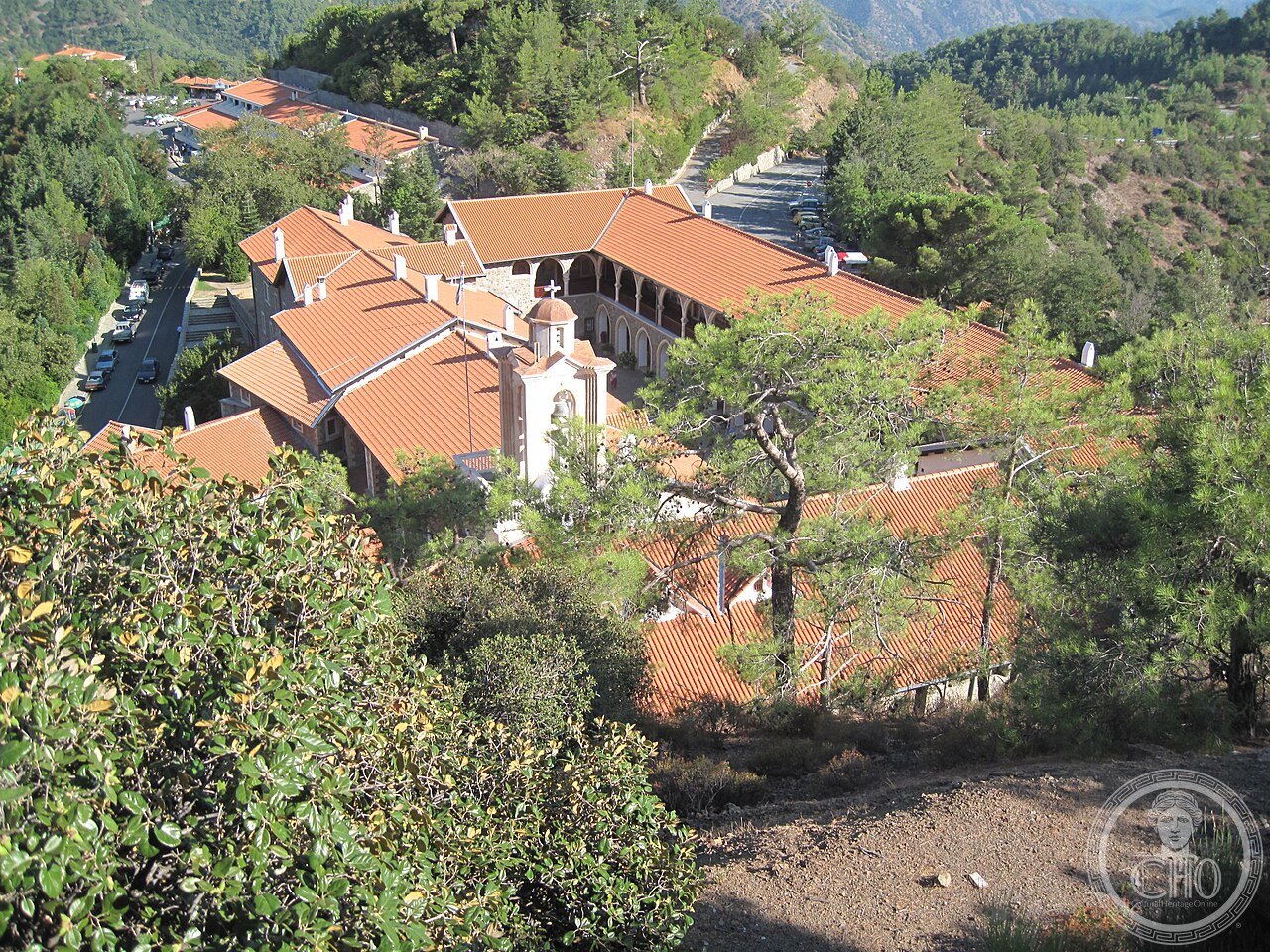
Custodita nel monastero più ricco e famoso di Cipro, l’icona della Madonna attribuita all’evangelista Luca è permanentemente coperta: secondo la tradizione, chiunque la guardi scoperta rischia di essere accecato. L’ultima persona che risulta averla vista è stato il patriarca di Alessandria Gerasimo, nel lontano 1669 — da allora, per oltre trecentocinquant’anni, nessun altro occhio umano l’ha più contemplata.
About Kykkos Monastery
Kykkos Monastery was founded around the end of the 11th century under the patronage of Byzantine Emperor Alexios I Komnenos (r. 1081-1118). According to tradition recorded by the Ukrainian pilgrim Vasil Grigorovich-Barsky in 1735, a hermit named Isaiah lived in a cave on the mountain; the Byzantine governor Manuel Boutoumites, lost while hunting, encountered Isaiah and treated him poorly, but later fell seriously ill and sought the hermit’s forgiveness. In another strand of the tradition, Isaiah is said to have miraculously healed the emperor’s own daughter, and in gratitude — though reportedly reluctant to part with the treasure — Alexios sent to Cyprus an icon of the Virgin believed to have been painted by the Apostle Luke, along with funds to build a monastery to house it. The icon, covered in silver gilt and enclosed in a shrine of tortoiseshell and mother-of-pearl before the iconostasis, remains permanently covered to this day: tradition holds that anyone who views the image directly risks being blinded, and the last person recorded to have seen the icon uncovered was Gerasimos, Patriarch of Alexandria, in 1669. Locals credit the icon with numerous miraculous interventions over the centuries, including a reported 1760 deliverance from a devastating locust plague. The monastery’s original buildings have been destroyed by fire on three separate occasions across its history, and the present church dates only to 1745. In 1926, the future Archbishop Makarios III — who would go on to become the first President of independent Cyprus — began his ecclesiastical career at Kykkos as a young monk; following the 1974 military coup against his government, he briefly sought refuge at the monastery’s metochion (dependency) in Nicosia, a building later struck by tank fire during the crisis. Makarios was ultimately buried at Throni, a site some 3 kilometres west of Kykkos. Today the monastery remains one of the wealthiest and most influential religious institutions in Cyprus, maintaining an extensive museum alongside its active monastic community.
Key facts
- c. late 11th century: founded under Emperor Alexios I Komnenos, following the hermit Isaiah’s legend
- The icon: attributed to the Apostle Luke, permanently covered; last seen uncovered by Patriarch Gerasimos of Alexandria in 1669
- 1760: the icon is credited with delivering the region from a locust plague
- Three fires: destroyed the original monastery buildings across its history
- 1745: the present church is built
- 1926: the future Archbishop Makarios III begins his monastic life at Kykkos
- 1974: Makarios’s Nicosia metochion is struck by tank fire during the coup against his government
- Today: Cyprus’s wealthiest and most influential monastery, with an extensive museum
History
The icon’s tradition of permanent concealment, unbroken since Patriarch Gerasimos’s 1669 viewing, gives Kykkos a genuinely unusual devotional practice among the Orthodox world’s many venerated Marian icons — most such images remain visible, at least periodically, to pilgrims, whereas Kykkos’s central relic has been deliberately hidden from human sight for over three and a half centuries, its power understood specifically to reside partly in its inaccessibility. The monastery’s repeated destruction by fire across its history, culminating in the current 1745 church, situates Kykkos among the many Orthodox monastic institutions whose physical structures have proven far more vulnerable than the devotional traditions and relics they were built to house.
Archbishop Makarios III’s beginnings as a young monk at Kykkos in 1926, decades before his rise to become both head of the Cypriot Orthodox Church and the first President of independent Cyprus, connects this remote mountain monastery directly to the country’s modern political founding — and his monastery-linked property being struck by tank fire during the 1974 coup against his government situates Kykkos within one of the most consequential crises in modern Cypriot history.
What you see
The present church, built in 1745 after the repeated destruction of earlier structures by fire, houses the permanently covered icon within its silver-gilt covering and tortoiseshell-and-mother-of-pearl shrine before the iconostasis. The wider monastic complex, set within the Troodos Mountains, includes an extensive museum documenting the monastery’s history, relics, and manuscripts, reflecting its status as one of Cyprus’s wealthiest religious institutions.
Practical information
- Opening hours: generally open daily with seasonal variation; check current hours before visiting; free admission to the monastery, fee for the museum
- Address: Ιερά Μονή Κύκκου, E912, Κύκκος, Tsakistra, Nicosia District, Cyprus
Getting there
Kykkos Monastery is reachable by car from Nicosia (approximately 1.5 hours) in the Troodos Mountains, Nicosia District. GPS: 34.9839° N, 32.7412° E.
Nearby
- Throni — approximately 3 km away; burial site of Archbishop Makarios III
- Troodos Mountains — the surrounding mountain range, home to several other painted Byzantine churches
- Pedoulas — a nearby traditional mountain village
Sources
- Wikipedia — “Kykkos Monastery” and “Makarios I of Cyprus” (en.wikipedia.org)
- OrthodoxWiki — “Monastery of Kykkos (Cyprus)” (orthodoxwiki.org)
- Visit Cyprus — “Kykkos Monastery” (visitcyprus.com)
Find it on the map
See this place and what’s around it →📷 Become a Cultural Heritage Online photographer
Share your photos of places: they stay published under your name as the author. The more they're seen, the more you get noticed — and soon a contest will reward the most appreciated photos.
Log in or sign up free to add a photo