

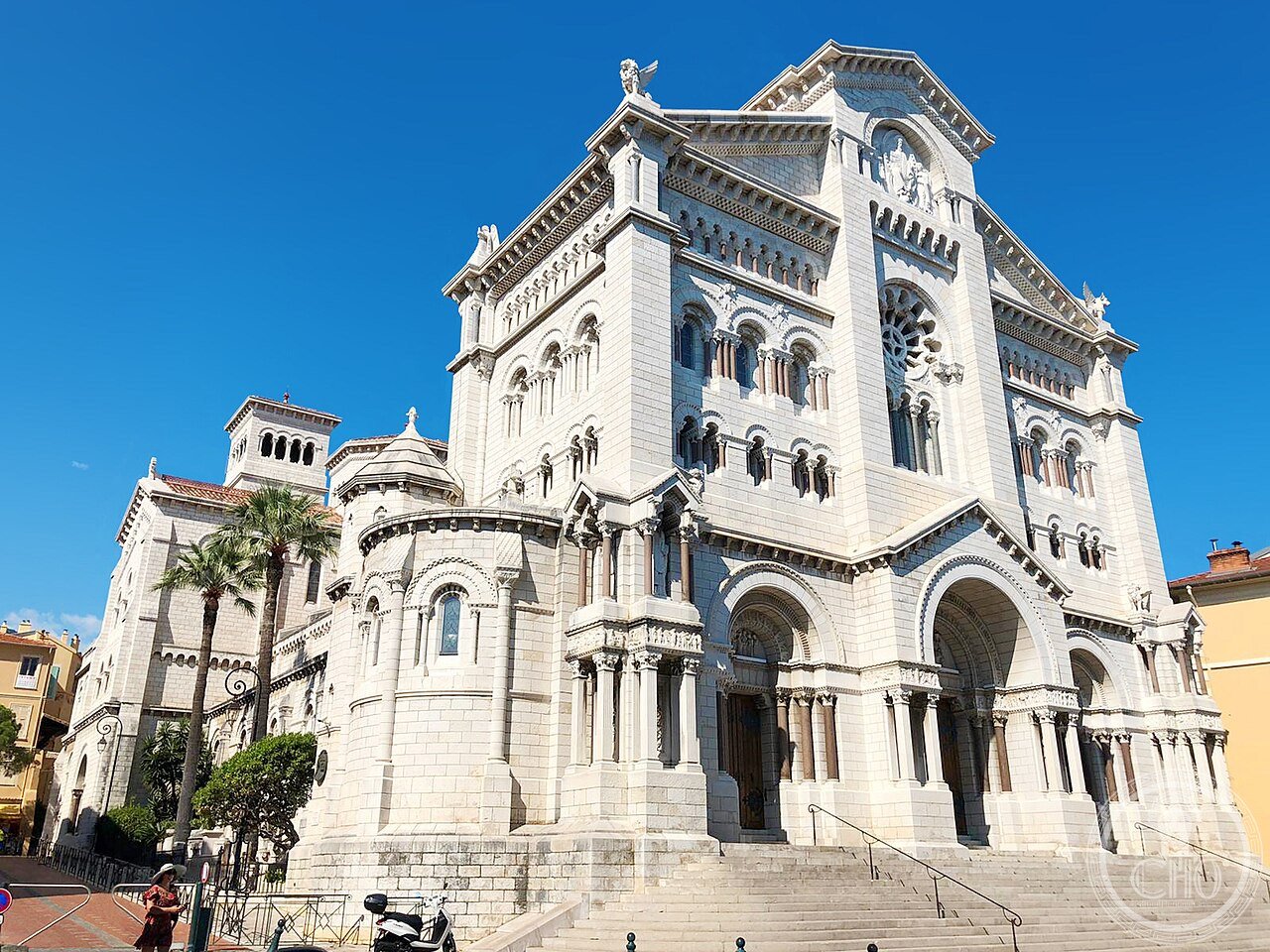
On 19 April 1956 the actress Grace Kelly married Prince Rainier III of Monaco in this very Romanesque-Byzantine cathedral, built between 1875 and 1911 on the site of a thirteenth-century chapel. Twenty-six years later, in 1982, Grace Kelly was buried here after a car accident; Rainier III joined her in 2005. Their tombs, together with those of other members of the Grimaldi dynasty, are still in the choir of the cathedral today.
About Monaco Cathedral
A 13th-century chapel dedicated to Saint Nicholas stood on the site of the present cathedral, built following permission granted by Pope Innocent IV in 1247; this original structure served Monaco’s spiritual needs for over six centuries before being demolished in 1874 to make way for a larger building. The replacement cathedral, dedicated to Notre-Dame-Immaculée, was designed by the French architect Charles Lenormand — already known for his work on the Basilique Notre-Dame de la Garde in Marseille — in a distinctive Romanesque-Byzantine style, a deliberate departure from the prevailing architectural trends of the period. The cornerstone was laid on 6 January 1875 under the patronage of Prince Charles III, construction continued through 1903, and the completed cathedral was finally consecrated on 11 June 1911. Its pristine white stone facade was quarried from La Turbie, standing in striking contrast against the Mediterranean coastline. The cathedral preserved important artworks rescued from the demolished earlier church, notably a 16th-century altarpiece by the Niçois painter Louis Bréa depicting Saint Nicholas, Mary Magdalene, and Saint John. The building entered the wider public imagination on 19 April 1956, when Prince Rainier III of Monaco married the American actress Grace Kelly there in a globally watched ceremony. Princess Grace died in 1982 following a car accident and was buried within the cathedral; Prince Rainier III was laid to rest beside her after his own death in 2005. Other members of the Grimaldi dynasty are also interred there, including Prince Louis II (buried 1949) and Prince Albert I (buried 1922), their tombs set within the cathedral’s choir.
Key facts
- 1247: Pope Innocent IV grants permission for a chapel dedicated to Saint Nicholas on the site
- 1874: the original chapel demolished to make way for a larger cathedral
- 6 January 1875: cornerstone laid under Prince Charles III; architect Charles Lenormand
- 1875-1903: construction in Romanesque-Byzantine style, white stone from La Turbie
- 11 June 1911: cathedral consecrated
- 19 April 1956: Prince Rainier III marries Grace Kelly in the cathedral
- 1982/2005: Princess Grace and Prince Rainier III buried in the choir
- Preserved artwork: a 16th-century altarpiece by Louis Bréa, rescued from the earlier church
History
Architect Charles Lenormand’s choice of Romanesque-Byzantine style for Monaco Cathedral, at a moment when Gothic Revival dominated much of contemporary European church architecture, gave the small principality’s principal church a deliberately distinctive visual identity, reinforced by the striking white La Turbie stone that sets it apart from its Mediterranean surroundings. The cathedral’s global visibility increased enormously following the 1956 wedding of Prince Rainier III and Grace Kelly, a ceremony watched around the world that permanently linked the building’s identity to one of the 20th century’s most famous royal marriages, well beyond its purely local ecclesiastical significance.
The cathedral’s role as the resting place of the Grimaldi dynasty across multiple generations — from Prince Albert I in 1922 through Princess Grace in 1982 to Prince Rainier III in 2005 — situates it as the continuous spiritual and dynastic heart of the Monégasque state, its choir functioning simultaneously as an active cathedral sanctuary and as the ruling family’s own dynastic mausoleum.
What you see
The cathedral’s white La Turbie stone facade, in Romanesque-Byzantine style, stands prominently within Monaco-Ville. Inside, the 16th-century altarpiece by Louis Bréa, depicting Saint Nicholas, Mary Magdalene, and Saint John, survives from the earlier demolished church. The simple, dignified tombs of Prince Rainier III and Princess Grace, set within the cathedral’s choir alongside those of earlier Grimaldi rulers, remain a focal point for visitors paying their respects.
Practical information
- Opening hours: generally open daily with seasonal variation; check current hours before visiting; free admission
- Address: Rue de l’Abbaye, 98000 Monaco-Ville, Monaco
Getting there
Monaco Cathedral is reachable on foot within Monaco-Ville, the historic old town of Monaco, atop the Rock of Monaco. GPS: 43.7302° N, 7.4227° E.
Nearby
- Prince’s Palace of Monaco — the ruling family’s official residence, nearby in Monaco-Ville
- Oceanographic Museum of Monaco — a major museum on the Rock of Monaco
- Monaco-Ville — the historic old town surrounding the cathedral
Sources
- HelloMonaco — “The 150 Year Modern Anniversary of Monaco’s Cathedral” (hellomonaco.com)
- Wondermondo — “Monaco Cathedral” (wondermondo.com)
- Wikipedia — “Wedding of Rainier III, Prince of Monaco, and Grace Kelly” (en.wikipedia.org)
Find it on the map
See this place and what’s around it →📷 Become a Cultural Heritage Online photographer
Share your photos of places: they stay published under your name as the author. The more they're seen, the more you get noticed — and soon a contest will reward the most appreciated photos.
Log in or sign up free to add a photo