
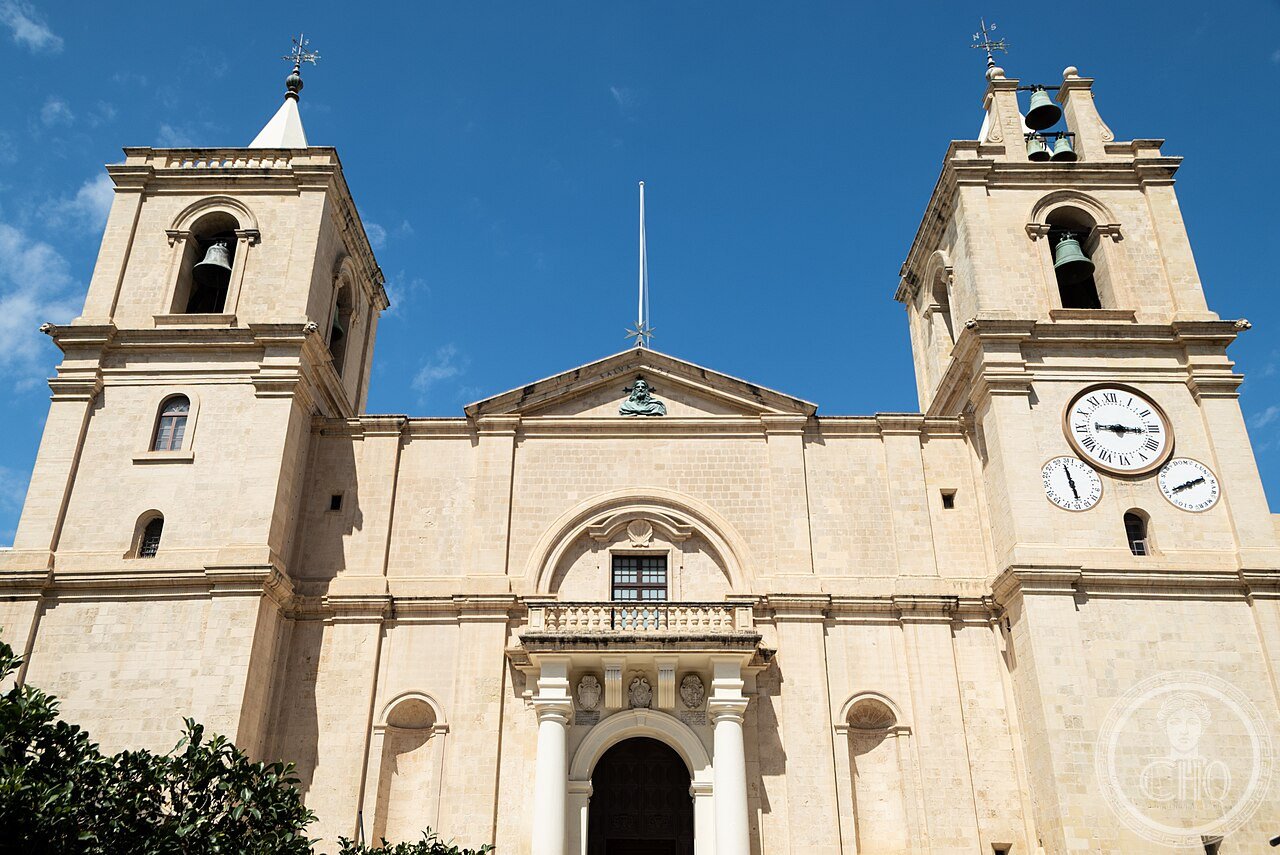
Dietro una facciata austera che ricorda una fortezza, la chiesa conventuale dei Cavalieri di Malta nasconde uno degli interni barocchi più sontuosi d’Europa e un capolavoro assoluto: la “Decollazione di san Giovanni Battista” di Caravaggio, la tela più grande mai dipinta dall’artista e l’unica che abbia mai firmato — la sua firma, tracciata nel sangue che sgorga dalla gola tagliata del Battista.
About St John’s Co-Cathedral
St John’s Co-Cathedral was commissioned in 1572 by Grand Master Jean de la Cassière of the Order of St John, in the aftermath of the Great Siege of Malta of 1565, and built between 1573 and 1578 by the Maltese architect Girolamo Cassar, who designed several of Valletta’s other prominent buildings; the church was consecrated on 20 February 1578 as the Conventual Church of Saint John, the Order’s own principal church. Its exterior presents a deliberately austere, fortress-like Mannerist style, giving little indication of the transformation that would later take place inside: in the 1660s, Grand Master Raphael Cotoner ordered a complete redecoration intended to rival the churches of Rome, and the Calabrian artist Mattia Preti, together with other artists, transformed the entire interior into one of the finest examples of High Baroque architecture in Europe. The church’s marble floor holds the tomb ledgers of some 400 Knights and officers of the Order, each richly inlaid with coats of arms and images narrating that knight’s own history and battlefield triumphs. Caravaggio arrived in Malta in July 1607 aboard a vessel of the Order and was formally received as a Knight of Obedience on 14 July 1608 by Grand Master Alof de Wignacourt; while on the island he painted both “St Jerome Writing” and “The Beheading of Saint John the Baptist” for the co-cathedral, the latter measuring 361 by 520 centimetres, the largest canvas he ever painted, and the only work bearing his signature — placed, famously, in the blood spilling from the Baptist’s severed throat. In the 1820s, the Bishop of Malta was permitted to use St John’s as an alternative episcopal seat alongside the archbishop’s cathedral in Mdina, formally establishing its status as a co-cathedral.
Key facts
- 1572: commissioned by Grand Master Jean de la Cassière after the Great Siege of 1565
- 1573-1578: built by architect Girolamo Cassar; consecrated 20 February 1578
- 1660s: Baroque interior redecoration by Mattia Preti, ordered by Grand Master Raphael Cotoner
- Floor: around 400 richly inlaid marble tomb ledgers of Knights and officers
- 1608: Caravaggio paints “The Beheading of Saint John the Baptist,” his only signed work, signed in the Baptist’s painted blood
- 14 July 1608: Caravaggio received as a Knight of Obedience by Grand Master Alof de Wignacourt
- 1820s: formally recognised as co-cathedral alongside Mdina Cathedral
History
The stark contrast between St John’s deliberately fortress-like Mannerist exterior and its transformed High Baroque interior mirrors the Order of St John’s own dual identity as both a militant crusading brotherhood, still defensively minded in the years following the Great Siege of 1565, and a wealthy, artistically ambitious European ecclesiastical institution eager to rival Rome’s own churches by the mid-17th century. The presence of some 400 Knights’ tomb ledgers set directly into the church floor turns the entire building into a continuous memorial to the Order’s own military and aristocratic membership, each individually inlaid marble slab narrating a specific knight’s coat of arms and personal history of service.
Caravaggio’s decision to sign only this single painting throughout his entire career, and to do so by tracing his name in the blood flowing from the Baptist’s severed neck, gives “The Beheading of Saint John the Baptist” a uniquely self-referential and macabre significance within his body of work — created during the brief period when the fugitive painter had himself been formally received into the Order of St John as a Knight, before a violent brawl later led to his expulsion and imprisonment on the island.
What you see
The austere Mannerist facade, fortress-like in character, gives way inside to Mattia Preti’s 1660s High Baroque transformation, with richly gilded and painted surfaces throughout the nave and side chapels — each chapel dedicated to and funded by a different langue, or national division, of the Order. The marble floor’s roughly 400 inlaid tomb ledgers form a continuous decorative and commemorative carpet across the entire church. Caravaggio’s “The Beheading of Saint John the Baptist,” his largest and only signed painting, remains on display within the co-cathedral’s oratory, alongside his “St Jerome Writing.”
Practical information
- Opening hours: generally open daily except Sundays, with seasonal variation; check current hours before visiting; admission fee applies
- Address: Triq San Ġwann, Il-Belt Valletta VLT 1113, Malta
Getting there
St John’s Co-Cathedral is reachable on foot within the historic centre of Valletta, Malta. GPS: 35.8977° N, 14.5126° E.
Nearby
- Grandmaster’s Palace — the historic seat of the Order of St John, nearby
- Valletta — the UNESCO World Heritage-listed capital of Malta, surrounding the co-cathedral
- Upper Barrakka Gardens — a nearby scenic viewpoint overlooking the Grand Harbour
Sources
- Wikipedia — “St John’s Co-Cathedral” and “The Beheading of Saint John the Baptist (Caravaggio)” (en.wikipedia.org)
- St John’s Co-Cathedral — official site, “Caravaggio” (stjohnscocathedral.com)
- Malta Uncovered — “St. John’s Co-Cathedral: Visiting the Crown Jewel of Valletta” (maltauncovered.com)
Find it on the map
See this place and what’s around it →📷 Become a Cultural Heritage Online photographer
Share your photos of places: they stay published under your name as the author. The more they're seen, the more you get noticed — and soon a contest will reward the most appreciated photos.
Log in or sign up free to add a photo