

Written almost entirely in Latin, the foundation charter of Tihany Abbey, signed by King Andrew I in 1055, contains fifty-eight words in Hungarian — among them the longest sentence ever recorded in that language up to then: “feheruuaru rea meneh hodu utu rea”, “along the military road that leads to Fehérvár”. It is the oldest continuous text ever written in Hungarian, and it is kept today in the mother abbey of Pannonhalma.
About Tihany Abbey
Tihany Abbey was founded in 1055 by King Andrew I of Hungary (r. 1046-1060) on a peninsula extending into Lake Balaton, dedicated to the Holy Virgin and to Saint Bishop Aignan of Orléans. King Andrew died in 1060 and was buried in the monastery church; his tomb, preserved in the church’s crypt, remains the only surviving grave of a medieval King of Hungary anywhere in the country. The abbey’s founding charter, drawn up in 1055, is a landmark document in the history of the Hungarian language: written mostly in Latin, it contains 58 Hungarian words and phrases scattered through the text, the longest being “feheruuaru rea meneh hodu utu rea” — in modern Hungarian, “Fehérvárra menő hadi útra,” meaning “onto the military road leading to Fehérvár” — making it the oldest surviving continuous text in the Hungarian language; the charter, written on vellum, is preserved today at Pannonhalma Archabbey. The medieval church that Andrew founded was rebuilt on a grand scale in the 18th century: reconstruction began in 1719 under the Carmelite architect Martin Wittwer, and after more than three decades of work the large Baroque church, with twin towers rising 34.5 metres, was completed in 1754. Its main altar was finished in 1757, and a further Mariazell altar was added in 1762; the church’s ceiling was later decorated with frescoes by Károly Lotz depicting Faith, Hope, and Love. The monastery was dissolved by the Communist state in 1950 and remained closed for four decades until it was reestablished in the 1990s by monks from Pannonhalma; Tihany became an independent monastery again in 2012 and today maintains a community of 12 monks.
Key facts
- 1055: founded by King Andrew I of Hungary on the Tihany peninsula, Lake Balaton
- Founding charter: contains 58 Hungarian words within its Latin text, the oldest surviving continuous Hungarian text; held at Pannonhalma Archabbey
- 1060: King Andrew I dies and is buried in the church crypt — the only surviving medieval Hungarian royal tomb
- 1719-1754: Baroque reconstruction under architect Martin Wittwer; twin towers 34.5 metres tall
- 1757/1762: main altar completed; Mariazell altar added
- 1950: monastery dissolved under Communist rule
- 1990s-2012: reestablished by monks from Pannonhalma; independent monastery again from 2012, 12 monks today
History
The 1055 founding charter’s 58 embedded Hungarian words, scattered within an overwhelmingly Latin legal document, give Tihany Abbey a foundational place in the documented history of the Hungarian language itself — a purely administrative act of medieval land donation inadvertently produced the oldest surviving continuous text in a language whose written tradition would otherwise have no earlier securely dated example. King Andrew I’s own burial at the abbey, and the survival of his tomb as the only preserved grave of any medieval Hungarian king, gives Tihany a unique material connection to the country’s earliest royal dynasty that no other surviving site in Hungary can claim.
The nearly four-decade closure of the monastery under Communist rule from 1950, followed by its restoration in the 1990s by monks from Pannonhalma and full independence in 2012, situates Tihany within the broader pattern of Central European monastic communities that survived 20th-century state suppression of religious life to resume active operation once political conditions allowed — a continuity spanning, in Tihany’s case, nearly a full millennium since its 1055 founding, interrupted only by this one 20th-century gap.
What you see
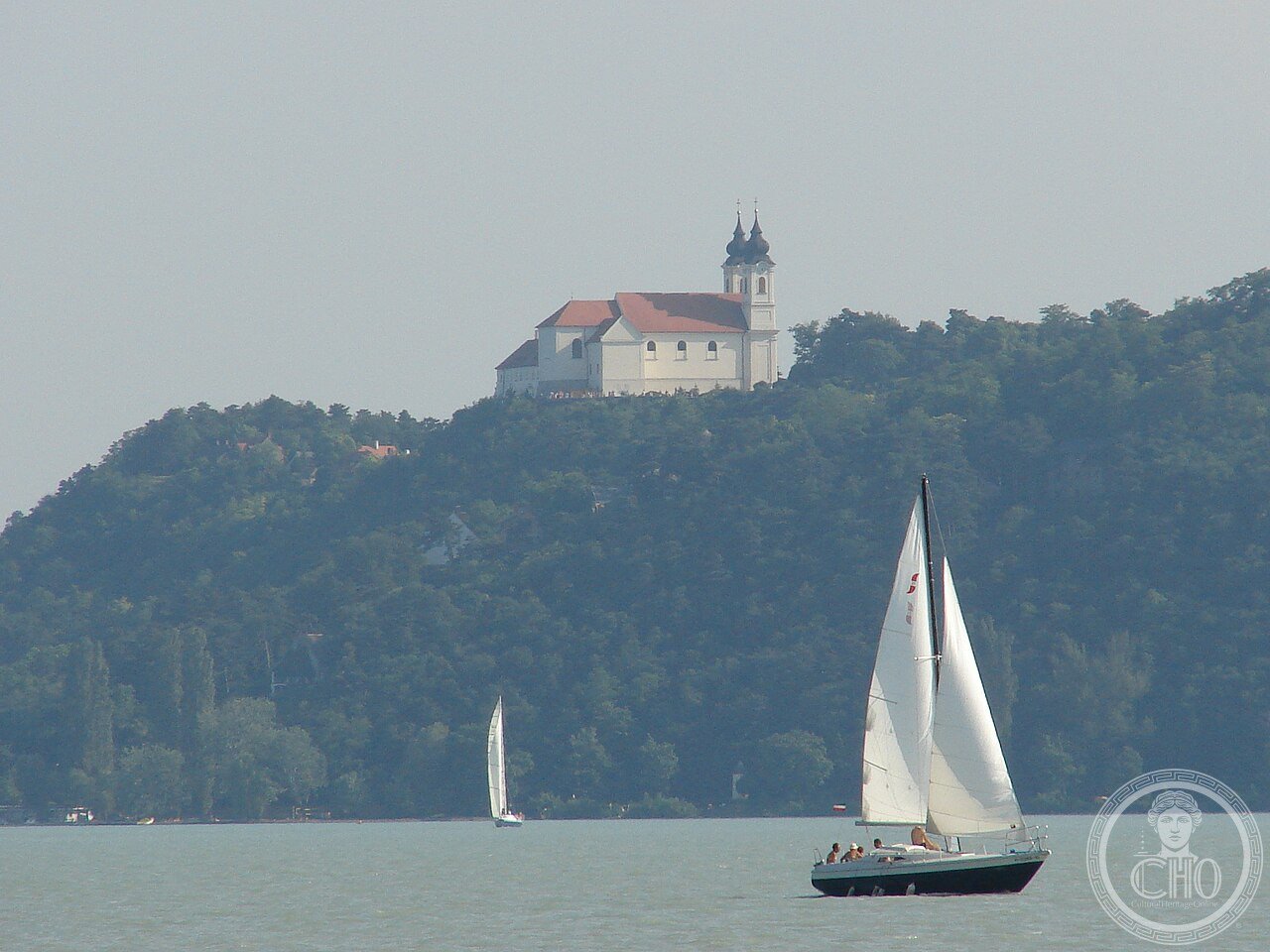
The Baroque abbey church, rebuilt between 1719 and 1754 under the Carmelite architect Martin Wittwer, presents a twin-towered west facade rising 34.5 metres, its richly detailed decoration a significant achievement of Hungarian Baroque architecture. Inside, the elaborately carved wooden furnishings rank among the finest examples of Hungarian Baroque woodwork, alongside the 1757 main altar, the 1762 Mariazell altar, and later ceiling frescoes by Károly Lotz depicting Faith, Hope, and Love. King Andrew I’s tomb remains preserved in the church’s crypt. The abbey’s position on the Tihany peninsula offers sweeping views across Lake Balaton.
Practical information
- Opening hours: generally open daily with seasonal variation; check current hours before visiting; admission fee applies
- Address: I. András tér 1, 8237 Tihany, Hungary
Getting there
Tihany is reachable by car from Balatonfüred (approximately 20 minutes) on the Tihany peninsula, Lake Balaton, Veszprém County. GPS: 46.9138° N, 17.8899° E.
Nearby
- Lake Balaton — Central Europe’s largest lake, surrounding the Tihany peninsula
- Balatonfüred — approximately 20 minutes away; a leading Lake Balaton resort town
- Inner Lake of Tihany — a smaller lake within the peninsula, a nature reserve
Sources
- Wikipedia — “Tihany Abbey” and “Establishing charter of the abbey of Tihany” (en.wikipedia.org)
- The Benedictine Abbey of Tihany — official site, “History” (eng.tihanyiapatsag.hu)
- Hungary Today — “Founding Charter of Ancient Tihany Abbey on Display” (hungarytoday.hu)
Find it on the map
See this place and what’s around it →📷 Become a Cultural Heritage Online photographer
Share your photos of places: they stay published under your name as the author. The more they're seen, the more you get noticed — and soon a contest will reward the most appreciated photos.
Log in or sign up free to add a photo