
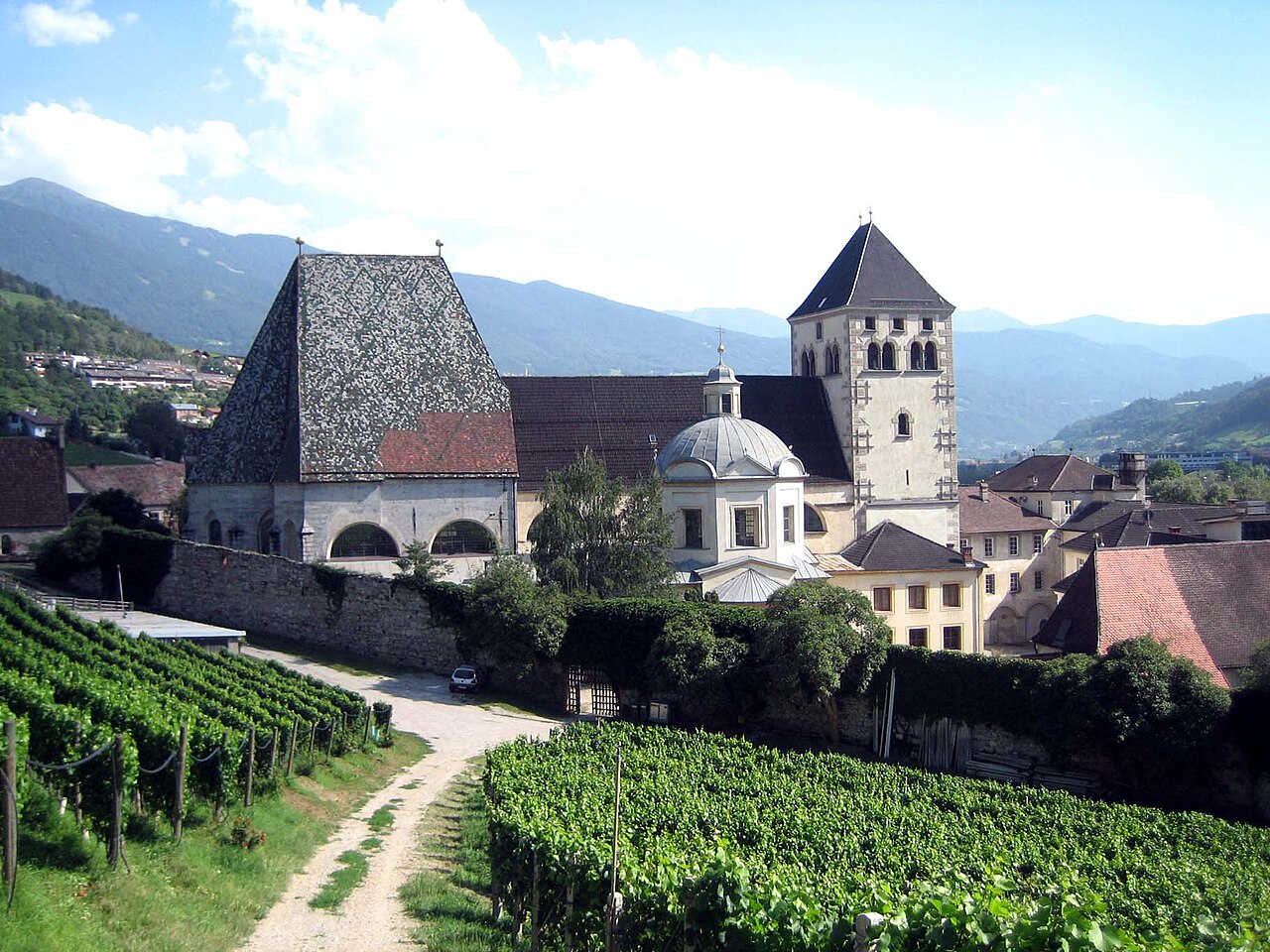
In the abbey’s first Gothic cloister stands the “Well of Wonders”: its sides show the seven wonders of the ancient world, but the painter Nikolaus Schiel added an eighth, dedicated to Novacella Abbey itself. Founded in 1142 by Blessed Hartmann, bishop of Brixen, the abbey has made wine without interruption since the very year of its foundation — one of the oldest working wineries in the world.
About Novacella Abbey
Novacella Abbey (Kloster Neustift) was founded in 1142 by Bishop Blessed Artmanno of Bressanone, and formally recognised by Pope Innocent II on 9 April 1143. It belongs to the Augustinian Canons of the Austrian Lateran Congregation, whose community today, led by an abbot, still carries out pastoral work across some 25 parishes spanning South Tyrol and East Tyrol. The fortified complex assembled over the centuries combines buildings in markedly different styles: a Romanesque bell tower, a Gothic choir, presbytery, and cloister, and a church and library rebuilt in Baroque and Rococo forms. Among its most distinctive structures is the Chapel of St. Michael, known as the “Castello dell’Angelo” (Engelsburg), a Romanesque rotunda recalling both ancient Roman architecture and the Church of the Holy Sepulchre in Jerusalem. At the heart of the Gothic cloister stands the “Pozzo delle Meraviglie” (Well of Wonders), its sides depicting the Seven Wonders of the ancient world — to which the painter Nikolaus Schiel added an eighth, dedicated to Novacella Abbey itself. The abbey’s library, occupying two floors of the monastery and holding roughly 65,000 printed volumes alongside numerous medieval manuscripts and illuminated codices, is anchored by its main reading room, completed by Antonio Giuseppe Sartori in 1773 and considered a masterpiece of South Tyrolean Rococo, its walls and ceiling adorned with gilded stucco. The Baroque basilica of Santa Maria Assunta, largely rebuilt in the 18th century while preserving its Gothic presbytery, holds frescoes by Matthäus Günther. Vineyards have been part of the abbey’s holdings since its 1142 founding, making its winery one of the oldest continuously operating wine estates in the world. The abbey was suppressed by Bavarian authorities in 1807 during the Napoleonic period, restored under Emperor Francis I in 1816, and its basilica was elevated to the rank of Minor Basilica by Pope Pius XII in 1956.
Key facts
- Foundation: 1142, by Bishop Blessed Artmanno of Bressanone; papal recognition 9 April 1143
- Order: Augustinian Canons of the Austrian Lateran Congregation, active in ~25 parishes today
- Chapel of St. Michael (Engelsburg): Romanesque rotunda recalling the Holy Sepulchre
- Pozzo delle Meraviglie: the Gothic cloister well depicting the Seven Wonders of the ancient world, plus an eighth — the abbey itself
- Library: approximately 65,000 volumes; Rococo reading room completed by Antonio Giuseppe Sartori in 1773
- Winery: vineyards held since 1142, one of the oldest continuously operating wine estates in the world
- 1807-1816: suppressed under Bavarian/Napoleonic rule, restored under Emperor Francis I
- 1956: basilica elevated to Minor Basilica status by Pope Pius XII
History
The painter Nikolaus Schiel’s decision to add an eighth wonder to the Pozzo delle Meraviglie’s traditional Seven Wonders of the ancient world — dedicating it to Novacella Abbey itself — reflects a genuinely self-confident act of institutional self-mythologising rare among European monastic houses, one that has endured as a distinctive interpretive feature of the abbey’s own cloister ever since. The continuity of Novacella’s winemaking tradition since its 1142 foundation, surviving the Napoleonic-era suppression of 1807 and subsequent 1816 restoration essentially intact, gives the abbey’s vineyards a claim to being among the very oldest continuously operating wine estates anywhere in the world, a commercial and agricultural tradition running in parallel with the community’s religious life for nearly nine centuries.
The 1807 Bavarian suppression and 1816 restoration under Emperor Francis I situates Novacella within the broader wave of monastic dissolutions and restorations that swept German-speaking and Alpine Europe during and after the Napoleonic Wars, as territorial reorganisation repeatedly redrew which secular or ecclesiastical authority controlled religious institutions across the region — Novacella’s survival and eventual 1956 elevation to Minor Basilica status marks a successful long-term recovery from this period of genuine institutional threat.
What you see
The fortified abbey complex combines a Romanesque bell tower, Gothic choir, presbytery, and cloister with a Baroque-Rococo church and library, its architectural layering visible across the centuries of successive rebuilding. The Chapel of St. Michael (Engelsburg) stands as a distinctive Romanesque rotunda within the complex. The Gothic cloister’s Pozzo delle Meraviglie depicts the Seven Wonders of antiquity plus the abbey’s own self-declared eighth wonder. The library’s 1773 Rococo reading room, with its gilded stucco and roughly 65,000 volumes, remains one of the finest surviving examples of South Tyrolean Rococo interior decoration. The Baroque basilica of Santa Maria Assunta preserves frescoes by Matthäus Günther within its largely 18th-century structure.
Practical information
- Opening hours: guided tours available on a scheduled basis with seasonal variation; check current hours before visiting; admission fee applies
- Address: Abbazia di Novacella, Via Isarco, 39040 Varna, Italy
Getting there
Novacella Abbey is reachable by car from Bressanone (approximately 5 minutes) in the Valle Isarco, South Tyrol. GPS: 46.7437° N, 11.6484° E.
Nearby
- Bressanone — approximately 5 minutes away; historic South Tyrolean town with its own cathedral
- Valle Isarco — the surrounding wine-growing valley
- Varna — the municipality in which the abbey stands
Sources
- Wikipedia — “Abbazia di Novacella” e “Neustift Abbey” (it.wikipedia.org, en.wikipedia.org)
- Kloster Neustift — sito ufficiale, “History” (kloster-neustift.it)
- Südtirolerland — “Novacella Abbey Museum” (suedtirolerland.it)
Find it on the map
See this place and what’s around it →📷 Become a Cultural Heritage Online photographer
Share your photos of places: they stay published under your name as the author. The more they're seen, the more you get noticed — and soon a contest will reward the most appreciated photos.
Log in or sign up free to add a photo