
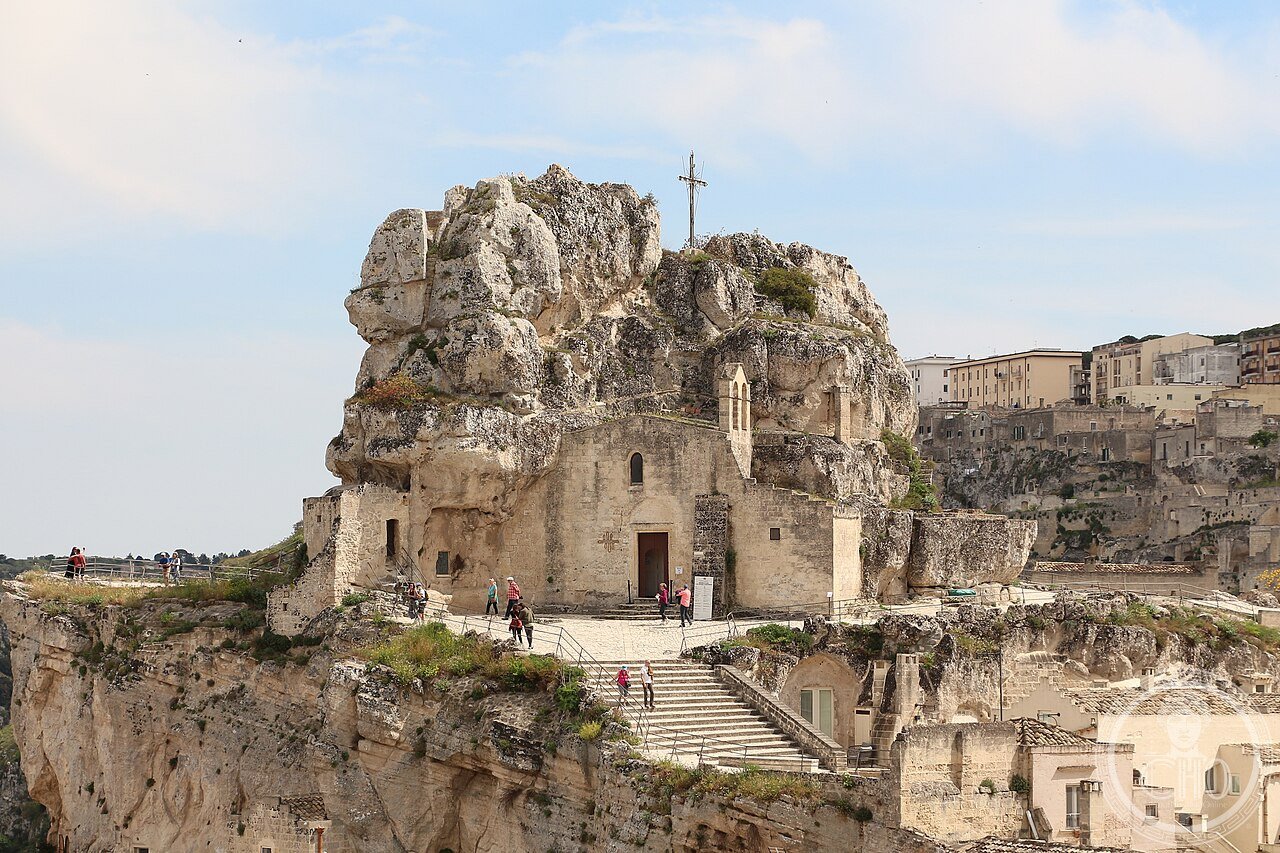
Sulla sommità del monolito calcareo del Monterrone, nel Sasso Caveoso, sorge questa chiesa rupestre scavata tra XII e XIII secolo. All’inizio dell’Ottocento, i monaci scavarono un corridoio per collegarla alla vicina cripta di San Giovanni in Monterrone: un intervento che, nel farlo, distrusse quasi completamente diversi affreschi medievali lungo il percorso — lasciando però intatto, nella cripta, un Cristo Pantocratore del XII secolo di chiara ascendenza bizantina.
About Santa Maria de Idris
The rock church of Santa Maria de Idris stands atop Monterrone, a limestone outcrop rising within Matera’s Sasso Caveoso district. Its name most likely derives from the Greek term “Odigitria” — “she who shows the way,” an epithet of the Virgin Mary — though some accounts trace it instead to water that once flowed from the rock face. The church’s original layout dates to between the 12th and 13th centuries, though its interior was substantially reworked over subsequent centuries, obscuring much of its earliest form; visible today are 17th-century tempera paintings, including a Madonna and Child on the altar. A narrow tunnel connects Santa Maria de Idris to the adjacent crypt of San Giovanni in Monterrone, an addition made at the beginning of the 19th century when the two rock churches were formally joined — the excavation of this connecting corridor came at the cost of the near-total destruction of several medieval frescoes that had stood in its path. The crypt of San Giovanni in Monterrone nonetheless preserves an important fresco cycle spanning the 12th to 17th centuries, including a 12th-century Christ Pantocrator, shown holding an open Gospel, that testifies directly to the Byzantine artistic influence present in the Matera territory during the medieval period, alongside further frescoes depicting Saint Andrew, a Madonna and Child, Saint Peter (without the keys of paradise), Saint James, and Saint John the Evangelist. Externally, Santa Maria de Idris presents a simple masonry front with a small bell gable rising from the rock summit, reached via a staircase near the nearby church of Santa Lucia alle Malve. The church belongs to the Archdiocese of Matera-Irsina and remains dedicated to the Madonna Odigitria.
Key facts
- 12th-13th century: original excavation of the church atop the Monterrone outcrop
- Name origin: likely from the Greek “Odigitria” (“she who shows the way”), an epithet of the Virgin Mary
- 17th century: surviving tempera paintings, including the altar’s Madonna and Child
- Early 19th century: a connecting tunnel is dug to the crypt of San Giovanni in Monterrone, destroying several medieval frescoes in the process
- San Giovanni in Monterrone crypt: frescoes spanning the 12th-17th centuries, including a 12th-century Byzantine-influenced Christ Pantocrator
- Exterior: a simple masonry facade with a small bell gable atop the rock, accessed via stairs near Santa Lucia alle Malve
History
The early-19th-century decision to physically join Santa Maria de Idris to the neighbouring crypt of San Giovanni in Monterrone via a carved connecting tunnel, even at the direct cost of destroying medieval frescoes standing in the excavation’s path, illustrates how later religious communities at Matera sometimes prioritised practical spatial connection between adjacent rock-cut spaces over the preservation of earlier artistic decoration — a trade-off with no simple parallel in conventionally built masonry churches, where such destructive excavation would rarely be necessary. The survival, despite this loss, of San Giovanni in Monterrone’s own 12th-century Christ Pantocrator and its broader fresco cycle spanning five centuries gives the joined complex genuine documentary depth for tracing the evolution of Byzantine-influenced religious painting in the Matera area across the medieval and early modern periods.
The church’s dedication to the Madonna Odigitria, if the Greek etymology of “Idris” is correct, would connect Santa Maria de Idris to the broader Byzantine devotional tradition of the Hodegetria icon type, reflecting the lasting imprint of Greek and Byzantine religious culture on this particular corner of Basilicata long after formal Byzantine political control of the region had ended.
What you see
The church’s simple masonry front and small bell gable rise directly from the summit of the Monterrone outcrop, a distinctive silhouette visible across much of the Sasso Caveoso. Inside, 17th-century tempera paintings survive on the altar. The connecting tunnel leads to the crypt of San Giovanni in Monterrone, where the 12th-century Christ Pantocrator and further frescoes depicting saints and the Madonna and Child remain visible, spanning several centuries of artistic production within a single excavated rock space.
Practical information
- Opening hours: generally open daily with seasonal variation; check current hours before visiting; admission fee applies
- Address: Monterrone, Sasso Caveoso, 75100 Matera, Italy
Getting there
Santa Maria de Idris is reachable on foot within the Sassi di Matera, in the Sasso Caveoso district, near the church of Santa Lucia alle Malve. GPS: 40.6640° N, 16.6122° E.
Nearby
- San Giovanni in Monterrone — the adjoining crypt, connected by tunnel
- Santa Lucia alle Malve — another rock church nearby, reached via the same staircase
- San Pietro Caveoso — the main parish church of the Sasso Caveoso district
Sources
- Wikipedia — “Chiesa di Santa Maria di Idris” (it.wikipedia.org)
- WikiMatera.it — “Chiese rupestri di Santa Maria di Idris e San Giovanni in Monterrone” (wikimatera.it)
- Oltrelarte Matera — “Santa Maria de Idris” (oltrelartematera.it)
Find it on the map
See this place and what’s around it →📷 Become a Cultural Heritage Online photographer
Share your photos of places: they stay published under your name as the author. The more they're seen, the more you get noticed — and soon a contest will reward the most appreciated photos.
Log in or sign up free to add a photo