

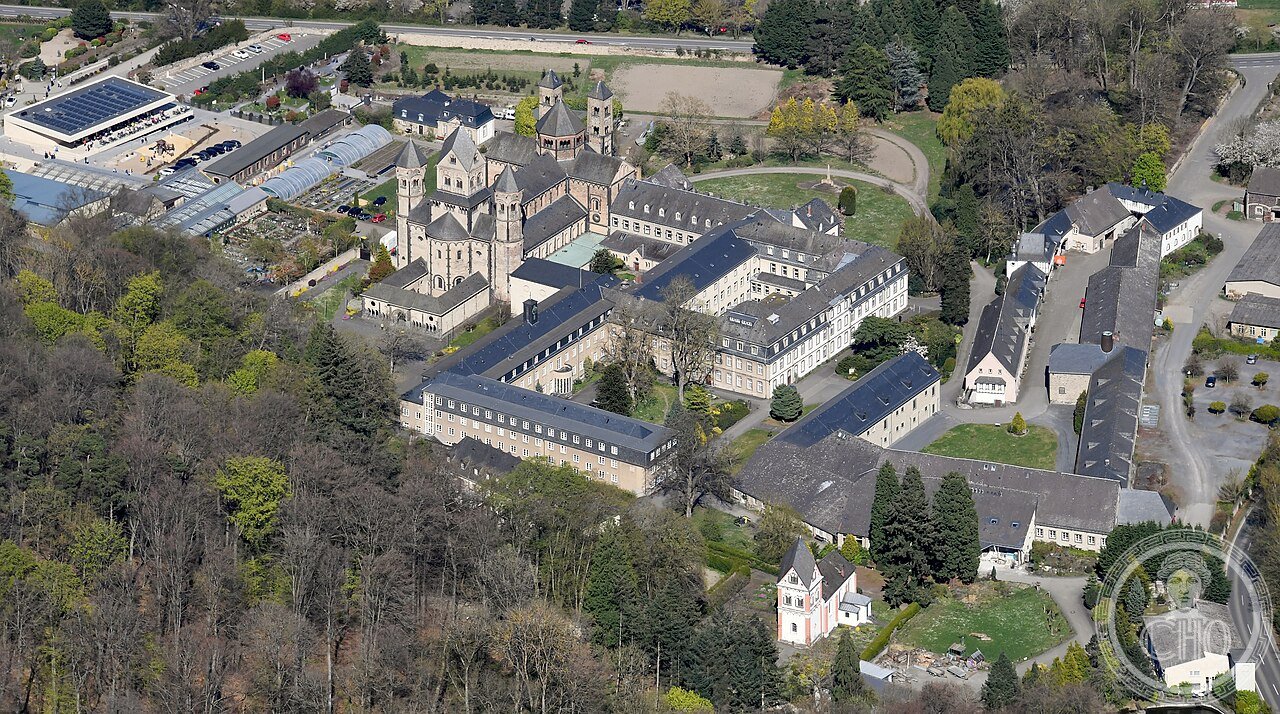
The lake the abbey of Maria Laach looks out over fills the only volcanic caldera in central Europe, formed about 12,900 years ago in a Plinian eruption of magnitude 6, comparable to Pinatubo in 1991, which scattered ash as far as Greece. The volcano is still considered active: bubbles of carbon dioxide still rise from the south-eastern shore of the lake, right below the six Romanesque towers of the Benedictine monastery founded in 1093.
About Maria Laach Abbey
Maria Laach Abbey sits on the southwestern shore of the Laacher See, a volcanic crater lake in Germany’s Eifel region formed by a massive Plinian eruption roughly 12,900 years ago, with a Volcanic Explosivity Index of 6 — comparable in scale to the 1991 eruption of Mount Pinatubo — that scattered ash as far as modern Greece and remains the last major volcanic event on the European continent; the volcano is still considered active today, with carbon dioxide from underlying magma continuing to bubble up along the lake’s southeastern shore. The abbey itself was founded in 1093 as a priory of Affligem Abbey in present-day Belgium, by Heinrich II, the first Count Palatine of the Rhine, and his wife Adelaide of Weimar-Orlamünde, who were unable to have children and chose to dedicate what would have been spent on a daughter’s dowry to founding a monastery across the lake from their own castle. The priory became an independent abbey in 1127 under Abbot Gilbert. Construction of the basilica proceeded between 1093 and 1177, during the Staufen period, producing a distinctive six-towered Romanesque church considered one of the most beautiful surviving examples of the style in Germany; a colonnaded west porch known as the Paradise was added around 1225. The abbey was dissolved during the secularisation of 1802; the Jesuits acquired the site in 1820 and ran a scholarly centre there until their expulsion during the Kulturkampf of the 1870s. Benedictine monks of the Beuronese Congregation took over the monastery in 1892, and it was raised again to the rank of abbey the following year, 1893. In the first half of the 20th century, Maria Laach became a leading centre of the Liturgical Movement within German Catholicism.
Key facts
- The lake: Laacher See, formed by a VEI-6 eruption c. 12,900 years ago, Central Europe’s only volcanic caldera; still considered active
- Foundation: 1093, by Count Palatine Heinrich II of the Rhine and his wife Adelaide, as a priory of Affligem Abbey
- 1127: becomes an independent abbey under Abbot Gilbert
- Architecture: six-towered Romanesque basilica, built 1093-1177; the Paradise west porch added c. 1225
- 1802: dissolved during secularisation; Jesuits present 1820s-1870s
- 1892-1893: Benedictines of the Beuronese Congregation return; raised again to abbey rank
- 20th century: a leading centre of the German Liturgical Movement
History
The stark geological fact that Maria Laach’s founders built one of Germany’s most celebrated Romanesque basilicas directly beside an active volcanic caldera — one whose last major eruption ranks among the most powerful in Central Europe’s history, and which continues today to vent volcanic gas from beneath its own lake — gives the abbey a genuinely unusual physical setting among Europe’s great medieval monasteries, one where the surrounding landscape’s deep geological history is at least as dramatic as the building’s own architectural history. The childless Count Heinrich and Countess Adelaide’s decision to redirect an unused dowry toward monastic foundation reflects a recognisable pattern of aristocratic religious patronage in which the absence of direct heirs became the occasion for substantial ecclesiastical investment.
The abbey’s 20th-century role as a centre of the Liturgical Movement — the influential Catholic reform current that reshaped how the Mass and other rites were understood and eventually celebrated — situates Maria Laach among a small number of monastic houses whose intellectual and pastoral influence extended significantly beyond their own walls into the wider development of 20th-century Catholic worship, well before the broader liturgical reforms of the Second Vatican Council.
What you see
The six-towered Romanesque basilica, built between 1093 and 1177 during the Staufen period, remains remarkably well preserved and is widely regarded as one of the finest Romanesque church buildings in Germany. Its colonnaded west porch, the Paradise, added around 1225, forms an atmospheric courtyard entrance unusual among German Romanesque churches. The abbey’s lakeside setting, directly overlooking the Laacher See’s volcanic caldera, remains one of its most striking visual features, with the six towers reflected in the lake’s still waters.
Practical information
- Opening hours: the basilica is generally open daily; check current hours before visiting; free admission
- Address: Abtei Maria Laach, 56653 Glees, Germany
Getting there
Maria Laach is reachable by car from Koblenz (approximately 30 minutes) in the Eifel region, Rhineland-Palatinate. GPS: 50.4031° N, 7.2524° E.
Nearby
- Laacher See — the volcanic crater lake surrounding the abbey, with walking trails
- Vulkanpark Osteifel — a regional geopark documenting the area’s volcanic history
- Koblenz — approximately 30 minutes away; at the confluence of the Rhine and Moselle rivers
Sources
- Wikipedia — “Maria Laach Abbey” and “Laacher See” (en.wikipedia.org)
- VolcanoDiscovery — “Laacher See Volcano, Germany” (volcanodiscovery.com)
- Visit Koblenz — “Maria Laach: The Volcanic Lake & Monastery” (visit-koblenz.de)
Find it on the map
See this place and what’s around it →📷 Become a Cultural Heritage Online photographer
Share your photos of places: they stay published under your name as the author. The more they're seen, the more you get noticed — and soon a contest will reward the most appreciated photos.
Log in or sign up free to add a photo