

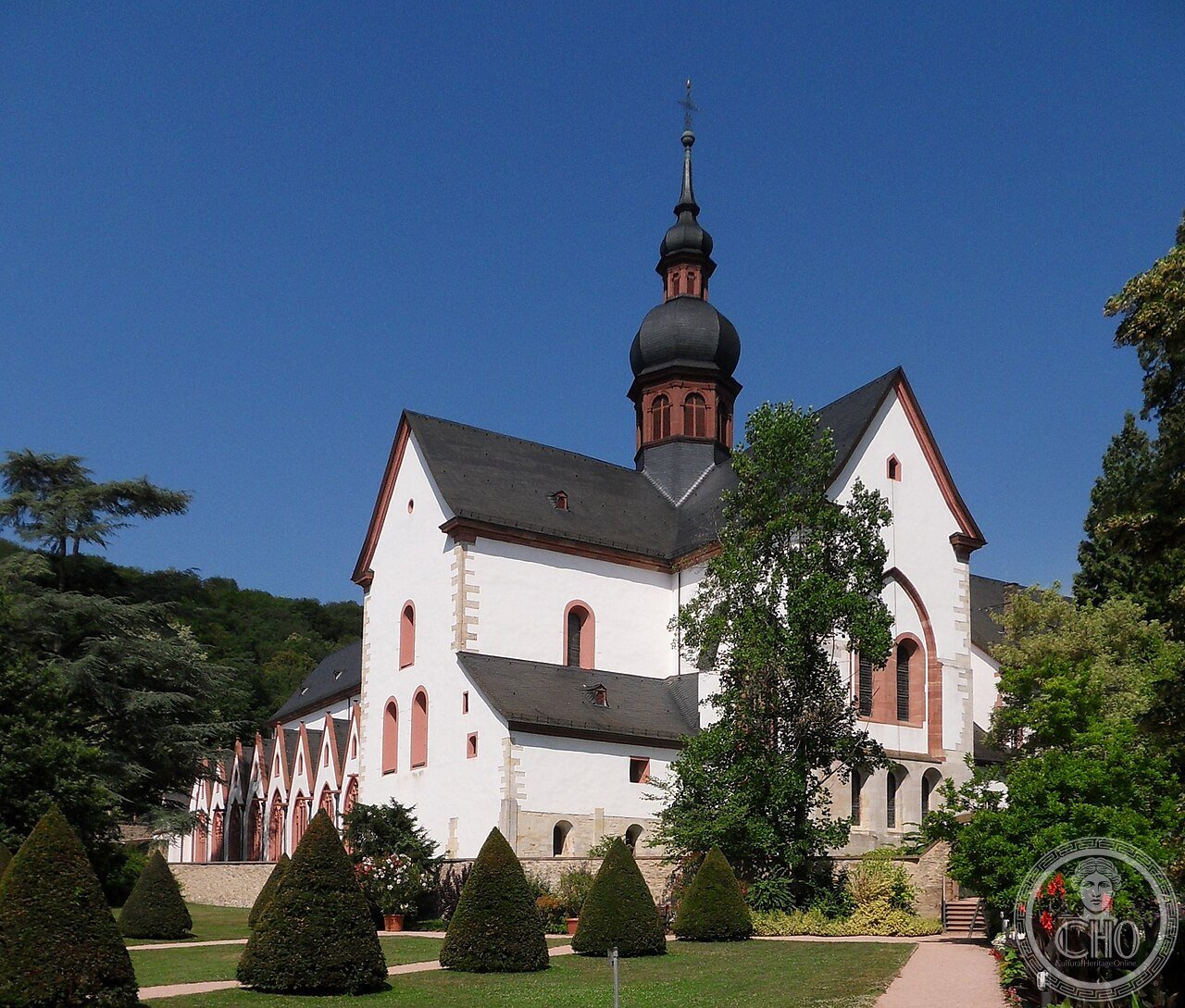
The Cistercian monks planted their first vines at Eberbach in the very year of the foundation, 1136, coming to cultivate three hundred hectares, the largest in medieval Europe. From their “Cabinetkeller”, the cellar set aside for the finest wines, comes the German word “Kabinett” still used today to classify quality wines. In the winter of 1985–1986 its intact Romanesque architecture became the set for the interior scenes of the film The Name of the Rose.
About Eberbach Abbey
A monastic house already existed at Eberbach from 1116, first occupied by Augustinian canons and transferred to Benedictine monks in 1131, before Bernard of Clairvaux founded the Cistercian abbey there in 1136 — the first Cistercian monastery on the eastern bank of the Rhine. Construction progressed through the 12th and 13th centuries, producing a three-aisled Romanesque basilica with transept alongside an increasingly extensive complex of monastic buildings; at its height in the 12th and 13th centuries, the community numbered around 100 monks and more than 200 lay brothers. The monks planted their first vineyards at Eberbach in 1136, the very year of the abbey’s founding, and by the Middle Ages had expanded their holdings to some 300 hectares, then the largest single vineyard estate in Europe, making the abbey one of the wealthiest and most economically significant monasteries in Germany. The abbey’s dedicated “Cabinetkeller,” a cellar reserved for its finest wines, gave rise to the German wine-quality term “Kabinett,” still in official use today. Count Johann IV of Katzenelnbogen introduced Riesling vines to the surrounding Rheingau region while the monks themselves still cultivated red varieties such as Grobrot. The abbey was dissolved on 18 September 1803 following the Reichsdeputationshauptschluss, the sweeping German territorial reorganisation of the era; it later passed into Prussian ownership in 1866, served as an asylum until 1873, and functioned as a prison until 1912. Its exceptionally well-preserved medieval architecture brought it to wider public attention in the winter of 1985-1986, when interior scenes of the film adaptation of Umberto Eco’s “The Name of the Rose” were shot there; since 1988 the abbey has also served as the principal venue of the Rheingau Musik Festival.
Key facts
- 1116-1131: earlier monastic house, first Augustinian, then Benedictine from 1131
- 1136: founded as a Cistercian abbey by Bernard of Clairvaux, first on the Rhine’s eastern bank
- 1136: the monks plant their first vineyards, eventually reaching 300 hectares by the Middle Ages, then Europe’s largest
- Peak community: around 100 monks and over 200 lay brothers, 12th-13th centuries
- “Kabinett”: the German wine-quality term originates from the abbey’s Cabinetkeller
- 1803: dissolved following the Reichsdeputationshauptschluss
- 1866-1912: Prussian property; used as an asylum (to 1873) and prison (to 1912)
- 1985-1986: interior filming location for “The Name of the Rose”; Rheingau Musik Festival venue since 1988
History
Eberbach’s status as the first Cistercian foundation on the eastern bank of the Rhine, combined with its rapid growth into one of medieval Germany’s wealthiest monasteries through wine cultivation, situates the abbey within the broader pattern of Cistercian economic sophistication — the order’s monks were renowned across medieval Europe for applying disciplined agricultural and commercial methods to monastic estates, and Eberbach’s 300-hectare vineyard holding represents one of the most successful examples of this model anywhere on the continent. The survival of the term “Kabinett” in official German wine classification today, directly traceable to the abbey’s own historic cellar practices, is a rare case of a specific medieval monastic institution’s internal vocabulary entering permanent national commercial and legal terminology.
The abbey’s post-dissolution century as Prussian asylum and then prison, followed by its rediscovery as an atmospheric, near-intact medieval film location for “The Name of the Rose,” traces an unusually varied institutional afterlife for a former monastery — few Cistercian houses have moved so directly from confining the mentally ill and incarcerated to hosting a major international literary film adaptation and, subsequently, a prestigious classical music festival.
What you see
The three-aisled Romanesque basilica with its transept remains the abbey’s architectural centrepiece, its interiors preserved with unusual completeness for a medieval monastic church of this scale. Surrounding monastic buildings, including dormitories and cellars, retain much of their original medieval fabric, a rarity that made the site especially valuable as a film location. The estate’s vineyards, still cultivated today, extend across the surrounding Rheingau hillsides, continuing an unbroken viticultural tradition dating to the abbey’s 1136 founding.
Practical information
- Opening hours: generally open daily, check current hours before visiting; admission fee applies
- Address: Kloster Eberbach, 65346 Eltville am Rhein, Germany
Getting there
Kloster Eberbach is reachable by car from Wiesbaden (approximately 20 minutes) in the Rheingau region, Hesse. GPS: 50.0420° N, 8.0480° E.
Nearby
- Eltville am Rhein — the nearby Rhine-side town, known for its own wine estates
- Rheingau wine region — the vineyard landscape surrounding the abbey
- Wiesbaden — approximately 20 minutes away; Hesse’s state capital
Sources
- Wikipedia — “Eberbach Abbey” (en.wikipedia.org)
- Kloster Eberbach — official site, “History” (kloster-eberbach.de)
- Europe Up Close — “Ora et Labora: The Vineyard Monastery of Eberbach, Germany” (europeupclose.com)
Find it on the map
See this place and what’s around it →📷 Become a Cultural Heritage Online photographer
Share your photos of places: they stay published under your name as the author. The more they're seen, the more you get noticed — and soon a contest will reward the most appreciated photos.
Log in or sign up free to add a photo