

In 1631 the central tower of the abbey church suddenly collapsed, damaging every adjoining part while leaving the cloister and the conventual buildings untouched. Only in 1969 did the monks find the answer: a tithe barn of the thirteenth to fifteenth century, from a village in the Eure, was taken apart and rebuilt inside the monastic enclosure, becoming the new abbey church, consecrated in 1970.
About Saint-Wandrille Abbey
Saint-Wandrille Abbey (Fontenelle Abbey) was founded in 649 by Saint Wandrille on a Gallo-Roman estate granted by King Clovis II. Wandrille, a member of the royal family of Austrasia who had held a high position at the court of his kinsman Dagobert I, chose instead to devote his life to God, retiring first to the abbey of Montfaucon-d’Argonne in Champagne in 629 before returning to Normandy in 648 to establish the monastery of Fontenelle, following the Rule of Saint Columbanus, which he had encountered at Bobbio in Italy. Wandrille’s first Carolingian-style basilica, dedicated to Saint Peter and nearly 300 feet (91 metres) long, was consecrated by Saint Ouen in 657. This original church was destroyed by fire in 756 and rebuilt by Abbot Ansegisus (823-833), who added a narthex and tower. Across its long history, the abbey suffered three major periods of destruction: Viking raids in the 9th century, the Wars of Religion in the 16th century, and the French Revolution in 1790. In 1631, the church’s central tower suddenly collapsed, ruining all the adjacent structures without, remarkably, damaging the cloisters or conventual buildings — leaving the community without a proper abbey church for centuries. Joseph Pothier, the scholar credited with reconstituting authentic Gregorian chant, was elected abbot of Saint-Wandrille in 1898, becoming its first abbot since the French Revolution and its first regular abbot since the 16th century. The buildings suffered further damage from bombing in 1944, with reconstruction lasting from 1948 to 1957. Finally, in 1969, a 13th-to-15th-century seigniorial tithe barn from the hamlet of Canteloup in the Eure department was relocated into the monastery enclosure and rebuilt according to plans by Marion Tournon-Branly, becoming the new abbey church, dedicated on 12 September 1970.
Key facts
- Foundation: 649, by Saint Wandrille, on land granted by King Clovis II
- First church: consecrated 657 by Saint Ouen; destroyed by fire 756, rebuilt 823-833
- Three destructions: Viking raids (9th century), Wars of Religion (16th century), French Revolution (1790)
- 1631: central tower collapse ruined the church without damaging the cloisters
- 1898: Joseph Pothier, restorer of Gregorian chant, becomes abbot, the first since the 16th century
- 1944: bombing damage; reconstruction 1948-1957
- 1969-1970: a 13th-15th-century tithe barn from Eure relocated and rebuilt as the new abbey church
History
Saint Wandrille’s own biography — a high-ranking Austrasian royal courtier who deliberately abandoned political power for monastic life — situates his foundation within the broader Merovingian-era pattern of aristocratic religious renunciation, in which figures with genuine access to secular power chose instead to found or join monastic communities, often bringing with them substantial royal patronage (in Wandrille’s case, Clovis II’s own land grant) that gave their new foundations immediate material advantage over more humbly founded contemporary monasteries. The abbey’s three distinct waves of destruction across thirteen centuries — Viking, religious-war, and revolutionary — make Saint-Wandrille a particularly comprehensive case study in the recurring vulnerability of major French monastic institutions to successive very different historical forces.
The 1969 solution to the abbey’s centuries-long lack of a proper church — relocating an entire late-medieval tithe barn from a different department and rebuilding it stone by stone as the new abbey church — represents a genuinely unusual and resourceful act of architectural adaptive reuse, giving the modern monastic community a genuinely medieval structure, albeit one built for an entirely different original agricultural purpose, as its functioning place of worship. Joseph Pothier’s tenure as abbot, arriving as the community’s first regular abbot in over three centuries and bringing his own scholarly reconstruction of authentic Gregorian chant directly to Saint-Wandrille’s daily liturgical practice, connects the abbey to one of the most significant developments in modern Catholic liturgical music history.
What you see
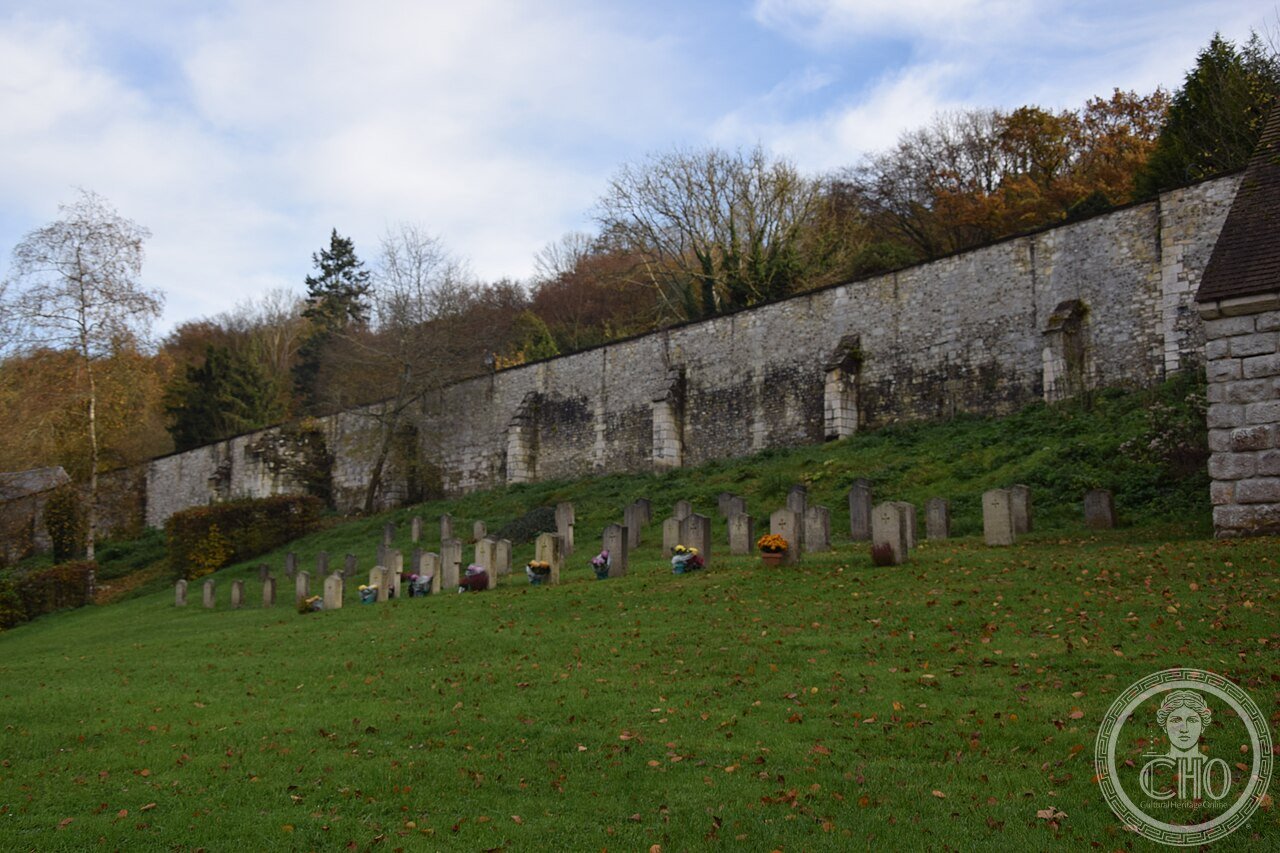
The ruins of the original Saint-Pierre abbey church, standing within a cemetery setting following the 1631 tower collapse and subsequent destructions, offer visitors a poignant physical record of the community’s long architectural misfortune. The relocated 13th-15th-century tithe barn, now serving as the functioning abbey church since 1970, gives visitors a genuinely unusual example of adaptive medieval architectural reuse. The abbey’s continuing active Benedictine community, following Joseph Pothier’s Gregorian chant revival tradition, situates Saint-Wandrille as a living monastery with a distinctive musical-liturgical heritage.
Practical information
- Opening hours: generally open daily, check current hours before visiting; free admission to the church, guided tours of the ruins available
- Address: Route d’Étaintot, 76490 Saint-Wandrille-Rançon, France
Getting there
Saint-Wandrille-Rançon is reachable by car from Rouen (approximately 30 minutes) in the Seine-Maritime department, Normandy, along the Seine river. GPS: 49.5301° N, 0.7678° E.
Nearby
- Jumièges Abbey — another major Seine-valley Benedictine abbey, within reach
- Rouen — approximately 30 minutes away; Normandy’s historic capital
- Caudebec-en-Caux — a nearby Seine-side town
Sources
- Wikipedia — “Abbey of Saint Wandrille” (en.wikipedia.org)
- Abbaye Saint-Wandrille — official portal, “History of the Abbey of Saint-Wandrille” (st-wandrille.com)
- National Catholic Register — “14 Centuries of Faith: How Benedictine Monks Are Reviving Their Ancient Abbey” (ncregister.com)
Find it on the map
See this place and what’s around it →📷 Become a Cultural Heritage Online photographer
Share your photos of places: they stay published under your name as the author. The more they're seen, the more you get noticed — and soon a contest will reward the most appreciated photos.
Log in or sign up free to add a photo