

According to legend, during the burial of Christ, Nicodemus gathered some particles of his blood and entrusted them to his nephew Isaac, who hid them in two lead phials inside the trunk of a fig tree, then cast into the sea. The trunk floated from the Mediterranean to the coast of the Pays de Caux, where it came ashore at Fécamp: the reputed relic of the Precious Blood made the abbey one of the chief pilgrimage centres of medieval Normandy.
About Fécamp Abbey
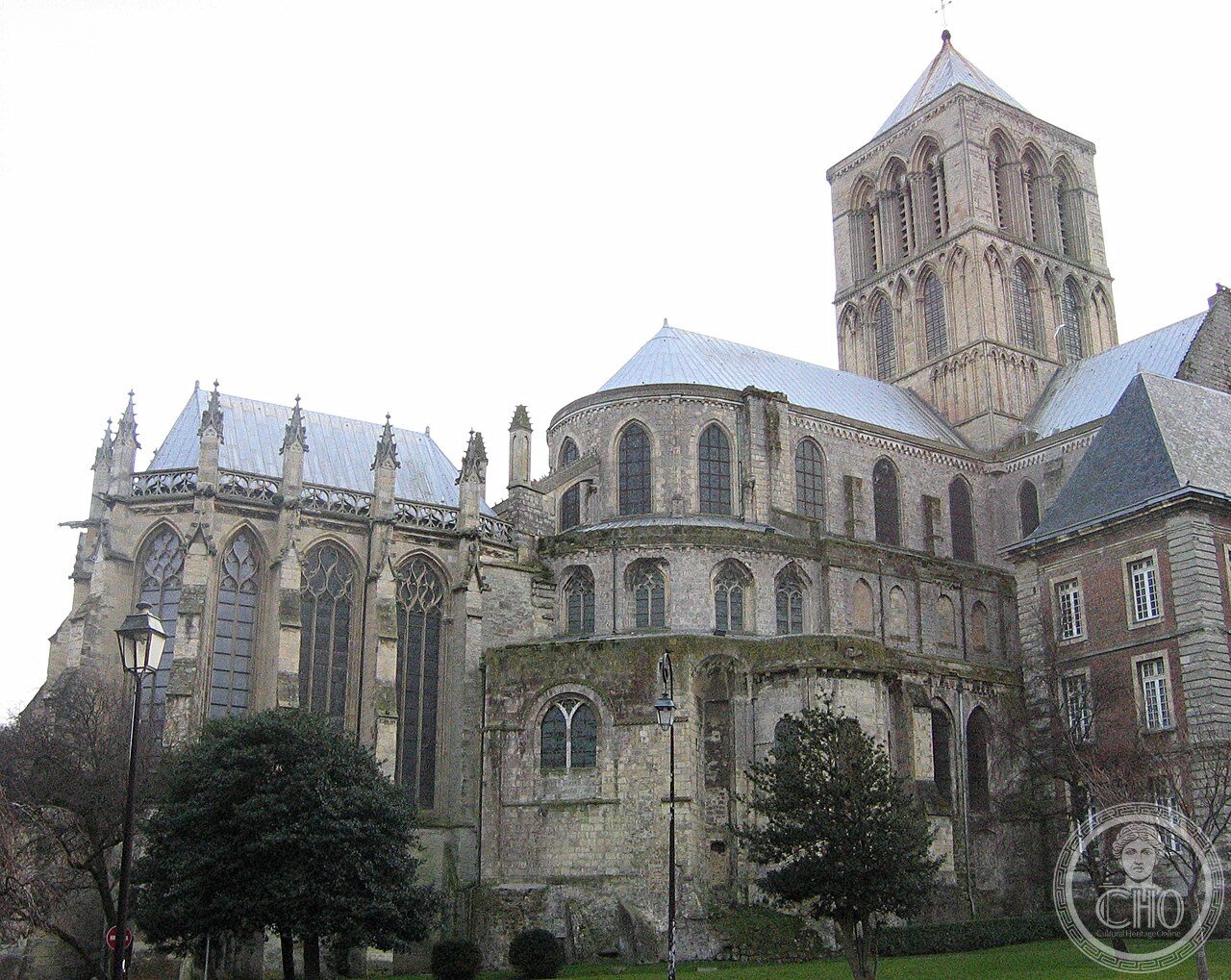
The Abbey of the Holy Trinity at Fécamp, in Seine-Maritime, Upper Normandy, traces its earliest origins to around 658, when the Merovingian count Waningus founded a nunnery on the site — destroyed by the Vikings in 841 — and a separate convent nearby in 660, near the site of the future Precious Blood relic, destroyed by the Vikings in 842. The community’s transformation into a major Benedictine institution began in 990, when Richard I, Duke of Normandy, ordered the construction of a collegiate church opposite his own ducal residence; in 1001, under his successor Richard II, the collegiate church was converted into a full Benedictine abbey, welcoming its first abbot, Guillaume de Volpiano. Fécamp’s medieval fame rested substantially on its claimed relic of the Precious Blood: according to legend, during Christ’s burial, Nicodemus collected particles of his blood, entrusting them to his nephew Isaac, who concealed the relic — preserved in two lead ampoules — inside the trunk of a fig tree before casting it into the sea; the wood is said to have floated all the way from the Mediterranean to the shores of the Pays de Caux, washing ashore at Fécamp itself, which became a major pilgrimage centre on the strength of this reputed relic. The present abbey church, dedicated to the Holy Trinity, was built between 1175 and 1220 using the cream-coloured stone of Caen, its superb lantern tower — 60 metres high — added in 1250; at 127 metres long, the church rivals Notre-Dame de Paris in scale. Generously endowed by Richard II, the abbey prospered throughout the 12th and 13th centuries as an “abbey nullius” (exempt from ordinary episcopal jurisdiction), possessing three subordinate abbeys (Bernay, Évreux, and Blangy in Artois), some 30 parish churches, and extensive landholdings across France, England, and Spain. The abbey church also holds the tombs of several Dukes of Normandy from the 13th and 14th centuries, and the site is historically recognised as the first producer of Bénédictine, the herbal brandy-based liqueur that takes its name directly from the abbey’s monastic tradition.
Key facts
- Earliest foundation: c. 658-660, by Count Waningus; destroyed by Vikings 841-842
- Benedictine refoundation: 1001, under Duke Richard II; first abbot Guillaume de Volpiano
- Precious Blood relic: legendary fig-tree relic of Christ’s blood, said to have floated from the Mediterranean to Fécamp
- Church construction: 1175-1220, Caen stone; lantern tower (60m) added 1250
- Scale: 127 metres long, comparable to Notre-Dame de Paris
- Status: “abbey nullius,” exempt from ordinary episcopal jurisdiction; owned 3 subordinate abbeys and c. 30 parish churches
- Ducal tombs: several Dukes of Normandy, 13th-14th centuries
- Bénédictine liqueur: historically traced to the abbey’s monastic tradition
History
The Precious Blood relic legend, with its specific narrative of Mediterranean-to-Norman-coast maritime transport inside a floating fig tree, situates Fécamp within the broader medieval European tradition of miraculous relic-arrival narratives, in which a sacred object’s supernatural journey to a specific site — rather than any documented human transport — provided divine legitimation for a shrine’s claimed possession, a pattern distinct from but functionally comparable to the more deliberate human relic transfers documented at sites like Conques or Fleury. The relic’s specific attribution to Nicodemus and his nephew Isaac gives the Fécamp legend an unusually elaborate biblical genealogy extending the story’s authority directly back to named New Testament witnesses of Christ’s burial.
Fécamp’s status as an “abbey nullius” under direct Norman ducal patronage, combined with its extensive cross-Channel and even Iberian landholdings, situates the abbey within the broader pattern of major Norman monastic institutions whose territorial reach expanded dramatically following the 1066 Conquest of England — Fécamp’s English properties reflecting the same cross-Channel ecclesiastical network visible at Marmoutier’s own post-Conquest English church patronage. The abbey’s later historical association with Bénédictine liqueur, still produced and marketed today under a name directly invoking the monastic tradition, gives Fécamp a continuing commercial and cultural presence entirely independent of its medieval religious history.
What you see
The Precious Blood relic and its dedicated chapel remain the abbey’s essential pilgrimage-historical destination, connecting visitors to the legendary fig-tree narrative. The Gothic abbey church itself, at 127 metres rivalling Notre-Dame de Paris in scale, with its 60-metre lantern tower added in 1250, offers visitors a major example of early Norman Gothic architecture. The ducal tombs of several Dukes of Normandy add a further dimension of medieval political history to the site.
Practical information
- Opening hours: generally open daily, check current hours before visiting; free admission
- Address: Rue Fontaine, 76400 Fécamp, France
Getting there
Fécamp has direct rail connections from Rouen (approximately 1 hour). By car, Fécamp sits on the Normandy coast in the Seine-Maritime department. GPS: 49.7553° N, 0.3814° E.
Nearby
- Palais Bénédictine — the ornate distillery and museum where Bénédictine liqueur is produced, a short walk away
- Fécamp cliffs and harbour — the Normandy coastline surrounding the town
- Étretat — the famous chalk cliffs, a short distance along the coast
Sources
- Wikipedia — “Fécamp Abbey” (en.wikipedia.org)
- Office de Tourisme de Fécamp — “The Abbey of the Holy Trinity” (en.fecamptourisme.com)
- History Hit — “Fecamp Abbey” (historyhit.com)
Find it on the map
See this place and what’s around it →📷 Become a Cultural Heritage Online photographer
Share your photos of places: they stay published under your name as the author. The more they're seen, the more you get noticed — and soon a contest will reward the most appreciated photos.
Log in or sign up free to add a photo