
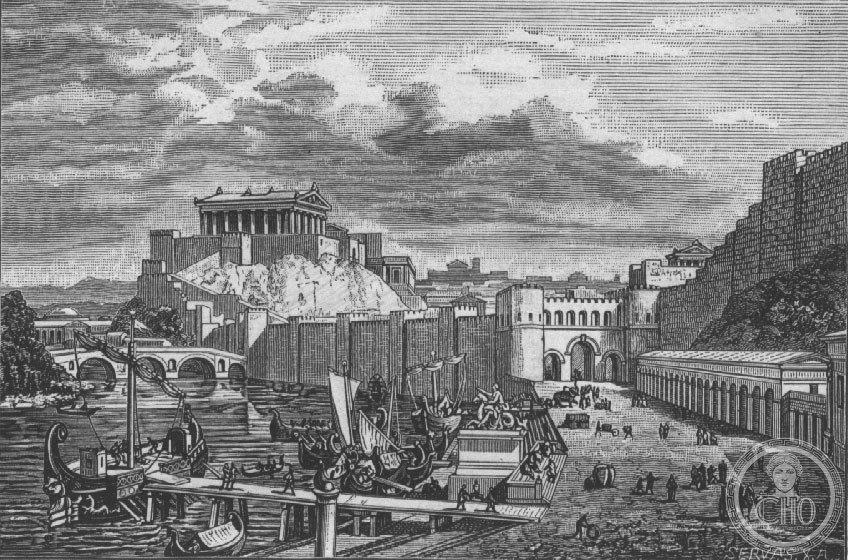
Piazza del Campidoglio is the crowning public space of the Capitoline Hill — the most celebrated of Rome’s seven hills and the symbolic heart of Roman civic power since antiquity. Designed by Michelangelo in the sixteenth century at the command of Pope Paul III and constructed largely after the artist’s death, the trapezoidal piazza is flanked by the Palazzo Senatorio and the twin Palazzi dei Conservatori and Nuovo, which together house the Capitoline Museums — the world’s oldest public museums, established in 1471. The composition, with its oval pavement design radiating from a central bronze equestrian statue of Marcus Aurelius, is one of the masterworks of Western urban design.
At a glance
- Type
- Renaissance civic square; museum complex
- Period
- Ancient hilltop site; Michelangelo’s design commissioned c.1536; construction completed 17th century
- Style
- Renaissance — Mannerist spatial composition with classical orders; oval pavement (1940 realisation of Michelangelo’s original design)
- Location
- Capitoline Hill (Campidoglio), Rome, Lazio · 41.8933° N, 12.4828° E
Overview
Piazza del Campidoglio occupies the summit of the Capitoline Hill, positioned between the Roman Forum to the south-east and the Campus Martius to the north. The square was designed by Michelangelo in the sixteenth century at the behest of Pope Paul III, who sought to restore imperial grandeur to a hilltop that had fallen into disrepair since antiquity. The three palaces framing the piazza were redesigned or completed according to Michelangelo’s plans by subsequent architects, with the cordonata (the wide ramped staircase leading up from Piazza d’Aracoeli) forming one of Rome’s most dramatic architectural promenades.
The Capitoline Museums, distributed across the Palazzo dei Conservatori and the Palazzo Nuovo, contain collections of extraordinary breadth: the original bronze equestrian Marcus Aurelius (the copy stands in the piazza), the Capitoline Wolf, the Dying Gaul, and vast holdings of Roman portrait sculpture and inscriptions.
The Palazzo Senatorio at the piazza’s head remains the seat of Rome’s municipal government, maintaining an unbroken tradition of civic administration on this hill stretching back to the Roman Republic.
History
The Capitoline Hill was the religious and political apex of ancient Rome, site of the Temple of Jupiter Optimus Maximus — the greatest temple of the Roman state — and the Arx, the citadel. Following the decline of Rome and the medieval centuries, the hill became pasture and quarry, and the ruins of its ancient buildings were buried or dismantled for building material.
Pope Paul III commissioned Michelangelo in 1536, prompted by the impending visit of Holy Roman Emperor Charles V, who would process through Rome in triumph. The project aimed to transform a neglected hilltop into a setting worthy of imperial pageantry and to reaffirm papal Rome’s claim to the heritage of the ancient city. Michelangelo’s design, recorded in an engraving by Étienne Dupérac (1569), guided construction long after the artist’s death in 1564.
The oval pavement with its twelve-pointed star design — arguably the most distinctive element of the composition — was not realised until 1940. The placement of the ancient bronze equestrian Marcus Aurelius at the centre (moved from the Lateran) gave the composition a classical anchor and allowed the piazza to function simultaneously as Renaissance design, ancient monument, and civic statement.
What you see
Approaching from the cordonata, the visitor ascends between the colossal statues of Castor and Pollux to arrive at the piazza’s open ellipse, dominated by the replica Marcus Aurelius at its geometric centre. The Palazzo Senatorio closes the view ahead with its double staircase and bell tower; the matching Palazzo dei Conservatori and Palazzo Nuovo frame the sides, their facades articulated by Michelangelo’s giant order of pilasters — an early use of this device in Rome.
The interior of the Capitoline Museums extends through both lateral palaces and is connected underground, allowing visitors to move between collections without crossing the piazza. The original bronze Marcus Aurelius is displayed inside the Palazzo dei Conservatori in a climate-controlled glass hall that also contains fragments of the colossal statue of Constantine.
From the piazza’s edge, the view over the Roman Forum to the Colosseum offers one of Rome’s defining urban panoramas — a sight that has drawn artists, architects, and travellers since the Renaissance.
Cultural significance
Piazza del Campidoglio represents a pivotal moment in Western urban design: Michelangelo’s use of the trapezoidal form, the giant order, and the converging perspective lines to create a unified spatial experience from disparate pre-existing buildings influenced civic square design across Europe for centuries. The project demonstrated that a modern architect could engage with ancient Rome not by imitation but by creative transformation.
The Capitoline Museums, inaugurated in 1471 when Pope Sixtus IV donated a group of ancient bronzes to the Roman people, are the world’s oldest public art museums — a precedent for the public museum as civic institution that spread across Europe during the Enlightenment. The hill thus functions simultaneously as ancient sacred site, Renaissance masterpiece, and birthplace of the museum idea.
Practical information
- Address
- Piazza del Campidoglio, 00186 Roma RM, Italy
- Piazza
- Open to the public at all hours; free access
- Capitoline Museums
- Tuesday–Sunday 09:30–19:30 (last entry 18:30); closed Mondays and 1 January, 1 May, 25 December
- Admission
- Museum ticket required; check the official Capitoline Museums website for current prices and online booking
Getting there
The Capitoline Hill is in the centre of Rome. The nearest Metro station is Colosseo (Line B), a 10-minute walk via the Roman Forum. Buses serve Piazza Venezia (a 5-minute walk); from there the cordonata is immediately visible. Tram line 8 stops at Piazza Venezia. No parking is available in the immediate area; Rome’s ZTL restricted traffic zone covers the historic centre. Visitors arriving by car should use park-and-ride facilities on the periphery or at Villa Borghese.
Sources & resources
- Wikipedia: Piazza del Campidoglio
- Capitoline Museums official site: museicapitolini.org
- Cultural Heritage Online — Italian and world heritage guides
See the place
Find it on the map
See this place and what’s around it →Historical events at this place (8)
- 2021 Rioni di Roma: X Rione Campitelli dal Campidoglio a Piazza Campitelli
- 2021 Rioni di Roma: X Rione Campitelli dal Campidoglio a Piazza Campitelli
- 2021 Il Campidoglio
- 2021 Il Campidoglio
- 2022 Le Statue Parlanti
- 2025 Omogirando la mostra ‘I Farnese nella Roma del Cinquecento’
- 2017 Passeggiando per i 7 Colli di Roma: Campidoglio
- 2017 I luoghi di Michelangelo a Roma, passeggiata
📷 Become a Cultural Heritage Online photographer
Share your photos of places: they stay published under your name as the author. The more they're seen, the more you get noticed — and soon a contest will reward the most appreciated photos.
Log in or sign up free to add a photoIs this page about you?
This page is read by travellers and heritage enthusiasts who find it on Google. Tell us how you are connected to this place and we will take it from there.