
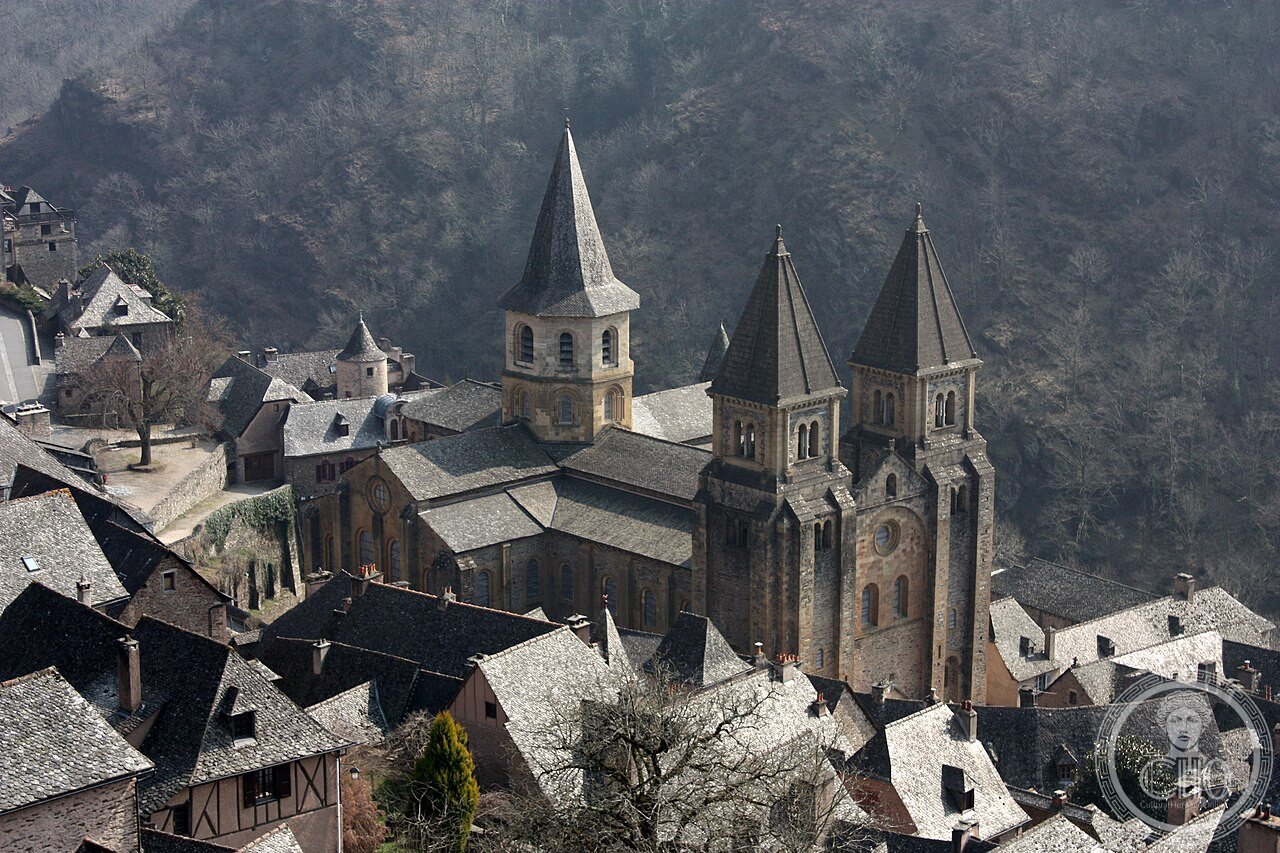
Nell’866, dopo più tentativi falliti, i monaci di Conques riuscirono infine a impossessarsi del cranio di Santa Fede, custodito ad Agen: un monaco vi si era infiltrato per quasi un decennio, fingendosi devoto religioso locale, prima di sottrarre la reliquia. Il furto spostò l’intero flusso di pellegrini da Agen a Conques, imponendo la ricostruzione di una chiesa ben più grande.
About Conques Abbey
The original monastery building at Conques was an 8th-century oratory built by monks fleeing the Saracen advance in Spain; in 819, Louis the Pious formally endowed the house and placed it under his royal protection. The abbey’s medieval fortunes were transformed by an act of calculated relic theft in 866: a monk from Conques, after multiple failed attempts to steal the relics of Saint Vincent of Saragossa and Saint Vincent Pompejac at Agen, spent nearly a decade posing as a loyal monk within the Agen community specifically to gain access to the relics of Sainte Foy (Saint Faith), a young woman martyred in the 4th century — he finally succeeded in retrieving her head in 866. The main draw for medieval pilgrims at Conques quickly became these very relics, and the arrival of Sainte Foy caused the wider pilgrimage route to shift decisively from Agen to Conques; the original chapel was demolished in the 11th century specifically to make way for a much larger church capable of receiving the resulting influx of pilgrims. The abbey’s treasury is dominated by the golden reliquary statue of Sainte Foy, an object dating from the 9th to 10th centuries that shelters the saint’s actual skullcap and is considered one of the five greatest surviving works of medieval goldsmith’s art in all of Europe — the only piece in France displaying so many surviving elements from the High Middle Ages in a single object. During the French Revolution, with local faith still running deep, the villagers of Conques themselves quietly “looted” the abbey treasury, hiding its various treasures in their own cellars and barns until government agents left the area, before returning everything intact to the abbey.
Key facts
- Origins: 8th-century oratory, built by monks fleeing Spain; endowed by Louis the Pious in 819
- Relic theft: 866, after a nearly decade-long infiltration of the Agen community, monks of Conques stole the head of Sainte Foy
- Pilgrimage shift: the theft redirected the pilgrimage route from Agen to Conques, requiring a larger 11th-century church
- Golden reliquary of Sainte Foy: 9th-10th century, holding the saint’s skullcap; one of the five greatest medieval goldsmith works in Europe
- French Revolution: villagers hid the treasury in their homes and barns, later returning it intact to the abbey
History
The deliberate, decade-long theft of Sainte Foy’s relics represents one of the best-documented examples of medieval “furta sacra” (holy theft) — a recognised phenomenon in which monasteries competed for the prestige and pilgrimage revenue that possessing significant saintly relics generated, sometimes resorting to calculated deception or outright theft to acquire them from rival institutions. Conques’s specific success in redirecting the pilgrimage route away from Agen through this theft demonstrates just how directly a medieval monastery’s economic and religious fortunes could hinge on possessing the right relics, transforming a modest mountain oratory into a major pilgrimage destination requiring an entirely new, much larger church within decades of the theft’s success.
The golden reliquary statue’s survival as one of only five comparable masterworks of medieval European goldsmith art, and the sole French example retaining so many High Medieval elements intact, owes directly to the Conques villagers’ quiet Revolutionary-era resistance — their decision to personally hide the treasury rather than surrender it to Revolutionary confiscation and likely melting-down represents a remarkable act of grassroots historical preservation, driven by genuine local devotion to Sainte Foy rather than any official institutional protection, and directly explains why this particular treasury survived intact when so many comparable French ecclesiastical treasures were destroyed during the same period.
What you see
The golden reliquary statue of Sainte Foy, in the abbey treasury, is the essential single destination, its 9th-10th century goldsmith work offering visitors direct access to one of Europe’s rarest surviving High Medieval artistic treasures. The Romanesque church itself, rebuilt in the 11th century specifically to accommodate the pilgrimage traffic the relic theft generated, gives visitors a legible architectural record of the abbey’s medieval prosperity. Conques’s setting within its small, largely unchanged medieval village adds further historical atmosphere to any visit.
Practical information
- Opening hours: generally open daily, check current hours before visiting; admission fee for the treasury
- Address: Impasse de l’Abbatiale, 12320 Conques, France
Getting there
Conques is reachable by car from Rodez (approximately 40 minutes) in Aveyron, Occitanie. The village itself is largely pedestrian, built on a steep hillside. GPS: 44.5992° N, 2.3981° E.
Nearby
- Conques village — a well-preserved medieval hillside village surrounding the abbey
- Rodez — approximately 40 minutes away; Aveyron’s capital, with its own significant cathedral
- Camino de Santiago (Via Podiensis) — Conques remains an active stage on the pilgrimage route to Santiago de Compostela
Sources
- Wikipedia — “Abbey Church of Sainte-Foy” and “Saint Faith” (en.wikipedia.org)
- Office de tourisme Conques-Marcillac — “Conques – The Treasure” (tourisme-conques.fr)
- Atlas Obscura — “St. Foy’s Golden Reliquary in Conques” (atlasobscura.com)
Find it on the map
See this place and what’s around it →📷 Become a Cultural Heritage Online photographer
Share your photos of places: they stay published under your name as the author. The more they're seen, the more you get noticed — and soon a contest will reward the most appreciated photos.
Log in or sign up free to add a photo