
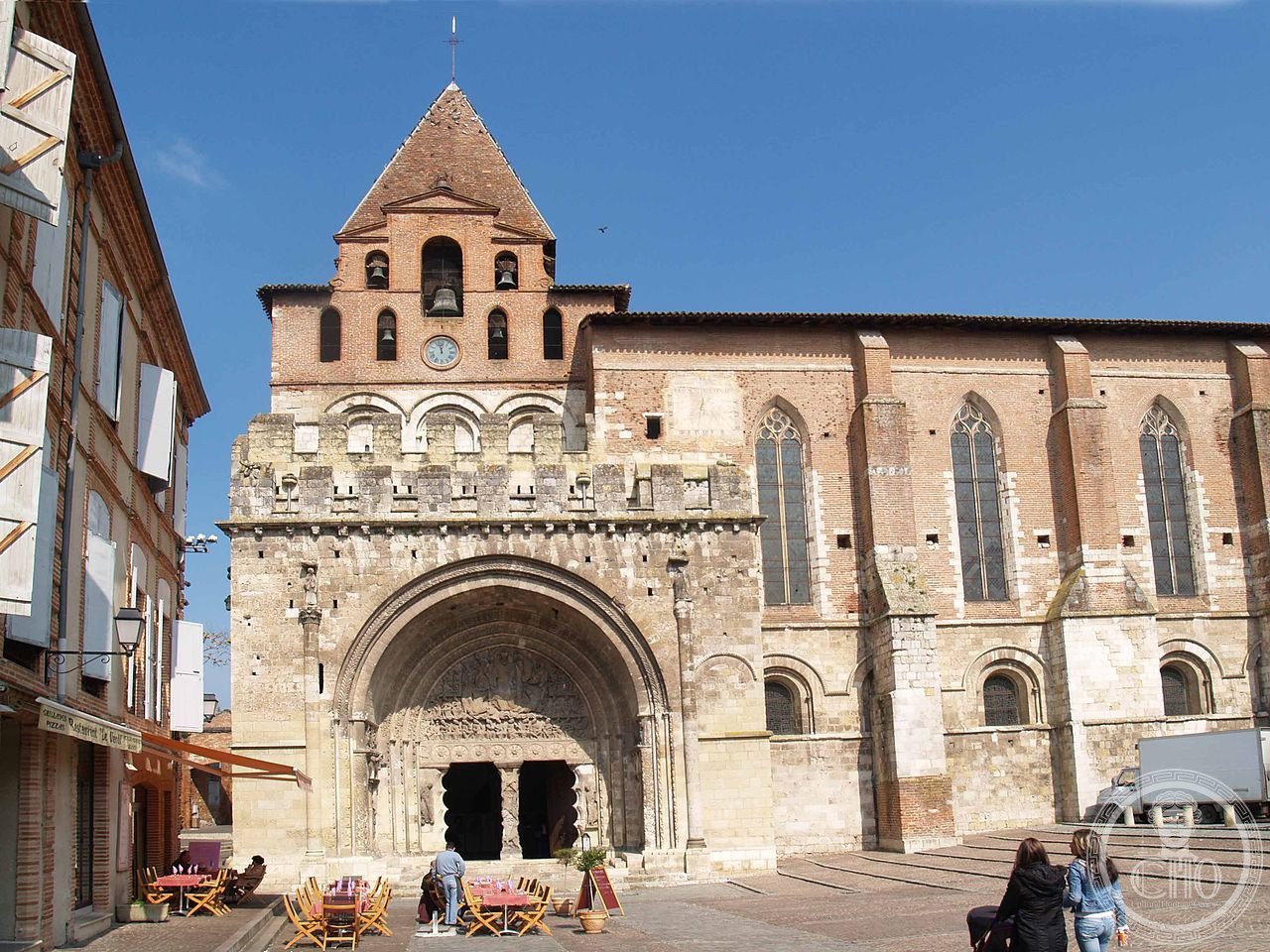
The tympanum of the south portal shows the return of Christ at the end of time, enthroned, majestic, surrounded by the twenty-four elders of the Apocalypse according to Saint John. The abbey cloister, among the largest and best preserved of the Romanesque period, holds seventy-six capitals carved with biblical scenes and fantastical creatures on eight piers.
About Moissac Abbey
Saint-Pierre Abbey in Moissac, a Benedictine and later Cluniac monastery in Tarn-et-Garonne in southwestern France, has a debated founding history: legend attributes its foundation to the Frankish king Clovis in 506, though historical evidence points instead to Saint Didier, Bishop of Cahors, in the middle of the 7th century. The abbey’s affiliation with Cluny and its adoption of the Cluniac Reforms transformed its fortunes: papal support, its position directly on the pilgrim road to Santiago de Compostela, building restoration, and the reforms themselves combined to make Moissac one of the most powerful abbeys in France — by the 12th century, its abbot ranked second in seniority within the entire Cluniac hierarchy, behind only the abbot of Cluny itself. The abbey’s south portal tympanum, one of the most celebrated works of Romanesque sculpture anywhere, depicts Christ’s return at the end of time, enthroned majestically at the centre and blessing the world, illustrating chapter IV of the Apocalypse according to Saint John amid the twenty-four Elders. The cloister ranks among the largest and best-preserved from the entire Romanesque period, its eight pillars and 76 sculpted capitals displaying remarkable diversity and richness of decoration, depicting biblical scenes and mythical creatures. For nearly a thousand years, religious communities have lived at Saint-Pierre Abbey, and in 1998 the site was inscribed on the UNESCO World Heritage List as part of the Routes of Santiago de Compostela in France, its cloister capitals and church portal specifically recognised within that designation.
Key facts
- Founding: legendarily 506 by Clovis; historically more likely mid-7th century, by Saint Didier of Cahors
- Cluniac affiliation: adopted the Cluniac Reforms, becoming one of France’s most powerful abbeys; abbot ranked second only to Cluny’s own abbot by the 12th century
- South portal tympanum: depicts Christ enthroned amid the 24 Elders of the Apocalypse, illustrating Revelation chapter IV
- Cloister: 8 pillars, 76 sculpted Romanesque capitals depicting biblical scenes and mythical creatures
- UNESCO status: inscribed 1998, as part of the Routes of Santiago de Compostela in France
- Continuous religious presence: nearly 1,000 years
History
Moissac’s transformation from a modest early medieval foundation into one of France’s most powerful abbeys, achieved through its adoption of the Cluniac Reforms and its strategic position directly on the pilgrim road to Santiago de Compostela, illustrates how a monastery’s fortunes could be dramatically reshaped by combining the right institutional affiliation with the right geographic position along a major medieval pilgrimage route — the abbot’s eventual seniority second only to Cluny itself reflects just how successfully Moissac capitalised on both factors simultaneously. The south portal tympanum’s specific Apocalyptic iconography, showing Christ enthroned amid the 24 Elders, situates Moissac’s sculptural programme within the broader tradition of major Romanesque pilgrimage church portals using dramatic, theologically sophisticated imagery to instruct and awe the arriving pilgrims for whom such portals often represented their first encounter with the church’s interior sanctity.
The cloister’s 76 individually sculpted capitals, combining biblical narrative with fantastical creature imagery across eight supporting pillars, represent one of the most extensive and technically accomplished single bodies of Romanesque sculptural decoration to survive largely intact, giving art historians an unusually comprehensive record of 12th-century sculptural technique and iconographic range within a single unified building campaign. The 1998 UNESCO inscription, recognising Moissac specifically within the broader Santiago de Compostela pilgrimage routes designation rather than as a standalone monument, situates the abbey within an internationally coordinated framework of medieval pilgrimage infrastructure recognition spanning multiple countries along the historic routes to Spain.
What you see
The south portal tympanum, with its Apocalyptic vision of Christ enthroned amid the 24 Elders, is one of the most celebrated single works of Romanesque sculpture in Europe and the essential first stop for any visitor. The cloister’s 76 sculpted capitals reward slow, methodical viewing pillar by pillar, each capital offering a distinct biblical or fantastical scene. The building’s overall Romanesque architecture, product of centuries of Cluniac-era investment, gives visitors a comprehensive sense of the abbey’s medieval prosperity and artistic ambition.
Practical information
- Opening hours: generally open daily, check current hours before visiting; admission fee for the cloister
- Address: Place Roger Delthil, 82200 Moissac, France
Getting there
Moissac has direct rail connections from Toulouse (approximately 1 hour) and Bordeaux (approximately 2 hours). By car, Moissac sits on the A62 motorway network in Tarn-et-Garonne. GPS: 44.1054° N, 1.0848° E.
Nearby
- Moissac old town — surrounding the abbey, at the confluence of the Tarn and Garonne rivers
- Canal de Garonne — a historic canal passing near Moissac, with a notable canal bridge (pont-canal)
- Toulouse — approximately 1 hour away; the “Pink City,” with its own major Romanesque churches
Sources
- Wikipedia — “Moissac Abbey” (en.wikipedia.org)
- Abbaye de Moissac — official portal, “Saint-Pierre abbey” (abbayemoissac.com)
- Tourisme Moissac — “Moissac Abbey: a nugget of Occitania, Compostela and UNESCO” (tourisme-moissac-terresdesconfluences.fr)
Find it on the map
See this place and what’s around it →📷 Become a Cultural Heritage Online photographer
Share your photos of places: they stay published under your name as the author. The more they're seen, the more you get noticed — and soon a contest will reward the most appreciated photos.
Log in or sign up free to add a photo