
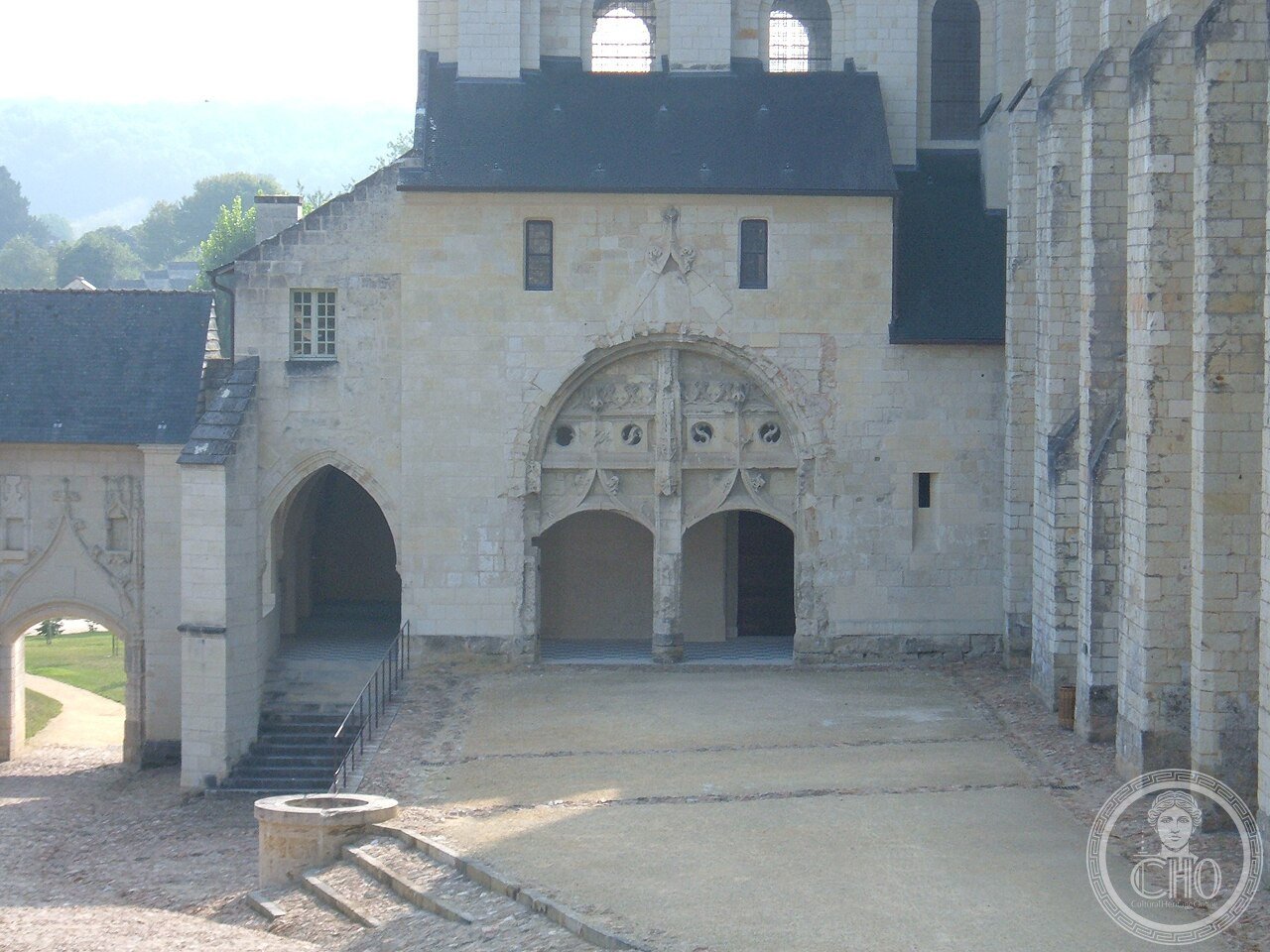
At the heart of the dynasty’s lands, Fontevraud became from 1189 the royal necropolis of the Plantagenets: Henry II, Eleanor of Aquitaine and Richard the Lionheart rest here. Before her death in 1204 it was Eleanor herself who commissioned the polychrome stone effigies for her own tomb and for those of her husband and her son — meaning to make Fontevraud, for the Plantagenets, what Saint-Denis was for the Capetians.
About Fontevraud Abbey
Fontevraud Abbey, in the Pays de la Loire region of France, was founded in 1101 by Robert d’Arbrissel. In the 12th century, the abbey stood within territory then held by the King of England, and successive English rulers became major benefactors of the community. Situated at the heart of Plantagenet territory, Fontevraud became the dynasty’s royal necropolis from 1189, ultimately holding the tombs of Henry II, Eleanor of Aquitaine, and Richard the Lionheart. For Eleanor, Fontevraud was meant to become for the Plantagenets what the Basilica of Saint-Denis represented for the Capetian kings of France: a royal necropolis symbolising the power of her own dynasty. After burying her husband Henry II there, Eleanor also buried her son Richard the Lionheart at the abbey in 1199, following his death; before her own death in 1204, she personally commissioned the polychrome tufa-stone recumbent effigies (gisants) for her own tomb and those of Henry II and Richard. This dynastic necropolis status directly reflected the emergence of the short-lived but genuinely vast Plantagenet “empire,” which took shape following Eleanor’s 1152 marriage to Henry II — between them, for roughly fifty years, the couple controlled territory stretching from the southern borders of Scotland to the Pyrenees. Although Fontevraud once held the actual royal remains, the bodies are believed to have been destroyed during the French Revolution; Richard’s heart and entrails, following his own specific wishes, had been buried separately at Rouen and Châlus respectively.
Key facts
- Foundation: 1101, by Robert d’Arbrissel
- Plantagenet necropolis: from 1189, following Henry II’s burial there
- Royal tombs: Henry II (d. 1189), Eleanor of Aquitaine (d. 1204), Richard the Lionheart (d. 1199)
- Tomb effigies: polychrome tufa-stone gisants, commissioned by Eleanor herself before her 1204 death
- Plantagenet “empire”: arising from Eleanor’s 1152 marriage to Henry II, territory from Scotland to the Pyrenees for roughly 50 years
- French Revolution: the actual royal remains believed destroyed; Richard’s heart (Rouen) and entrails (Châlus) buried separately, per his own wishes
History
Eleanor of Aquitaine’s deliberate ambition to make Fontevraud a Plantagenet equivalent to the Capetian royal necropolis at Saint-Denis reflects the sophisticated dynastic self-presentation strategies employed by one of medieval Europe’s most politically consequential women — Eleanor, successively Queen of France and then Queen of England through her two marriages, used her final years to actively shape how her own dynasty’s power and legitimacy would be remembered and commemorated across future generations. The Plantagenet “empire” itself, uniting England with vast French territories through Eleanor and Henry II’s marriage, represented one of medieval Europe’s most geographically extensive and politically complex composite monarchies, its eventual fragmentation under Henry’s sons setting the stage for centuries of subsequent Anglo-French conflict.
The French Revolution’s destruction of the actual royal remains at Fontevraud, while the commissioned tomb effigies themselves survived, illustrates a broader pattern in which Revolutionary iconoclasm specifically targeted the physical bodies and burial sites of the old monarchy as symbols of the discredited Ancien Régime, even when the surviving artistic monuments commemorating those same monarchs were sometimes preserved as historical or artistic artefacts distinct from the objectionable remains themselves. Richard the Lionheart’s own specific burial arrangements — heart at Rouen, entrails at Châlus (where he died), body at Fontevraud — reflect a genuinely distinctive medieval practice of dividing a monarch’s remains across multiple symbolically significant locations, each site claiming its own partial connection to the deceased ruler.
What you see
The polychrome tomb effigies of Henry II, Eleanor of Aquitaine, and Richard the Lionheart, commissioned by Eleanor herself, are the abbey’s essential single destination, offering visitors direct visual access to one of medieval Europe’s most historically significant royal funerary monuments. The abbey’s Romanesque-Gothic architecture, spanning its long institutional history from 1101 onward, gives the complex a substantial architectural record. The site’s continuing role as a major cultural venue in the Loire valley extends its significance well beyond its medieval royal history.
Practical information
- Opening hours: generally open daily, check current hours before visiting; admission fee
- Address: Fontevraud-l’Abbaye, 49590, France
Getting there
Fontevraud-l’Abbaye is reachable by car from Saumur (approximately 15 minutes) in the Loire valley. The nearest major rail station is Saumur, with onward bus or taxi connections. GPS: 47.1814° N, 0.0379° E.
Nearby
- Saumur — approximately 15 minutes away; a historic Loire town with its own château
- Château de Chinon — a short drive away; a major Plantagenet fortress, where Henry II died
- Loire valley châteaux — numerous UNESCO-listed castles within easy reach
Sources
- Fontevraud.fr — official abbey portal, “The tombstones of Fontevraud, the royal necropolis of the Plantagenets” (fontevraud.fr)
- World History Encyclopedia — “The Royal Tombs of Fontevraud Abbey” (worldhistory.org)
- Atlas Obscura — “Fontevraud Abbey” (atlasobscura.com)
Find it on the map
See this place and what’s around it →📷 Become a Cultural Heritage Online photographer
Share your photos of places: they stay published under your name as the author. The more they're seen, the more you get noticed — and soon a contest will reward the most appreciated photos.
Log in or sign up free to add a photo