

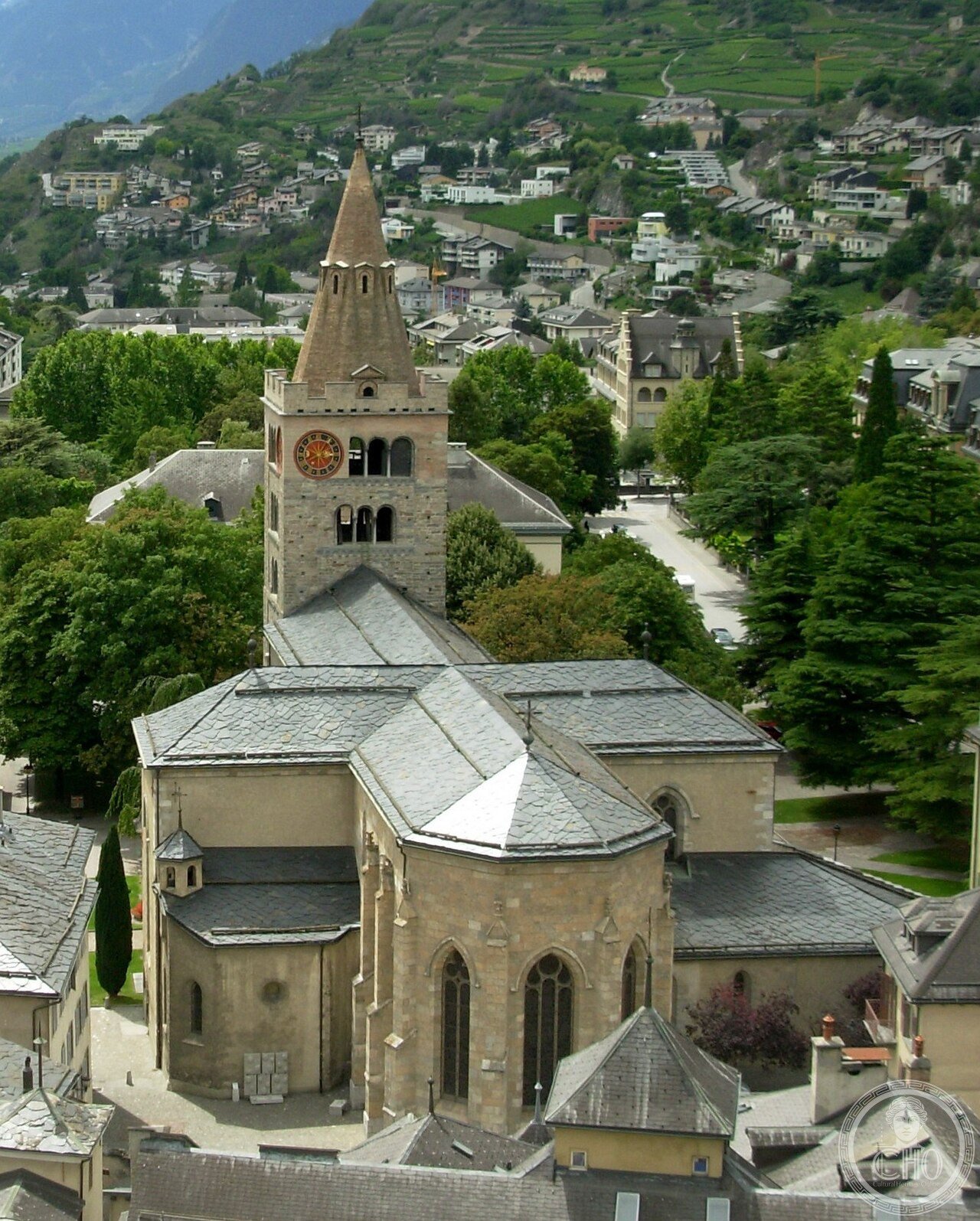
Three earlier buildings lie one on top of the other beneath the present Gothic cathedral: a Carolingian church of the eighth or ninth century, a Romanesque cathedral of the eleventh century still in use into the fifteenth, and finally the Gothic cathedral commissioned by the bishops Walter Supersaxo, Jost de Silenen and Nicolas Schiner between the end of the fifteenth and the beginning of the sixteenth century — making it, paradoxically, the youngest medieval cathedral in all of Switzerland.
About Sion Cathedral
Sion Cathedral (Cathédrale Notre-Dame de Sion), also known as Notre-Dame du Glarier — a name referring to the alluvial terrain on which it stands — traces a layered building history spanning several distinct architectural phases on the same site. From the 8th-9th centuries, a Carolingian church stood here; in the 11th century, this was replaced by a Romanesque cathedral that remained in use, with modifications, until the 15th century. Around the late 12th or early 13th century, a powerful bell tower-porch was added in front of the western facade, its first level featuring a rounded-arch portal with a painted tympanum characteristic of Alpine Romanesque buildings with strong Lombard influence; the tower’s upper level and brick spire were added later, around the mid-15th century. The current Gothic cathedral was then constructed in the late 15th and early 16th centuries, built directly on the foundations of the Romanesque church, under bishops Walter Supersaxo (1457-1482), Jost de Silenen (1482-1496), and Nicolas Schiner (1496-1499) — making Sion, despite its ancient origins, the youngest medieval cathedral in Switzerland. Sion itself developed as the political and religious centre of the Valais region after the late 10th century, when Rudolph III, the last King of Upper Burgundy, granted the County of Valais to Bishop Hugo (998-1017), combining spiritual and secular power in the Prince-Bishops of Sion, who ranked among the most powerful nobles in the Upper Rhône valley — their residence at nearby Tourbillon Castle facing the separate hilltop basilica of Valère across the town.
Key facts
- Carolingian church: 8th-9th centuries, the earliest documented structure on the site
- Romanesque cathedral: 11th century, in use with modifications until the 15th century
- Bell tower-porch: late 12th/early 13th century, rounded-arch portal with Lombard-influenced Romanesque style; upper level and spire added mid-15th century
- Present Gothic cathedral: built late 15th-early 16th century over the Romanesque foundations, under bishops Walter Supersaxo, Jost de Silenen, and Nicolas Schiner
- Distinction: the youngest medieval cathedral in Switzerland
- Name origin: “Notre-Dame du Glarier,” referring to the alluvial (“glarier”) ground it stands on
- Prince-Bishops of Sion: combined spiritual and secular rule over Valais from 998, residing at Tourbillon Castle
History
Bishop Hugo’s 998 grant of the County of Valais from Rudolph III of Upper Burgundy established one of medieval Europe’s more durable prince-bishoprics, combining religious and secular authority in a single office that made the Bishop of Sion the dominant political figure across the Upper Rhône valley for centuries — a dual authority reflected physically in Sion’s distinctive two-hill townscape, with the cathedral serving the town below while the Prince-Bishop’s own residence at Tourbillon Castle faced the cathedral chapter’s separate seat at Valère across the valley. The cathedral’s own layered construction history — Carolingian, then Romanesque, then Gothic, each phase built directly atop its predecessor’s foundations — gives Sion’s present building a genuinely multi-century archaeological depth beneath its comparatively late Gothic surface.
The cathedral’s paradoxical status as Switzerland’s “youngest” medieval cathedral, despite standing on a site with Carolingian-era Christian use, illustrates how a location’s documented religious continuity and its visible architectural age can diverge considerably — Sion’s present Gothic fabric dates almost entirely to a single, relatively brief late-15th to early-16th-century building campaign, even though the site itself had already served as a cathedral for roughly seven centuries by that point. The involvement of three successive bishops (Supersaxo, Silenen, Schiner) in completing this campaign reflects how major cathedral rebuilding projects frequently outlasted any single episcopal tenure, requiring sustained institutional commitment across multiple bishoprics to reach completion.
What you see
The Romanesque bell tower-porch, with its Lombard-influenced rounded-arch portal and painted tympanum, offers visitors direct access to the site’s oldest surviving above-ground architectural layer. The Gothic nave and choir, product of the late-15th to early-16th-century rebuilding, give the cathedral its present overall character. The wider two-hill townscape of Sion, with Tourbillon Castle and the Valère basilica visible from the cathedral precinct, situates the building within the broader physical geography of the historic Prince-Bishopric.
Practical information
- Opening hours: generally open daily, check current hours before visiting; free admission
- Address: Rue de la Cathédrale, 1950 Sion, Switzerland
Getting there
Sion has direct rail connections from Lausanne (approximately 50 minutes) and Geneva (approximately 1.5 hours). By car, Sion sits on the A9 motorway in the Rhône valley, Valais. The cathedral stands in the old town below Valère and Tourbillon. GPS: 46.2340° N, 7.3594° E.
Nearby
- Valère Basilica — on the hill above town, former seat of the cathedral chapter, with one of the oldest playable organs in the world
- Tourbillon Castle — the ruined 13th-century residence of the Prince-Bishops, on the opposite hill
- Sion old town — the historic centre surrounding the cathedral
Sources
- Wikipedia — “Sion Cathedral” and “Valère Basilica” (en.wikipedia.org)
- Diocèse de Sion — “Cathédrale de Sion” (diocese-sion.ch)
- Discovr — “Cathédrale Notre-Dame de Sion: plus jeune cathédrale médiévale” (discovr.ch)
Find it on the map
See this place and what’s around it →📷 Become a Cultural Heritage Online photographer
Share your photos of places: they stay published under your name as the author. The more they're seen, the more you get noticed — and soon a contest will reward the most appreciated photos.
Log in or sign up free to add a photo