
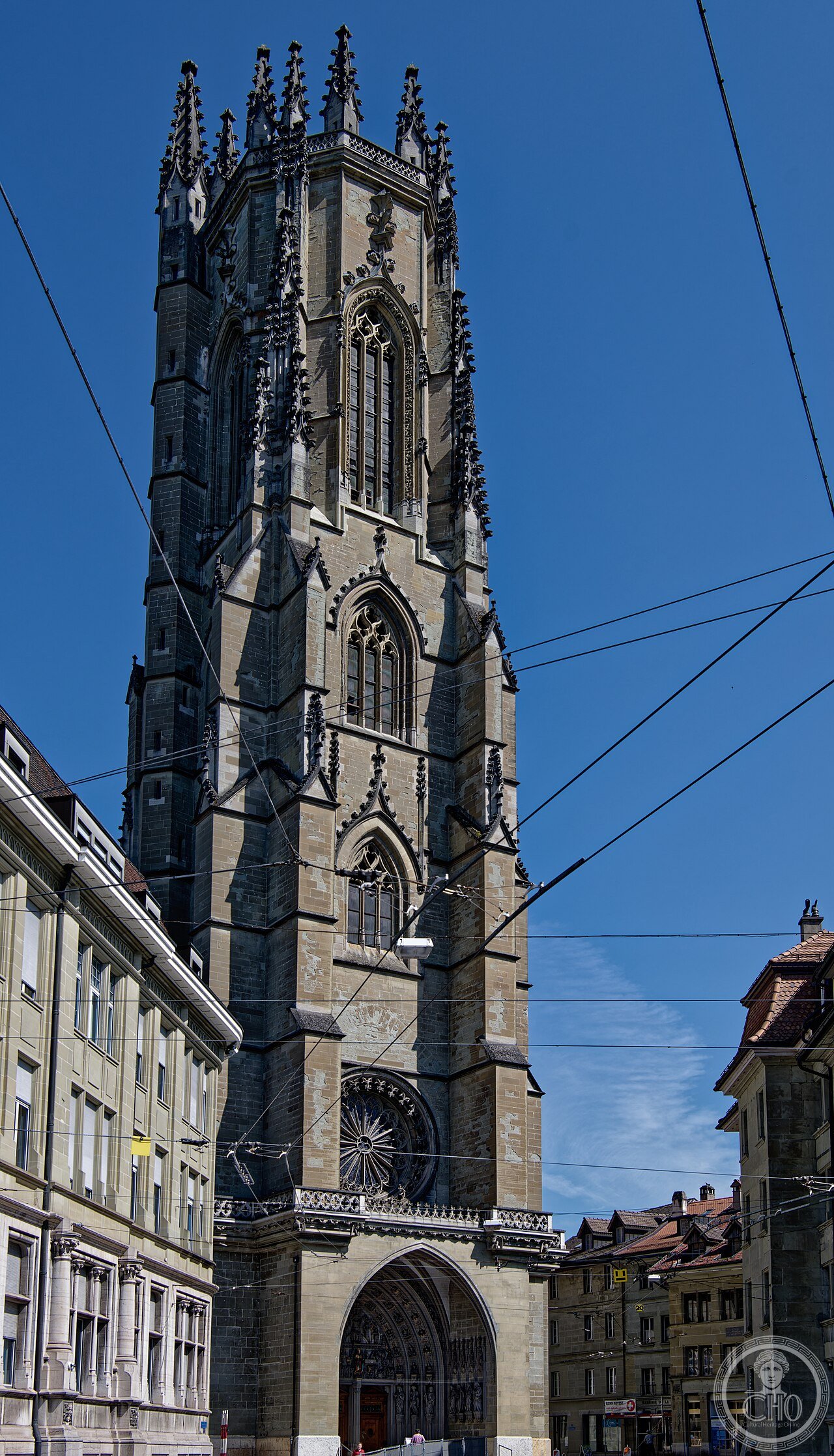
Built between 1283 and 1490 in Gothic style on a site commanding the city, the cathedral of Saint Nicholas preserves on its main portal, raised around 1380, a fifteenth-century tympanum with the Last Judgement. Between 1896 and 1936 the Polish painter Józef Mehoffer designed its windows, today one of the most important ensembles of Art Nouveau stained glass in Europe.
About Fribourg Cathedral
Fribourg Cathedral (Cathédrale Saint-Nicolas), the episcopal seat of the Diocese of Lausanne, Geneva and Fribourg, was built between 1283 and 1490 in Gothic style, occupying an elevated position overlooking the city. Its bell tower, added in the 15th century, rises 74-76 metres and can be climbed via 365 steps, rewarding visitors with panoramic views over Fribourg. The cathedral’s main portal, erected around 1380, is adorned with a bas-relief tympanum depicting the Last Judgment, its 15th-century sculptures showing Christ as judge flanked by saints and angels, with contrasting scenes of the damned and the elect. The organs, built between 1824 and 1834 by local organ-maker Aloys Mooser, combine classical and Romantic characteristics. Between 1896 and 1936, the Polish painter Józef Mehoffer designed the cathedral’s stained-glass windows, which today form one of the most important complete ensembles of Art Nouveau church stained glass anywhere in Europe.
Key facts
- Construction: 1283-1490, Gothic style, on an elevated site overlooking Fribourg
- Bell tower: added in the 15th century, 74-76 metres tall, climbable via 365 steps
- Main portal: erected c. 1380, with a 15th-century Last Judgment tympanum
- Organs: built 1824-1834 by Aloys Mooser, combining Classical and Romantic features
- Stained glass: designed 1896-1936 by Polish painter Józef Mehoffer; one of the most important complete Art Nouveau church glass ensembles in Europe
- Diocesan role: seat of the Diocese of Lausanne, Geneva and Fribourg
History
The roughly two-century span of Fribourg Cathedral’s original Gothic construction (1283-1490) reflects the substantial, sustained civic and ecclesiastical investment the growing city of Fribourg committed to its principal church across multiple generations, the eventual 15th-century tower completion crowning a building project that had already occupied the city’s resources for well over a century by that point. The Last Judgment tympanum’s iconographic programme, contrasting the saved and the damned around Christ as judge, situates Fribourg’s portal within the standard medieval Gothic tradition of using cathedral entrance sculpture as public moral instruction for a largely illiterate congregation, its specific c. 1380-1400s dating placing it within the broader wave of comparable Last Judgment portal sculpture visible at numerous Gothic cathedrals across the same period.
Józef Mehoffer’s four-decade stained-glass commission (1896-1936) situates Fribourg Cathedral within a comparatively rare category of major Gothic churches whose windows were substantially replaced or newly created not in the medieval period itself but during the Art Nouveau era, giving the building an unusual and historically significant combination: a genuinely medieval Gothic structure and portal sculpture paired with an internationally significant body of early-20th-century decorative glass. Mehoffer’s own reputation as one of Poland’s leading Art Nouveau artists gives Fribourg’s windows particular international art-historical weight, extending the cathedral’s significance well beyond purely Swiss or Catholic devotional history into the broader European Art Nouveau movement.
What you see
Józef Mehoffer’s Art Nouveau stained-glass windows, installed across four decades from 1896 to 1936, are the cathedral’s most internationally significant feature, rewarding visitors specifically interested in early-20th-century decorative glass art. The Last Judgment tympanum on the main portal offers a classic example of Gothic moral-instructional sculpture. The 365-step tower climb rewards visitors with panoramic views over Fribourg’s old town and the surrounding Sarine river valley.
Practical information
- Opening hours: generally open daily, check current hours before visiting; small fee for the tower climb
- Address: Rue de la Cathédrale-Saint-Nicolas 7, 1700 Fribourg, Switzerland
Getting there
Fribourg has direct rail connections from Bern (approximately 25 minutes) and Lausanne (approximately 50 minutes). By car, Fribourg sits on the A12 motorway network. The cathedral stands in the old town above the Sarine river. GPS: 46.8062° N, 7.1632° E.
Nearby
- Fribourg old town — a well-preserved medieval quarter surrounding the cathedral
- Pont de Berne and Sarine river — the historic bridge and river below the old town
- Bern — approximately 25 minutes by train
Sources
- Wikipedia — “Fribourg Cathedral” (en.wikipedia.org)
- Fribourg.ch — “St-Nicholas Cathedral” (fribourg.ch)
- Lonely Planet — “Cathédrale St Nicolas de Fribourg” (lonelyplanet.com)
Find it on the map
See this place and what’s around it →📷 Become a Cultural Heritage Online photographer
Share your photos of places: they stay published under your name as the author. The more they're seen, the more you get noticed — and soon a contest will reward the most appreciated photos.
Log in or sign up free to add a photo