
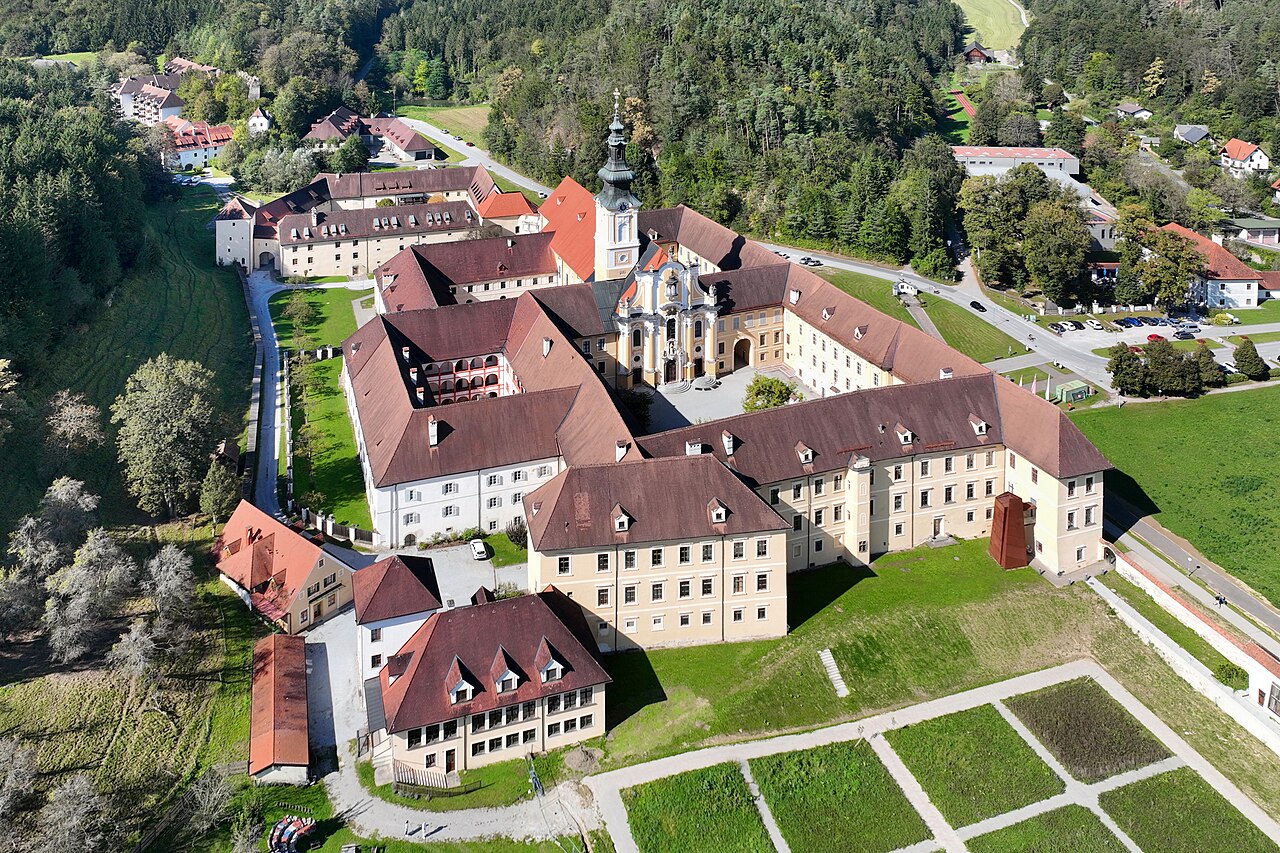
Founded in 1129 by Margrave Leopold the Strong of Styria, Rein was the thirty-eighth Cistercian monastery ever established. All thirty-seven earlier foundations have been dissolved over the centuries: Rein remains the only Cistercian monastery in the world still in existence, without interruption, on the same site — save for a brief Nazi requisition during the Second World War, with the monks returning in 1945.
About Rein Abbey
Rein Abbey (Stift Rein), a Cistercian monastery in Rein near Gratwein in Styria, is known as the “Cradle of Styria” (Wiege der Steiermark) and holds the distinction of being the oldest surviving Cistercian community in the world. It was founded in 1129 by Margrave Leopold the Strong of Styria and settled by monks from Ebrach Abbey in Bavaria under the abbey’s first abbot, Gerlacus. Rein was the 38th Cistercian monastery ever founded — the previous 37 have all since been dissolved, leaving Rein as the sole surviving example of the order’s earliest wave of foundations. The abbey has remained a continuously functioning Cistercian community on the same site ever since, its only interruption a brief wartime exile: the Nazi regime confiscated the premises and evicted the monks during World War II, with the community able to return in 1945. The abbey’s library holds more than 100,000 items, including 390 manuscripts and 150 incunabula. Restoration work in 2006 led to archaeological excavations that uncovered the foundations of the abbey’s former Romanesque chapter house, along with a number of graves — including that of the founder himself, Margrave Leopold I of Styria.
Key facts
- Foundation: 1129, by Margrave Leopold the Strong of Styria; settled by monks from Ebrach Abbey, Bavaria, under first abbot Gerlacus
- Significance: the 38th Cistercian monastery founded, and the oldest surviving Cistercian community in the world (the previous 37 have all been dissolved)
- Continuity: uninterrupted on the same site except for Nazi confiscation during WWII; monks returned in 1945
- Library: over 100,000 items, including 390 manuscripts and 150 incunabula
- 2006 excavations: uncovered the former Romanesque chapter house foundations and several graves, including that of founder Leopold I
- Nickname: “Cradle of Styria” (Wiege der Steiermark)
History
Rein’s status as the sole survivor among the Cistercian order’s first 38 foundations gives it a genuinely exceptional position within the broader history of European monasticism: the Cistercian order’s rapid 12th-century expansion produced dozens of new houses across Europe within just a few decades of Cîteaux’s own 1098 founding, yet the accumulated pressures of the Reformation, Napoleonic-era secularisation, and 20th-century political upheaval eventually dissolved every other member of that earliest cohort, leaving Rein as an unusually direct, unbroken living link to the order’s founding generation. The abbey’s specific designation as the “Cradle of Styria” reflects its deep entanglement with the region’s own early political and territorial formation under the Margraves of Styria, whose foundation of Rein represented both genuine religious patronage and a deliberate act of territorial and dynastic consolidation.
The brief but real disruption of Rein’s otherwise continuous existence during the Nazi era — confiscation and eviction of the monastic community, followed by return in 1945 — situates the abbey within the broader pattern of Catholic religious institutions across Austria and Germany facing direct persecution and property seizure under National Socialist rule, making Rein’s specific wartime interruption a notable exception within an otherwise genuinely unbroken 890-year institutional history. The 2006 archaeological discovery of founder Leopold I’s own grave beneath the abbey grounds gives modern visitors and scholars a direct physical connection to the 1129 founding moment, recovered through careful restoration-linked excavation rather than through any continuously known burial tradition.
What you see
The abbey library, with its 390 manuscripts and 150 incunabula among more than 100,000 total items, offers visitors direct access to centuries of Cistercian manuscript culture. The excavated Romanesque chapter house foundations, uncovered in 2006, and founder Leopold I’s rediscovered grave connect the site physically to its 1129 origins. The abbey’s continuing status as a functioning Cistercian monastery, its community only briefly and forcibly interrupted during WWII, gives Rein a genuinely rare unbroken institutional identity among the order’s earliest foundations.
Practical information
- Opening hours: generally open daily during the visitor season, check current hours before visiting; admission fee for guided tours
- Address: Stift Rein 1, 8103 Gratwein-Straßengel, Austria
Getting there
Rein Abbey is reachable by regional bus from Graz (approximately 30 minutes). By car, Rein sits just off the A9 motorway near Graz, Styria. GPS: 47.1351° N, 15.2860° E.
Nearby
- Graz — approximately 30 minutes away; Styria’s capital, with its own UNESCO World Heritage old town
- Mariatrost Basilica — another significant pilgrimage church near Graz
- Gratwein-Straßengel parish church — a notable Gothic church in the immediate area
Sources
- Wikipedia — “Rein Abbey, Austria” (en.wikipedia.org)
- Steiermark Tourismus — “Cistercian Monastery Rein in Gratwein-Straßengel” (steiermark.com)
- Velvet Escape — “Rein Abbey: a magnificent monastery near Graz” (velvetescape.com)
Find it on the map
See this place and what’s around it →📷 Become a Cultural Heritage Online photographer
Share your photos of places: they stay published under your name as the author. The more they're seen, the more you get noticed — and soon a contest will reward the most appreciated photos.
Log in or sign up free to add a photo