
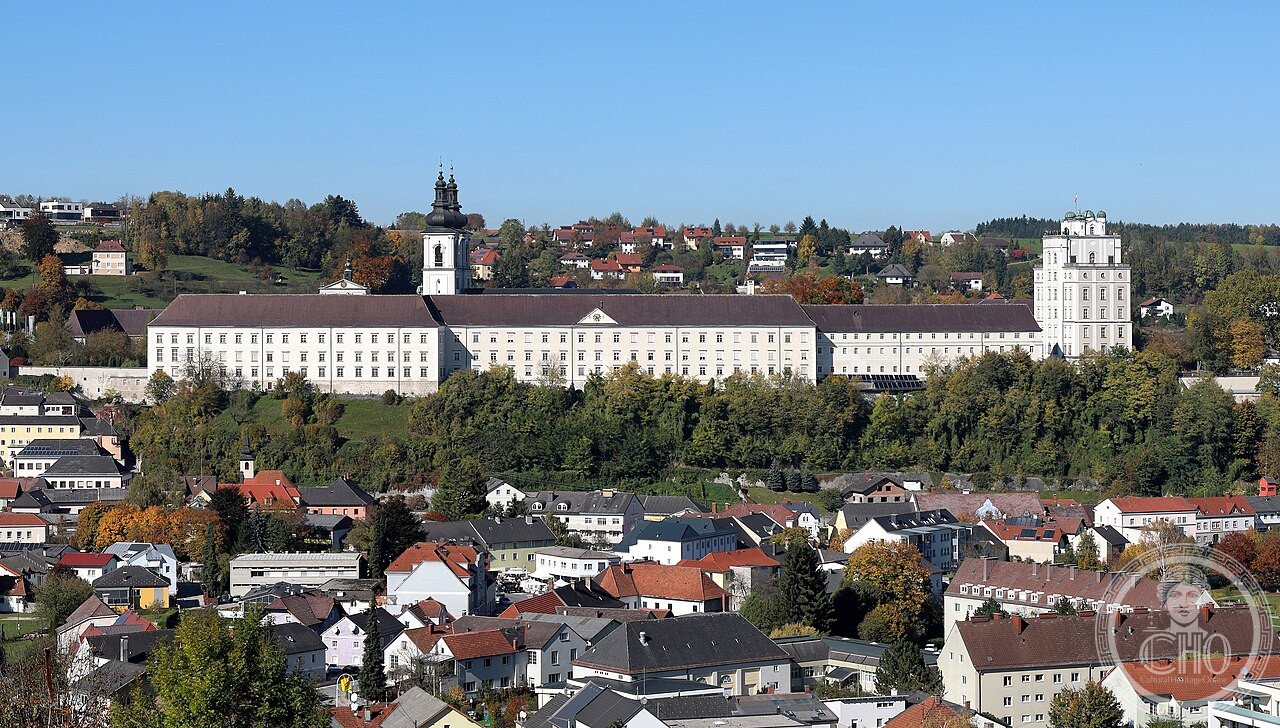
Secondo la tradizione, il duca bavarese Tassilone III fondò l’abbazia nel 777 proprio nel luogo dove suo figlio Gunther morì ferito da un cinghiale durante una battuta di caccia. Il calice che Tassilone donò al monastero è ancora usato nelle funzioni religiose oggi; la sua “torre matematica”, costruita tra il 1748 e il 1758, sale per nove piani dalla natura inanimata fino all’osservatorio astronomico e alla cappella.
About Kremsmünster Abbey
Kremsmünster Abbey was founded in 777 by Tassilo III, Duke of Bavaria, tradition holding that he established the monastery on the spot where his son Gunther was fatally wounded by a wild boar during a hunt. The abbey’s treasury holds its most celebrated object, the Tassilo Chalice, donated by the founder himself; the chalice, together with candlesticks and the Codex Millenarius manuscript, remains in occasional liturgical use to this day, on special occasions. The abbey’s most architecturally distinctive feature is the Mathematical Tower (the observatory), built between 1748 and 1758: a nine-storey structure conceived to house a “universal museum” leading the visitor upward from inanimate nature, through lower and then human life sciences and arts, to the cosmos itself in the astronomical observatory, and finally to the reflection of God in the chapel at its summit. Starting in 1762, Benedictine scientists at the observatory began an uninterrupted daily series of temperature measurements and weather data collection, one of the longest continuous meteorological records in the world; Placidus Fixlmillner, the first astronomer to compute the orbit of Uranus, later served as the observatory’s director. The tower’s lower levels house a notable natural history collection, including a fish grotto with statue-decorated tanks and a colonnade.
Key facts
- Foundation: 777, by Tassilo III, Duke of Bavaria; tradition connects the site to his son Gunther’s death by wild boar
- Tassilo Chalice: donated by the founder; still occasionally used liturgically today, alongside candlesticks and the Codex Millenarius
- Mathematical Tower (observatory): built 1748-1758, nine storeys, conceived as a “universal museum” ascending from nature to cosmos to God
- Weather record: uninterrupted daily meteorological observation since 1762, one of the longest continuous series in the world
- Placidus Fixlmillner: first astronomer to compute the orbit of Uranus; later director of the observatory
- Fish grotto: statue-decorated fish tanks and colonnade in the tower’s lower levels, part of the natural history collection
History
Tassilo III’s 777 foundation places Kremsmünster among the oldest continuously significant monastic institutions in the Bavarian-Austrian region, founded by a duke whose own subsequent political downfall — deposed by Charlemagne in 788 amid disputed accusations of treason — makes the abbey a rare surviving physical monument to a ruler whose broader territorial legacy was largely absorbed into the expanding Carolingian empire shortly after Kremsmünster’s establishment. The Tassilo Chalice’s continued occasional liturgical use today, over 1,200 years after its donation, gives the abbey an unusually direct, functioning connection to its 8th-century founder rather than a purely museum-preserved relationship.
The Mathematical Tower’s explicit conceptual programme — leading visitors physically upward through a curated sequence from inanimate matter to living nature to human achievement to the cosmos and finally to God — reflects a distinctively Baroque-era intellectual ambition to synthesise natural science, human learning, and religious devotion within a single unified architectural and didactic structure, a design philosophy characteristic of Enlightenment-adjacent Catholic monastic scientific institutions of the mid-18th century. The observatory’s continuous meteorological record since 1762, sustained by generations of Benedictine scientist-monks, represents a genuinely significant contribution to long-term climate science, providing modern researchers with one of the world’s longest unbroken instrumental weather datasets from a single location.
What you see
The Mathematical Tower, with its nine ascending storeys from natural history collections through the astronomical observatory to the summit chapel, is the abbey’s essential single destination, offering a physically embodied journey through its 18th-century conceptual programme. The Tassilo Chalice, in the abbey treasury, connects directly to the 8th-century founder. The fish grotto, with its statue-decorated tanks and colonnade, adds a distinctive, somewhat playful lower-level counterpoint to the tower’s more solemn upper reaches.
Practical information
- Opening hours: generally open daily during the visitor season, check current hours before visiting; admission fee for the Mathematical Tower and treasury
- Address: Stift Kremsmünster, 4550 Kremsmünster, Austria
Getting there
Kremsmünster is reachable by regional train from Linz (approximately 40 minutes, via Kremsmünster station). By car, Kremsmünster sits on the B139 road in Upper Austria. GPS: 48.0551° N, 14.1295° E.
Nearby
- Linz — approximately 40 minutes by train; Upper Austria’s capital, on the Danube
- Traunsee and Traunkirchen — a scenic Salzkammergut lake region within reach of Kremsmünster
- St. Florian Priory — another major Austrian Augustinian abbey, in the same general region
Sources
- Wikipedia — “Kremsmünster Abbey” (en.wikipedia.org)
- Magis Center — “Kremsmünster Abbey: A Benedictine Scientific Powerhouse” (magiscenter.com)
- Astronomical Heritage — “Kremsmünster Observatory, Austria” (web.astronomicalheritage.net)
Find it on the map
See this place and what’s around it →📷 Become a Cultural Heritage Online photographer
Share your photos of places: they stay published under your name as the author. The more they're seen, the more you get noticed — and soon a contest will reward the most appreciated photos.
Log in or sign up free to add a photo