
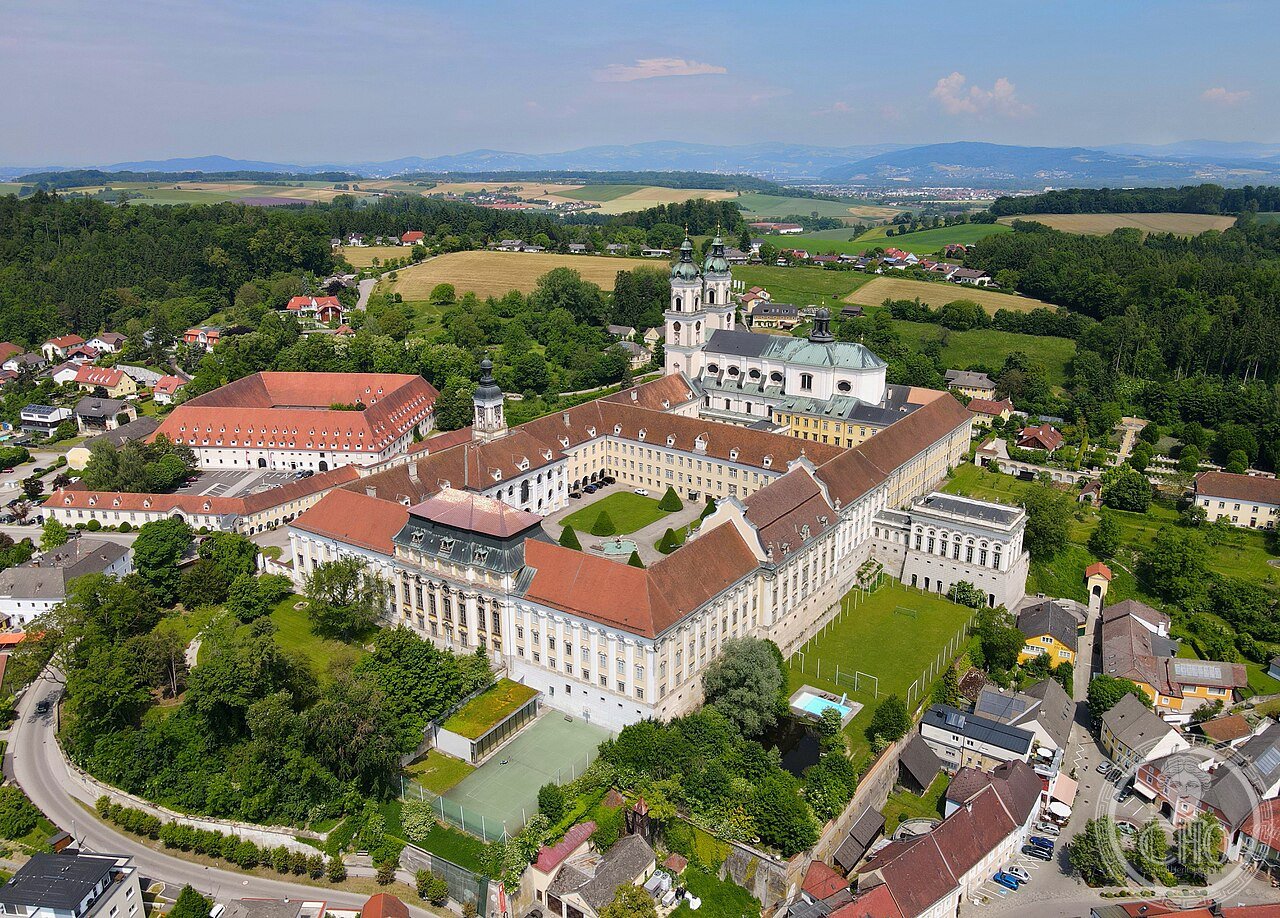
Anton Bruckner was first a chorister and then the organist of this monastery, between 1848 and 1855. The great organ of the basilica, today called the “Bruckner organ”, has four manuals, 103 stops and 7,343 pipes: beneath it, by his own wish, the composer’s remains now rest.
About St. Florian Priory
St. Florian Priory, the largest monastery in Upper Austria, was founded in the early 9th century and later refounded by Augustinian canons in the 11th century. Between 1686 and 1708, the monastery complex was entirely reconstructed in Baroque style by Carlo Antonio Carlone, with Jakob Prandtauer — the same architect responsible for Melk Abbey’s own Baroque transformation — continuing the work after Carlone’s death. The composer Anton Bruckner, who had been a choirboy at the monastery in his youth, returned to serve as its organist between 1848 and 1855; the priory’s larger organ, now known as the “Bruckner Organ,” comprises four manuals, 103 stops, and 7,343 pipes. At his own wish, Bruckner was laid to rest directly beneath this organ inside the basilica. Beneath the church, the crypt holds a large accumulation of skulls and skeletal remains, discovered in the 13th century and said to be the remains of more than 6,000 Christians buried in the area since Roman times. The monastery’s library, a late-Baroque hall built between 1744 and 1750, holds between 130,000 and 150,000 volumes and features a ceiling fresco by Bartolomeo Altomonte symbolising the marriage of virtue and science under the protection of religion — one of many decorative contributions Altomonte made throughout the complex.
Key facts
- Foundation: early 9th century; refounded by Augustinian canons in the 11th century
- Baroque reconstruction: 1686-1708, by Carlo Antonio Carlone, continued after his death by Jakob Prandtauer
- Anton Bruckner: choirboy in youth; organist 1848-1855; buried beneath the “Bruckner Organ” (4 manuals, 103 stops, 7,343 pipes) at his own request
- Crypt/ossuary: discovered 13th century; skulls and bones said to belong to over 6,000 Christians buried since Roman times
- Library: late-Baroque hall, 1744-1750, 130,000-150,000 volumes, ceiling fresco by Bartolomeo Altomonte
- Significance: the largest monastery in Upper Austria
History
Anton Bruckner’s specific request to be buried beneath his own organ at St. Florian gives the priory a rare, deeply personal connection to one of late Romantic music’s most significant symphonic composers, whose own compositional style was profoundly shaped by his years as a working church organist here — Bruckner’s symphonies retain a distinctly organ-influenced sense of massed sonority and architectural pacing that scholars often trace directly to his formative decade at St. Florian. The continuity between Carlo Antonio Carlone’s initial Baroque reconstruction and Jakob Prandtauer’s completion of the work after Carlone’s death situates St. Florian within the same broader network of leading Baroque architects who reshaped multiple major Austrian monasteries during the same building boom, Prandtauer’s parallel work at Melk giving the two abbeys a shared architectural authorship.
The 13th-century discovery of the crypt’s mass ossuary, its remains attributed to over 6,000 Christians buried since Roman times, connects St. Florian to the much older pre-monastic history of the site and the broader region, situating the later Baroque monastery atop centuries of earlier burial activity whose specific circumstances are less precisely documented than the monastery’s own well-recorded institutional history. The library’s Altomonte ceiling fresco, explicitly allegorising the union of virtue, science, and religious protection, reflects the same broader Baroque-era intellectual synthesis of learning and piety visible in comparable Austrian monastic libraries of the period, including Admont’s own celebrated library hall.
What you see
The Bruckner Organ and the composer’s grave beneath it form the priory’s single most resonant destination for visitors with any interest in music history. The library hall, with its Altomonte ceiling fresco and vast holdings, offers a comparable experience to Admont’s celebrated library within a distinctly Prandtauer-Carlone Baroque architectural setting. The crypt’s mass ossuary, with its accumulated skulls and bones dating back to Roman-era burials, adds a considerably older and more sombre historical layer beneath the Baroque splendour above.
Practical information
- Opening hours: generally open daily during the visitor season, check current hours before visiting; admission fee for guided tours
- Address: Stiftstraße 1, 4490 Sankt Florian, Austria
Getting there
Sankt Florian is reachable by regional bus from Linz (approximately 30 minutes). By car, the priory sits just off the A1 motorway near Linz, Upper Austria. GPS: 48.2070° N, 14.3781° E.
Nearby
- Linz — approximately 30 minutes away; Upper Austria’s capital, on the Danube
- Ars Electronica Center — in Linz, a major museum of digital and media art
- Kremsmünster Abbey — another major Upper Austrian Benedictine monastery, within reach
Sources
- Wikipedia — “St. Florian Monastery” (en.wikipedia.org)
- Sacred Destinations — “Abbey of St. Florian” (sacred-destinations.com)
- Atlas Obscura — “St. Florian Ossuary” (atlasobscura.com)
Find it on the map
See this place and what’s around it →📷 Become a Cultural Heritage Online photographer
Share your photos of places: they stay published under your name as the author. The more they're seen, the more you get noticed — and soon a contest will reward the most appreciated photos.
Log in or sign up free to add a photo