
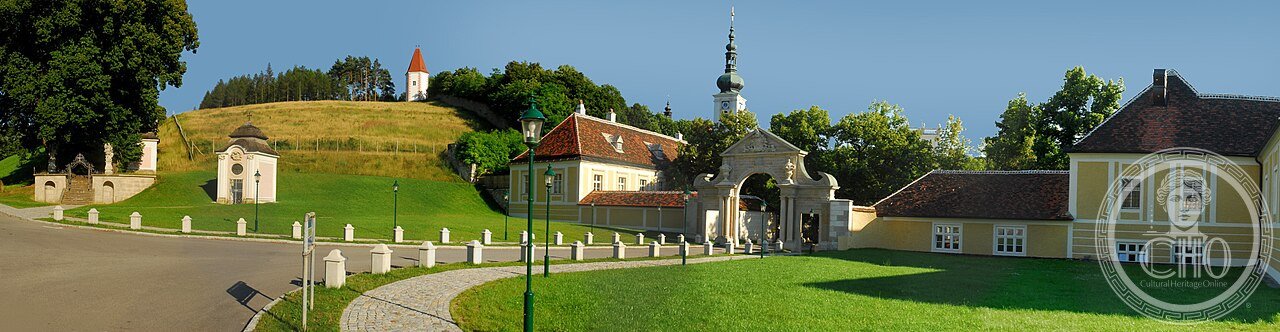
Nel 1182, Baldovino IV, il “re lebbroso” di Gerusalemme, donò al duca Leopoldo V d’Austria un frammento della Vera Croce. Nel 1188 Leopoldo lo consegnò all’abbazia di Heiligenkreuz, fondata cinquant’anni prima dal padre Leopoldo III: la reliquia, ancora visibile oggi, ha dato il nome al monastero, ininterrottamente abitato da monaci cistercensi dal 1133 — il più antico esempio al mondo.
About Heiligenkreuz Abbey
Heiligenkreuz Abbey, a Cistercian monastery in the southern part of the Vienna Woods around 13 km northwest of Baden in Lower Austria, was founded in 1133 by Margrave Saint Leopold III of Austria, at the request of his son Otto, soon to become abbot of the Cistercian monastery of Morimond in Burgundy and later Bishop of Freising. The first twelve monks, together with their abbot Gottschalk, came from Morimond at Leopold III’s invitation, and the abbey church was consecrated on 11 September 1133. Heiligenkreuz holds the distinction of being the oldest continuously occupied Cistercian monastery in the world, its monastic life never interrupted since its founding. The abbey’s name — “Holy Cross” — derives from its most treasured relic: on 31 May 1188, Duke Leopold V of Austria presented the abbey with a fragment of the True Cross, a relic he himself had received in 1182 as a gift from Baldwin IV, the “Leper King” of Jerusalem. That relic remains on display at the abbey today. Heiligenkreuz was richly endowed by its founding Babenberg dynasty and became active in founding numerous daughter houses across Central Europe; the abbey’s chapter house contains the graves of thirteen members of the House of Babenberg. Today, Stift Heiligenkreuz is recognised as one of the most vibrant and vocationally active monasteries in Central Europe.
Key facts
- Foundation: 1133, by Margrave Saint Leopold III of Austria, at the request of his son Otto; first monks from Morimond Abbey, Burgundy, under abbot Gottschalk
- Consecration: 11 September 1133
- Significance: the oldest continuously occupied Cistercian monastery in the world
- True Cross relic: given to Duke Leopold V of Austria by Baldwin IV, King of Jerusalem, in 1182; presented to the abbey on 31 May 1188; still displayed today
- Babenberg burials: the chapter house holds the graves of thirteen members of the House of Babenberg
- Daughter houses: Heiligenkreuz was active in founding numerous affiliated Cistercian monasteries across Central Europe
- Current status: one of the most vibrant, vocationally active monasteries in Central Europe today
History
The True Cross relic’s specific journey — from Jerusalem’s crusader kingdom, through Baldwin IV’s 1182 gift to Duke Leopold V, to its 1188 arrival at Heiligenkreuz — connects the abbey directly to the Crusader States during one of their final, most precarious decades, since Jerusalem itself would fall to Saladin in 1187, mere years after Baldwin IV’s gift and just a year before the relic reached Austria; the relic’s transfer to European safekeeping at this specific historical moment situates Heiligenkreuz within the broader pattern of significant Holy Land relics moving westward as Crusader control over Jerusalem itself became increasingly untenable.
The abbey’s status as the oldest continuously occupied Cistercian monastery anywhere in the world is a genuinely remarkable historical fact given how many comparable medieval monastic foundations across Europe were dissolved, secularised, destroyed, or otherwise interrupted at some point across the eight-plus intervening centuries — through the Reformation, the Napoleonic secularisations, or 20th-century political upheaval — making Heiligenkreuz’s unbroken monastic continuity since 1133 an unusually well-preserved living link to 12th-century Cistercian religious life, still actively practised by its resident community today rather than surviving merely as an architectural monument.
What you see
The True Cross relic, on display at the abbey, is the single most historically resonant object for visitors, connecting directly to the final years of the Crusader Kingdom of Jerusalem. The thirteen Babenberg tombs in the chapter house offer a dense concentration of early Austrian dynastic history within one space. The cloisters’ grisaille windows, some dating to the 13th century, and the abbey’s continuing active Cistercian community give Heiligenkreuz a rare combination of deep historical layering and genuinely unbroken living monastic tradition.
Practical information
- Opening hours: generally open daily during the visitor season, check current hours before visiting; admission fee for guided tours
- Address: Stift Heiligenkreuz 1, 2532 Heiligenkreuz, Austria
Getting there
Heiligenkreuz is reachable by regional bus from Baden bei Wien (approximately 30 minutes). By car, Heiligenkreuz sits within the Vienna Woods on the B11 road, southwest of Vienna. GPS: 48.0550° N, 16.1320° E.
Nearby
- Mayerling — a short distance away; site of the 1889 Habsburg royal tragedy involving Crown Prince Rudolf
- Vienna Woods (Wienerwald) — the surrounding forested hills, popular for hiking
- Baden bei Wien — approximately 30 minutes away; a historic spa town
Sources
- Wikipedia — “Heiligenkreuz Abbey” (en.wikipedia.org)
- Cistopedia — “Heiligenkreuz Abbey” (cistopedia.org)
- SpottingHistory — heritage documentation (spottinghistory.com)
Find it on the map
See this place and what’s around it →📷 Become a Cultural Heritage Online photographer
Share your photos of places: they stay published under your name as the author. The more they're seen, the more you get noticed — and soon a contest will reward the most appreciated photos.
Log in or sign up free to add a photo