
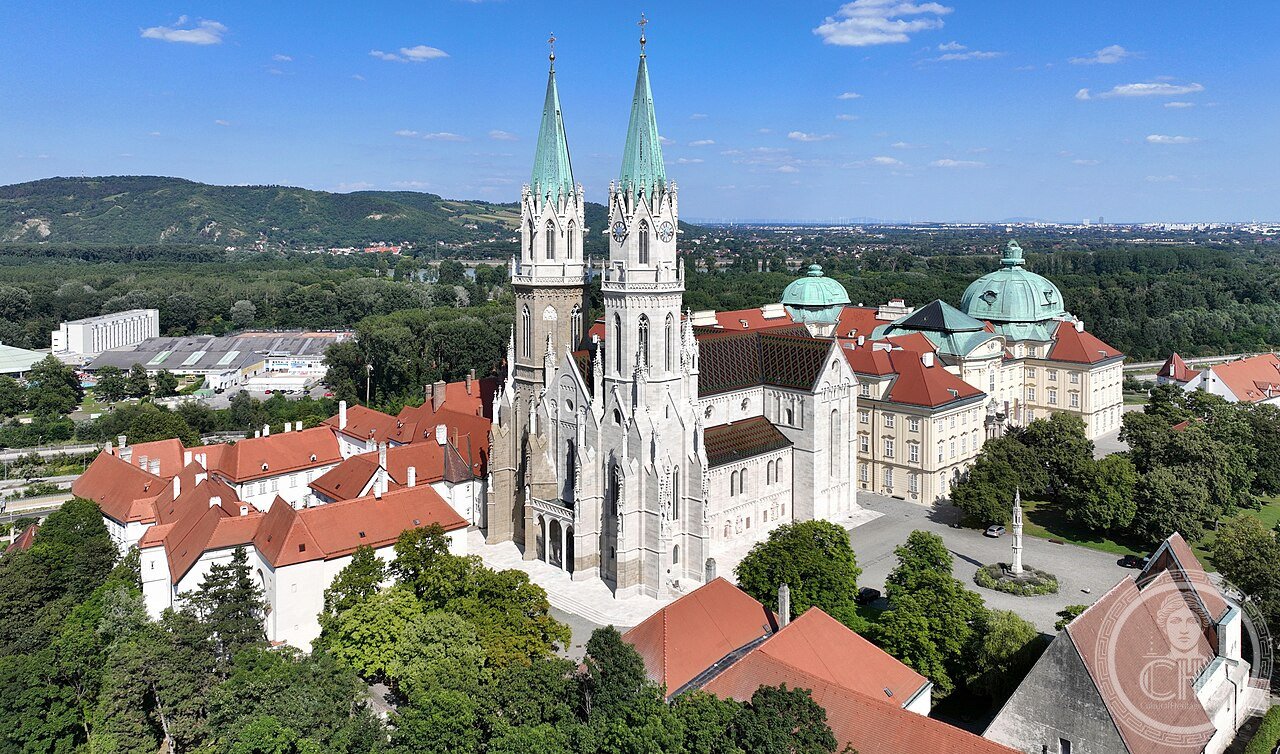
Tradition has it that on the wedding day of Leopold III of Austria and Agnes of Waiblingen, a gust of wind carried away the bride’s wedding veil. Nine years later, during a hunt in the woods of Klosterneuburg, Leopold found it caught on a flowering elder: to fulfil the vow he made at that moment, he founded here, in 1114, the Augustinian abbey that still bears the name of the town.
About Klosterneuburg Abbey
Klosterneuburg Abbey was founded in 1114 by Saint Leopold III of Babenberg, patron saint of Austria, and his second wife Agnes of Germany, who established a monastery for secular canons beside Leopold’s own castle, endowed with generous land donations. The cornerstone ceremony for the new abbey church took place on 12 June 1114, and after twenty-two years of construction, the church was consecrated on 29 September 1136. Tradition connects the foundation to a specific legend: on their wedding day, a sudden gust of wind carried away Agnes’s bridal veil, and nine years later Leopold, hunting in the Klosterneuburg woods, miraculously discovered the veil caught on a blossoming elder tree — in fulfilment of a vow made at that moment, he founded the abbey on the spot. The monastery’s most celebrated treasure is the Verdun Altar, created in 1181 by the goldsmith and enamel artist Nicholas of Verdun, comprising 51 enamelled panels arranged in three horizontal registers corresponding to distinct epochs of salvation history; Nicholas of Verdun is regarded as a forerunner of the Gothic style. Following a fire in 1330, the altar was converted into a winged altarpiece, the form in which it survives today.
Key facts
- Foundation: 1114, by Saint Leopold III of Babenberg (patron saint of Austria) and his wife Agnes of Germany, for secular canons
- Church construction: cornerstone 12 June 1114; consecrated 29 September 1136 after 22 years
- Founding legend: Agnes’s bridal veil blown away by wind, found nine years later by Leopold on a blossoming elder tree; the abbey fulfils his vow
- Verdun Altar: created 1181 by Nicholas of Verdun, 51 enamelled panels in three registers depicting salvation history; converted to a winged altarpiece after a 1330 fire
- Nicholas of Verdun: regarded as a forerunner of the Gothic style in enamel and goldsmith work
History
Leopold III’s foundation of Klosterneuburg situates the abbey directly within the Babenberg dynasty’s broader pattern of monastic patronage along the Danube during the same general period as Melk Abbey’s own Babenberg-linked establishment, both reflecting the ruling margraves’ consistent use of monastery-founding as both genuine piety and territorial consolidation strategy across the March of Austria. Leopold III’s own later canonisation and status as Austria’s patron saint gives Klosterneuburg a particular devotional significance beyond that of a merely well-endowed medieval foundation, connecting the site directly to the officially recognised spiritual patron of the entire modern Austrian nation.
The Verdun Altar’s creation by Nicholas of Verdun, one of the most technically accomplished goldsmith-enamellers of the late 12th century, places Klosterneuburg’s most important artwork within a body of work — including Nicholas’s other celebrated commissions across the Meuse-Rhine region — recognised by art historians as pivotal in the transition from Romanesque to Gothic artistic sensibility. The altar’s forced conversion from its original form into a winged altarpiece after the 1330 fire exemplifies how medieval religious art frequently survived not in its originally intended form but through practical, damage-driven adaptation, with the winged-altarpiece format in which the Verdun panels survive today itself now considered inseparable from the work’s historic identity.
What you see
The Verdun Altar, housed in the Leopold Chapel, is the abbey’s essential single destination, its 51 enamelled panels rewarding close, extended viewing given both their art-historical significance and their density of narrative detail across three thematic registers. The abbey complex itself, including its Baroque-era additions layered onto the original 12th-century foundation, offers a legible architectural record spanning nearly nine centuries. Saint Leopold’s tomb and the site’s founding-legend associations extend the abbey’s significance directly into Austria’s devotional and national-symbolic history.
Practical information
- Opening hours: generally open daily during the visitor season, check current hours before visiting; admission fee for the abbey museum and Verdun Altar viewing
- Address: Stiftsplatz 1, 3400 Klosterneuburg, Austria
Getting there
Klosterneuburg has direct S-Bahn and rail connections from central Vienna (approximately 20-30 minutes). By car, Klosterneuburg sits just off the A22 motorway, on the edge of the Vienna Woods. The abbey stands at the centre of the town. GPS: 48.3072° N, 16.3262° E.
Nearby
- Leopoldsberg — a hill overlooking Klosterneuburg and Vienna, offering panoramic Danube views
- Vienna Woods (Wienerwald) — the forested hills surrounding Klosterneuburg
- Vienna — approximately 20-30 minutes by S-Bahn
Sources
- Wikipedia — “Klosterneuburg Abbey” (en.wikipedia.org)
- Stift Klosterneuburg — official portal, “Verdun Altar” (stift-klosterneuburg.at)
- Ancient History Sites — “Klosterneuburg Monastery” (ancient-history-sites.com)
Find it on the map
See this place and what’s around it →📷 Become a Cultural Heritage Online photographer
Share your photos of places: they stay published under your name as the author. The more they're seen, the more you get noticed — and soon a contest will reward the most appreciated photos.
Log in or sign up free to add a photo