
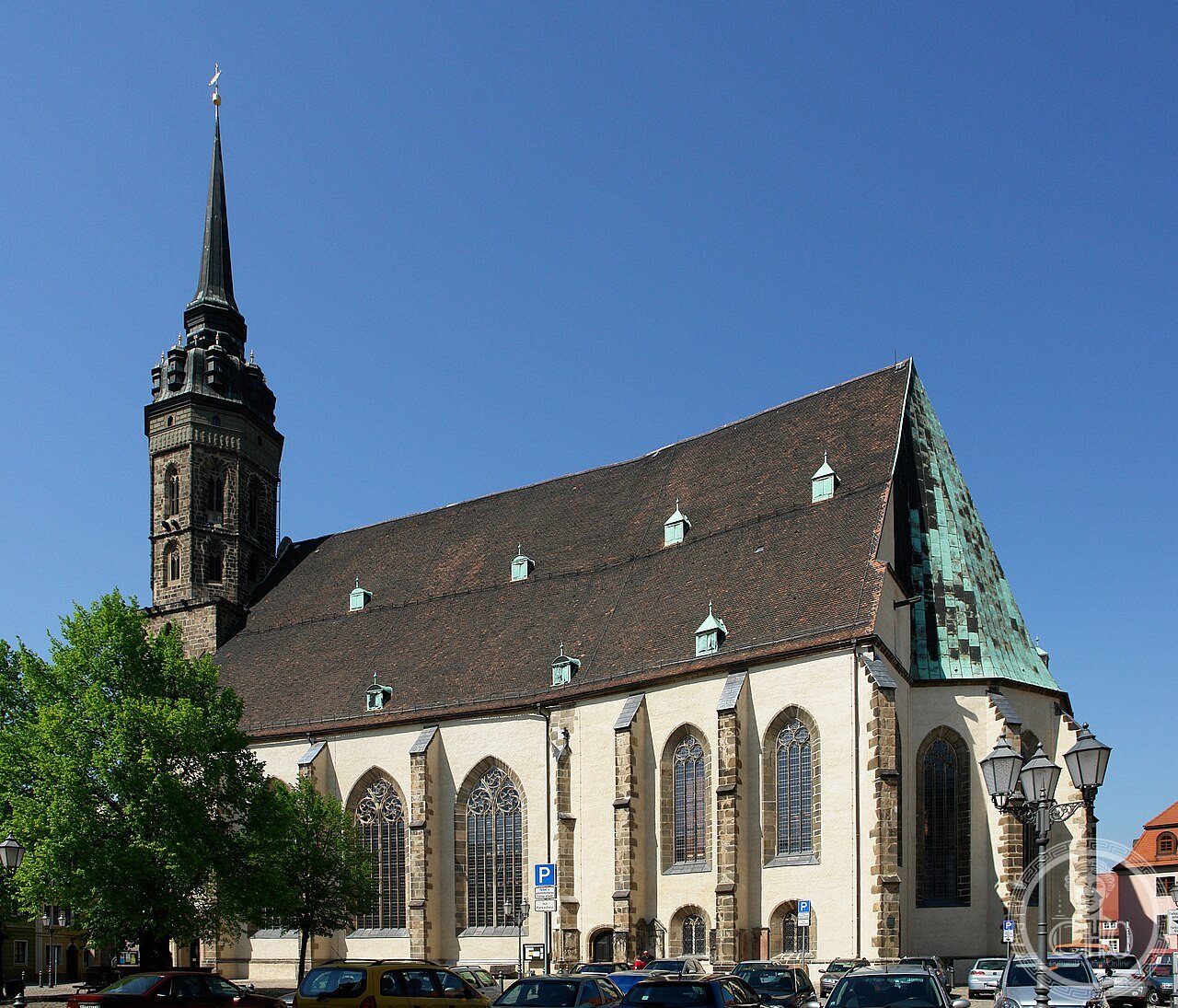
Dal 1530, una tenda alta 4 metri separa il presbiterio del duomo di Bautzen: da una parte i cattolici, dall’altra i luterani, nella stessa chiesa. Un contratto scritto nel 1583 dal decano Leisentrit regola ancora oggi gli orari di utilizzo delle due comunità — interrotto solo poche volte nella storia, come durante la rivolta boema del 1620.
About the Cathedral of St Peter, Bautzen
The Cathedral of St Peter (Dom St. Petri) in Bautzen, Upper Lusatia, is among the oldest and largest simultaneum churches in Germany — a shared church (Simultankirche) in which adherents of more than one denomination conduct public worship in the same building. A first church stood on the site around the year 1000; near the beginning of the 13th century, a proper cathedral was built under the supervision of Bishop Bruno II. The path to shared use began with the Reformation: in 1523 an Evangelical Lutheran preacher first preached inside the church, and from 1530 onward both Catholics and Lutherans have shared the building continuously, a four-metre-tall screen physically separating the sanctuary between the two communities. In 1583, the cathedral dean Leisentrit formalised the arrangement in a written contract defining precisely when each denomination could use the building and under what conditions — an agreement still in effect today, interrupted only rarely across the centuries, most notably during the Bohemian Uprising of 1620, when Catholics were briefly expelled from the building. Since 1980, the cathedral has additionally served as a Catholic co-cathedral.
Key facts
- First church: c. 1000 AD on this site
- Cathedral construction: early 13th century, under Bishop Bruno II
- Reformation: first Lutheran preaching 1523; shared Catholic-Lutheran use from 1530, divided by a 4-metre screen
- 1583 contract: formalised by dean Leisentrit, still in effect today, governing each denomination’s use of the church
- Interruptions: rare, most notably during the Bohemian Uprising of 1620 (brief Catholic expulsion)
- Significance: the oldest documented simultaneum in the world
- Modern status: Catholic co-cathedral since 1980, alongside continued Lutheran use
History
Bautzen’s simultaneum arrangement, formalised in writing as early as 1583 and remaining continuously in force for over four centuries since, represents an unusually early and durable practical solution to the confessional conflicts that split so much of Germany during and after the Reformation — a period in which competing Catholic and Protestant claims over church buildings frequently produced violent conflict, forced conversion of church use, or outright destruction elsewhere across the Holy Roman Empire. That Bautzen’s dean and civic authorities instead negotiated a durable, contractually specified sharing arrangement as early as the late 16th century, and that this arrangement survived the far more severe confessional violence of the subsequent Thirty Years’ War (1618-1648) essentially intact — aside from the brief 1620 disruption during the Bohemian Uprising — makes the cathedral a genuinely remarkable case study in confessional coexistence achieved through concrete legal and architectural compromise rather than through the more common historical pattern of one side’s eventual complete displacement.
The cathedral’s 1980 elevation to Catholic co-cathedral status, layered onto an already-four-century-old continuous shared-use arrangement, reflects the modern Catholic Church’s formal recognition of an already long-functioning practical reality rather than any change to the underlying sharing arrangement itself — the Lutheran congregation’s continuous presence in the building since 1530 remaining entirely unaffected by the more recent Catholic administrative designation.
What you see
The 4-metre screen dividing the sanctuary between Catholic and Lutheran sections is the cathedral’s single most historically significant feature, a physical embodiment of nearly five centuries of continuous confessional coexistence within one building. The Gothic architecture, dating substantially to the early 13th-century construction under Bishop Bruno II, provides the shared architectural framework within which both communities have worshipped since the Reformation. Visitors can observe how the two sides of the church reflect distinct denominational decorative traditions despite occupying the same continuous structure.
Practical information
- Opening hours: generally open daily, check current hours before visiting; free admission
- Address: An der Petrikirche 1, 02625 Bautzen
Getting there
Bautzen has direct rail connections from Dresden (approximately 1 hour). By car, Bautzen sits on the B96/A4 road network. The cathedral stands in Bautzen’s historic old town. GPS: 51.1825° N, 14.4235° E.
Nearby
- Bautzen old town — a well-preserved historic centre with numerous medieval towers and the Ortenburg castle
- Sorbian Museum — dedicated to the Sorbs, the Slavic minority native to Upper Lusatia around Bautzen
- Dresden — approximately 1 hour by train; Saxony’s state capital
Sources
- Wikipedia — “Cathedral of St Peter, Bautzen” and “Simultaneum” (en.wikipedia.org)
- Places of Germany — “Bautzen St Peter’s Cathedral: Germany’s oldest simultaneous church” (placesofgermany.de)
- Visit Saxony — “Cathedral St. Petri Bautzen” (visitsaxony.com)
Find it on the map
See this place and what’s around it →📷 Become a Cultural Heritage Online photographer
Share your photos of places: they stay published under your name as the author. The more they're seen, the more you get noticed — and soon a contest will reward the most appreciated photos.
Log in or sign up free to add a photo