
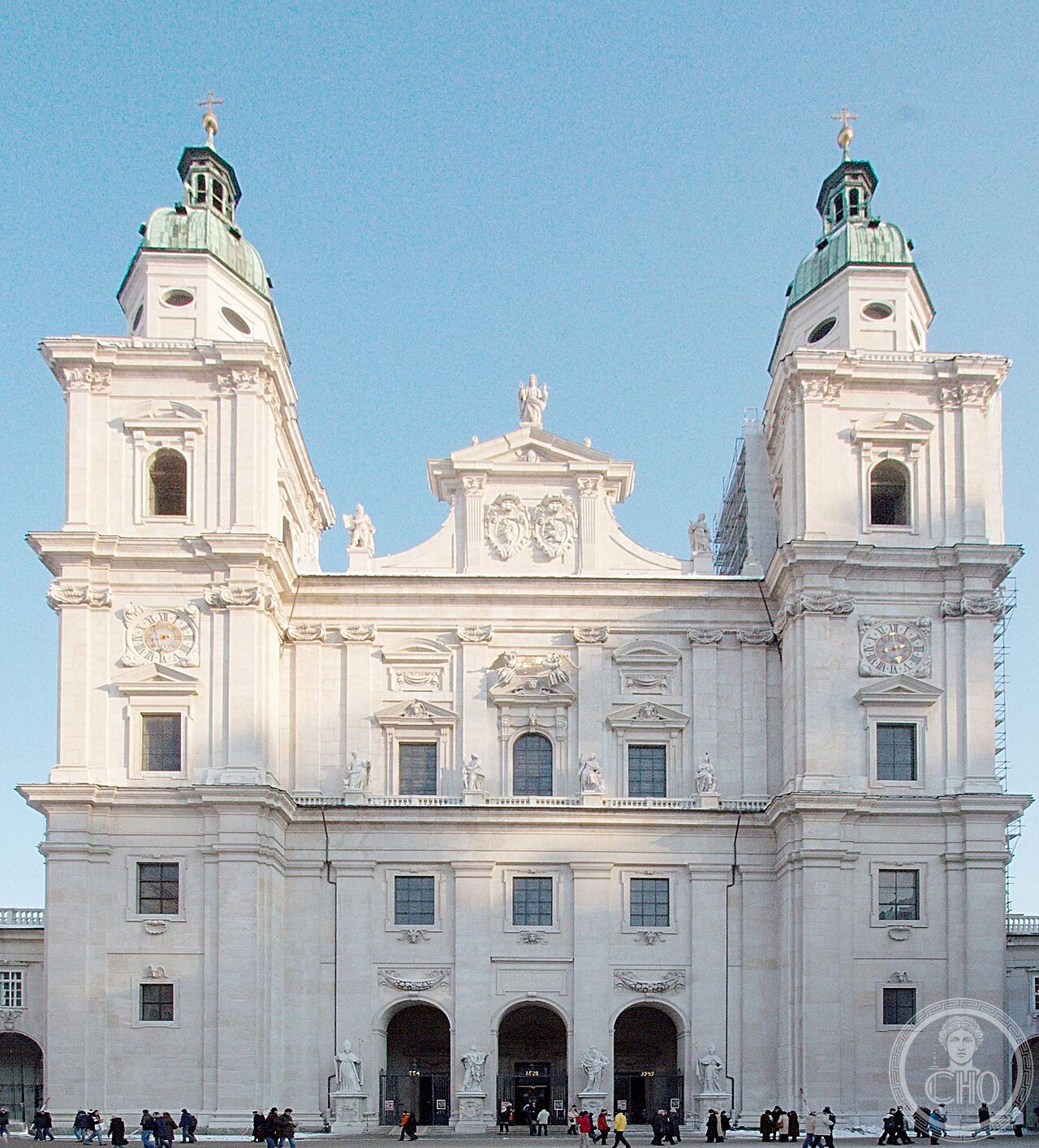
San Virgilio fondò la chiesa nel 774 sui resti di una città romana. Un incendio nel 1598 la distrusse quasi interamente; l’arcivescovo Wolf Dietrich avviò una ricostruzione poi portata a termine dal successore Markus Sittikus, che commissionò a Santino Solari la prima chiesa barocca a nord delle Alpi, consacrata nel 1628. Danneggiata da una bomba nel 1944, fu riconsacrata solo nel 1959: le date 774, 1628 e 1959 restano incise sui cancelli d’ingresso.
About Salzburg Cathedral
Salzburg Cathedral (Salzburger Dom) was founded in 774 by Saint Virgilius, built on the remnants of a Roman town, and rebuilt in 1181 after an early fire. The building suffered repeated destruction by fire across the following centuries, most severely in 1598, when Archbishop Wolf Dietrich began a reconstruction pursued, by most accounts, quite recklessly; only after his capture and death could his successor, Archbishop Markus Sittikus, bring the project to completion. Markus Sittikus commissioned the Italian architect Santino Solari to design what became the first early Baroque church built north of the Alps, constructed between 1614 and 1655 and consecrated by Archbishop Paris Lodron in 1628. Among the cathedral’s treasures is a bronze baptismal font from 1311, incorporating lion figures from around 1200, in which Wolfgang Amadeus Mozart was baptised, as was Joseph Mohr, later the lyricist of “Silent Night, Holy Night.” In 1944, an Allied aerial bomb struck the cathedral, damaging the dome and parts of the altar area; the building was not fully restored to its former state until 1959. The three consecration years — 774, 1628, and 1959 — are inscribed on the cathedral’s entrance gate grilles, and the building today seats around 900 people.
Key facts
- Foundation: 774, by Saint Virgilius, on the site of a Roman town; rebuilt 1181 after fire
- 1598 fire: destroyed much of the building; reconstruction begun by Archbishop Wolf Dietrich, completed by his successor Markus Sittikus
- Santino Solari’s design: the first early Baroque church built north of the Alps, constructed 1614-1655, consecrated 1628 by Archbishop Paris Lodron
- Baptismal font: bronze, 1311, with lion figures c. 1200; used to baptise Wolfgang Amadeus Mozart and Joseph Mohr
- 1944 bombing: Allied bomb damaged the dome and altar area
- Reconsecration: 1959, after full restoration; the years 774, 1628, and 1959 inscribed on the entrance gates
- Capacity: seats approximately 900
History
Archbishop Wolf Dietrich’s reckless management of the post-1598-fire reconstruction, followed by his own capture and death before its completion, situates the cathedral’s rebuilding within the broader turbulent political career of one of Salzburg’s most consequential and controversial prince-archbishops — Wolf Dietrich’s eventual downfall stemmed from his conflict with neighbouring Bavaria, and his imprisonment left the ambitious reconstruction project to his successor Markus Sittikus, whose decision to commission Santino Solari produced a building whose status as the first early Baroque church north of the Alps gave Salzburg genuine architectural priority in introducing this influential Italian style into German-speaking Central Europe.
Mozart’s baptism in the cathedral’s 1311 bronze font, alongside Joseph Mohr’s, connects the building to two entirely distinct strands of Austrian and world cultural history — Mozart’s status as one of history’s most significant composers, and “Silent Night”‘s status as one of the world’s most widely performed Christmas carols — both originating from baptisms in the same specific medieval object centuries apart. The cathedral’s 1944 bomb damage and subsequent fifteen-year restoration to 1959, commemorated by the third consecration date inscribed on the entrance gates alongside 774 and 1628, situates Salzburg within the broader pattern of major Austrian and German ecclesiastical monuments requiring extensive postwar reconstruction, with the specific choice to inscribe all three consecration dates together giving the building a uniquely legible, self-documented thirteen-century timeline directly at its threshold.
What you see
The bronze 1311 baptismal font, with its c. 1200 lion figures, is the cathedral’s single most historically resonant object, connecting directly to Mozart’s own biography. Santino Solari’s early Baroque design, complete with its distinctive dome and twin towers, offers direct access to the style’s first full expression north of the Alps. The inscribed consecration dates on the entrance gates — 774, 1628, 1959 — reward attention as a uniquely condensed physical record of the building’s entire history.
Practical information
- Opening hours: generally open daily, check current hours before visiting; free admission, excavation museum beneath the cathedral has separate admission
- Address: Domplatz 1a, 5020 Salzburg
Getting there
Salzburg has direct rail connections from Munich (approximately 1.5 hours) and Vienna (approximately 2.5 hours). By car, Salzburg sits on the A1/A10 motorway network. The cathedral stands on Domplatz in Salzburg’s historic old town. GPS: 47.7978° N, 13.0466° E.
Nearby
- Hohensalzburg Fortress — overlooking the cathedral and old town from its hilltop position
- Mozart’s Birthplace — a short walk away, on Getreidegasse
- Residenzplatz and St. Peter’s Abbey — directly adjoining the cathedral square
Sources
- Wikipedia — “Salzburg Cathedral” (en.wikipedia.org)
- Salzburg.info — “Salzburg Cathedral” (salzburg.info)
- Sacred Destinations — “Salzburg Cathedral” (sacred-destinations.com)
Find it on the map
See this place and what’s around it →📷 Become a Cultural Heritage Online photographer
Share your photos of places: they stay published under your name as the author. The more they're seen, the more you get noticed — and soon a contest will reward the most appreciated photos.
Log in or sign up free to add a photo