
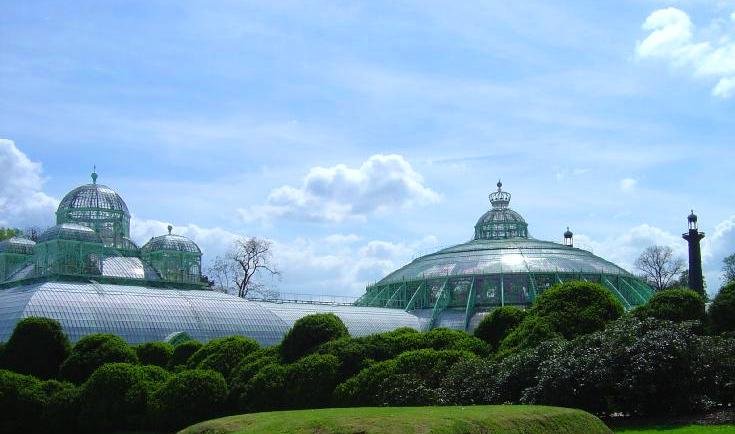
A monumental complex of heated greenhouses housing one of Europe’s finest botanical collections, commissioned by King Leopold II and built over three decades in the park of the Royal Palace.
At a glance
The Royal Greenhouses form an extensive complex of tropical, subtropical and cold houses within the Royal Palace park in northern Brussels. They contain the celebrated Royal Botanic Collection, renowned for its rare camellias, heritage orange trees and plants gathered from Africa during the era of Belgian colonial expansion. Public access is strictly limited to a handful of days annually.
History
King Leopold II envisioned this botanical sanctuary and commissioned its construction in 1874. Architect Alphonse Balat designed the initial scheme and oversaw work through the 1880s and early 1890s. Following Balat’s death in 1895, Leopold engaged architects Henri Maquet and Charles Girault to complete the project. Construction continued until 1905, spanning more than three decades of gradual expansion and refinement. Today the greenhouses remain part of the Royal Domain of Laeken, privately maintained by the Belgian royal family.
What you see
The complex showcases a masterwork of 19th-century horticultural engineering. Monumental glass and iron structures enclose distinct climate zones—tropical heat, subtropical warmth, and cool temperate conditions—each tailored to specific plant needs. The architectural design balances Victorian grandeur with functional precision, allowing natural light while maintaining precise temperature control. Inside, camellias and rare specimens flourish alongside heritage citrus varieties, creating an immersive journey through global flora.
Cultural significance
The greenhouses represent a pinnacle of royal botanical patronage and colonial-era plant collecting. They document Belgium’s horticultural ambitions and the scientific impulse to gather, cultivate and preserve specimens from distant territories. The collections reflect both aristocratic taste and genuine botanical curiosity. As a rare surviving example of monumental 19th-century greenhouse architecture, they illuminate the era’s marriage of engineering innovation, aesthetic ambition and imperial reach.
Key facts
- Location: Laeken, Brussels, Belgium
- Coordinates: 50.88833333, 4.36027778
- Construction period: 1874–1905
- Original architect: Alphonse Balat
- Subsequent architects: Henri Maquet, Charles Girault
- Commissioned by: King Leopold II
- Public access: Limited to a few days per year
- Nearest metro: Stuyvenbergh station (Line 6, Brussels Metro)
Practical information & getting there
The greenhouses are located within the Royal Palace park and are not routinely open. Visiting requires advance notice; consult official Belgian royal family or Brussels tourism channels for annual opening dates. Public transport: Stuyvenbergh metro station (Line 6) provides direct access. Photography and extended visits may be restricted during public opening days. Plan ahead—this remains an exclusive, invitation-sensitive venue.
Sources & resources
Find it on the map
See this place and what’s around it →📷 Become a Cultural Heritage Online photographer
Share your photos of places: they stay published under your name as the author. The more they're seen, the more you get noticed — and soon a contest will reward the most appreciated photos.
Log in or sign up free to add a photoIs this page about you?
This page is read by travellers and heritage enthusiasts who find it on Google. Tell us how you are connected to this place and we will take it from there.