
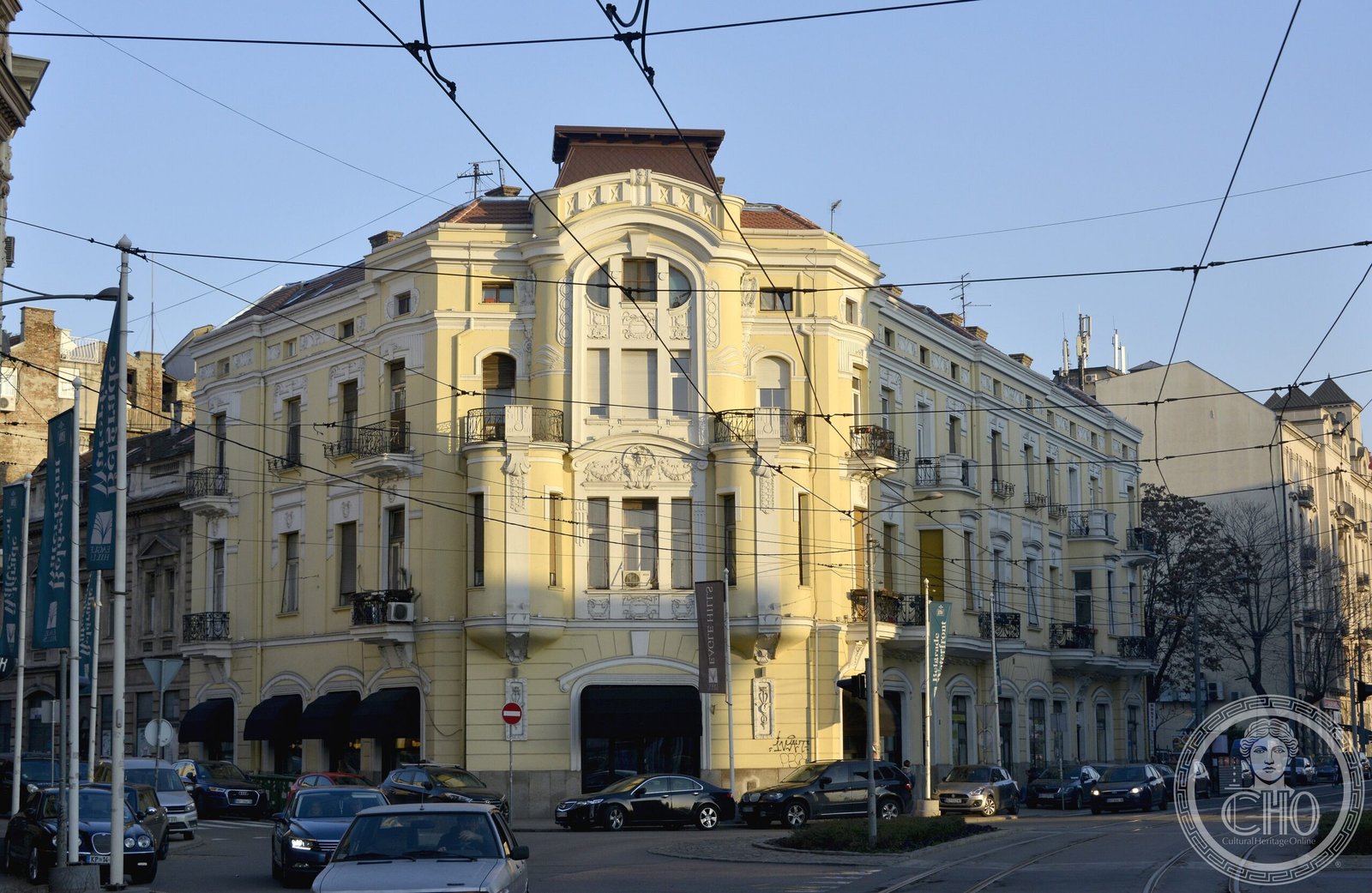
Vučo House on the Sava River
A pioneering Art Nouveau merchant’s residence that fused commercial enterprise with elegant urban living on Belgrade’s vibrant Sava waterfront.
At a glance
Built in 1908 for merchant Đorđe Vučo, this two-storey building exemplifies early 20th-century Belgrade’s architectural ambitions. Architect Dimitrije T. Leko designed the structure during the flourishing of the “Sava settlement,” creating a dual-purpose building with ground-floor shops and residential apartments above. The house stands as a cultural monument representing the transition from traditional Serbian architecture to European modernism.
History
The Vučo house rose during Belgrade’s commercial expansion along the Sava, when the area attracted prosperous merchants and civic leaders. Prior to its construction, the neighborhood hosted estates of notable citizens including Antule, Vuče, and Stojanović. Other significant structures nearby—such as Ljubomir Krsmanović’s house (1894) and the Hotel Bosna—reinforced the district’s prestige.
Second World War bombing inflicted partial damage to the building. Restoration work followed in 1946, preserving the structure for posterity.
What you see
The façade balances classical symmetry with avant-garde ornamentation. Three-part windows across each floor emphasize vertical movement, while an arched attic crowned by a pyramidal dome anchors the composition. The centerpiece of decorative treatment—a woman’s head with shell and garlands in a semicircular tympanum on the first floor—introduces Art Nouveau’s natural motifs and sensuality.
Iron balconies on the side facades feature geometric and floral patterns. The ground floor’s commercial spaces contrast deliberately with the residential elegance above, reflecting the building’s mixed-use character.
Cultural significance
Vučo House exemplifies Belgrade’s architectural modernization during the early 1900s. Architect Leko’s multiple commissions for the Vučo family—an uncommon concentration of work by one designer—shaped the evolution of the Mali pijac district. The building documents the penetration of Art Nouveau into Serbian commercial architecture, marking the city’s embrace of European aesthetic currents while maintaining practical, mixed-use urban design.
Key facts
- Location: 61–61a Karađorđeva Street, Savski venac city municipality, Belgrade
- Year built: 1908
- Architect: Dimitrije T. Leko
- Style: Art Nouveau with traditional Serbian elements
- Original owner: Merchant Đorđe Vučo
- Status: Protected cultural monument
- Coordinates: 44.81°N, 20.45°E
Practical information & getting there
The house occupies a prominent location on Karađorđeva Street in the Savski venac district near the Sava River embankment. As a protected cultural monument, it remains in situ and viewable from the street. Belgrade’s public transport network serves the broader Sava riverfront area. For visiting hours, permissions, or interior access, consult local heritage authorities or Belgrade’s cultural heritage office.
Sources & resources
Find it on the map
See this place and what’s around it →📷 Diventa un fotografo di Cultural Heritage Online
Condividi le tue foto dei luoghi: restano pubblicate con la tua firma come autore. Più vengono viste, più ti fai conoscere — e presto un concorso premierà le foto più apprezzate.
Accedi o registrati gratis per aggiungere una fotoDo you manage this place?
This page is read by travellers and heritage enthusiasts who find it on Google. Keep it accurate — and make it work for you. Free for non-profit heritage institutions.