
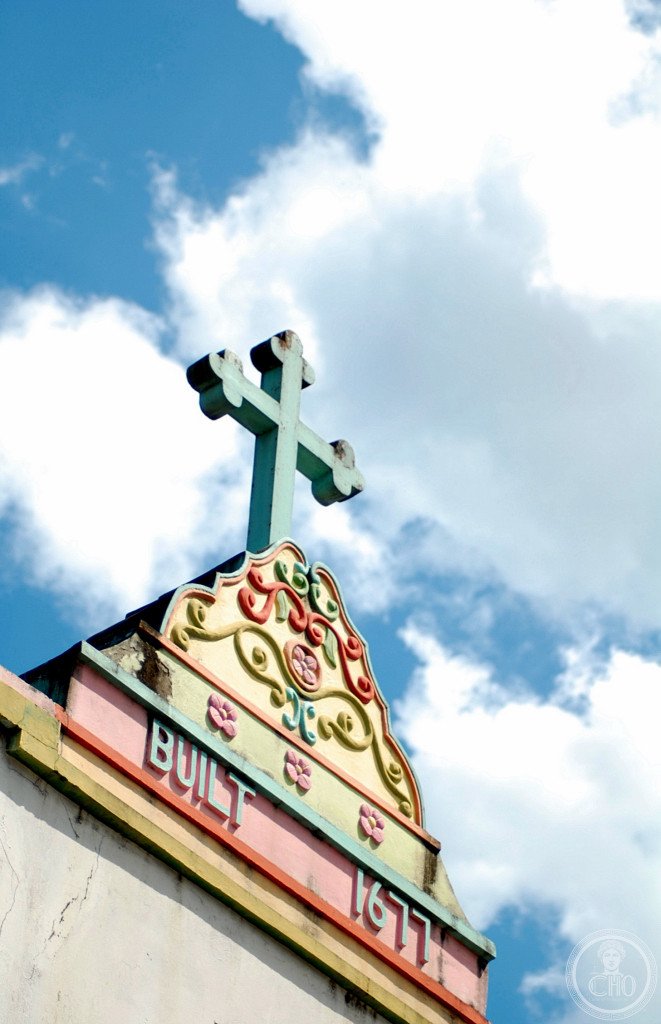
In Dhaka, the capital of Bangladesh, Holy Rosary Church in Tejgaon is traditionally dated to 1677, the year carved on a plaque on its gable, though historians are far from agreeing on this chronology. Different sources propose dates ranging from “before 1599” to 1714, and some even point to an earlier building put up by Nestorian Christian merchants on the same site. Founded by Portuguese Augustinian missionaries, it is described as the second church of Dhaka and one of the oldest still standing in Bangladesh. It is not, however, as is sometimes believed, the cathedral of the archdiocese of Dhaka: that role belongs to St. Mary’s Cathedral in Kakrail, while this remains a parish church. The building has a basilical plan with a nave, a side corridor and a square apse, Tuscan-order columns inside, and hollow corner towers on the east side, once meant to hold statues. No source consulted records the name of an architect for any of its building phases. Sources agree only in part on the later restorations: some count three, in 1714, 1940 and 2000, others four between 1779 and 2000, with a heavier intervention in 1939-40 and further works around 2014, a chronology that should therefore be reported with caution. A new and larger church, seating around one thousand five hundred worshippers, was built beside the historic building and blessed on 22 January 1993, precisely because the old structure had become too small for the growing community. The archdiocese of Dhaka, erected as the apostolic vicariate of Eastern Bengal in 1850 and raised to an archdiocese in 1950, has, according to the sources consulted, no specifically documented event linked to this church during the Bangladesh Liberation War of 1971, although several Catholic priests were killed elsewhere in the country in those same months and some churches, not this one, were desecrated or hit. In a country about 91 per cent Muslim, with a Christian minority of around 0.3 per cent of the population, no source documents tensions or interreligious events specifically linked to this church. The best-documented moment of its recent history dates to 2 December 2017, when Pope Francis, during his apostolic visit to Bangladesh, came here three times in a single morning: to the Mother Teresa House of the Missionaries of Charity; to the new church, where he met priests, religious, seminarians and novices, setting aside his eight-page written speech with a remark that became famous, “I don’t know whether it will be better or worse, but I promise it will be less boring”; and finally to the old historic church of 1677 and the parish cemetery. Whether Pope John Paul II, visiting Bangladesh on 19 November 1986, came specifically to this church cannot be verified.
About Holy Rosary Church
In Dhaka, Bangladesh, Holy Rosary Church in Tejgaon is traditionally dated to 1677, the year inscribed on a plaque at its gable, though historians are genuinely divided on the chronology — proposed founding dates in various sources range from “before 1599” to as late as 1714. Founded by Portuguese Augustinian missionaries, it is described as the second church of Dhaka and one of the oldest still standing in Bangladesh.
Key facts
- 1677 (traditional date, disputed): founding inscription on the church’s gable.
- 1940: a major renovation of the historic structure.
- 22 January 1993: a new, larger church blessed alongside the historic building.
- 2 December 2017: Pope Francis visits the parish three times in one morning.
- Not the cathedral of Dhaka — that is St. Mary’s Cathedral, Kakrail.
- Christians make up roughly 0.3% of Bangladesh’s population, overwhelmingly Muslim.
History
Founded by Portuguese Augustinian missionaries on a disputed date historians place anywhere from before 1599 to 1714, this parish church grew too small for its congregation by 1993, when a larger church was built alongside it while the historic structure remained standing. Its best-documented modern moment came on 2 December 2017, when Pope Francis visited the parish three times in a single morning, at one point abandoning his prepared eight-page speech to priests, religious and novices with a joke that it would be “less boring” without it.
What you see
A basilica-plan church with nave, side aisle and a small square apse, its interior aisles divided by Tuscan-order columns and its eastern side marked by hollow corner towers that once held statues in capped cupolas, above a gabled facade bearing the “Built 1677” inscription.
Practical information
- Opening hours: generally open daily outside services; check current hours before visiting.
- Address: Holy Cross College Road, Tejgaon, Dhaka 1215, Bangladesh.
Getting there
The church stands in the Tejgaon area of Dhaka, near Holy Cross College. GPS: 23°45′32″N, 90°23′32″E.
Nearby
- Holy Cross College, Tejgaon — a Catholic institution adjoining the church compound.
Sources
- Wikipedia — “Holy Rosary Church, Dhaka” and “St. Mary’s Cathedral, Dhaka”
- Banglapedia — “Holy Rosary Church”
- Archdiocese of Dhaka — official site, Tejgaon Parish page.
- Vatican.va — official transcript, Pope Francis’s address at Holy Rosary Church, 2 December 2017.
- Vatican News and bdnews24 — coverage of the 2017 papal visit to Tejgaon.
Find it on the map
See this place and what’s around it →📷 Become a Cultural Heritage Online photographer
Share your photos of places: they stay published under your name as the author. The more they're seen, the more you get noticed — and soon a contest will reward the most appreciated photos.
Log in or sign up free to add a photo