
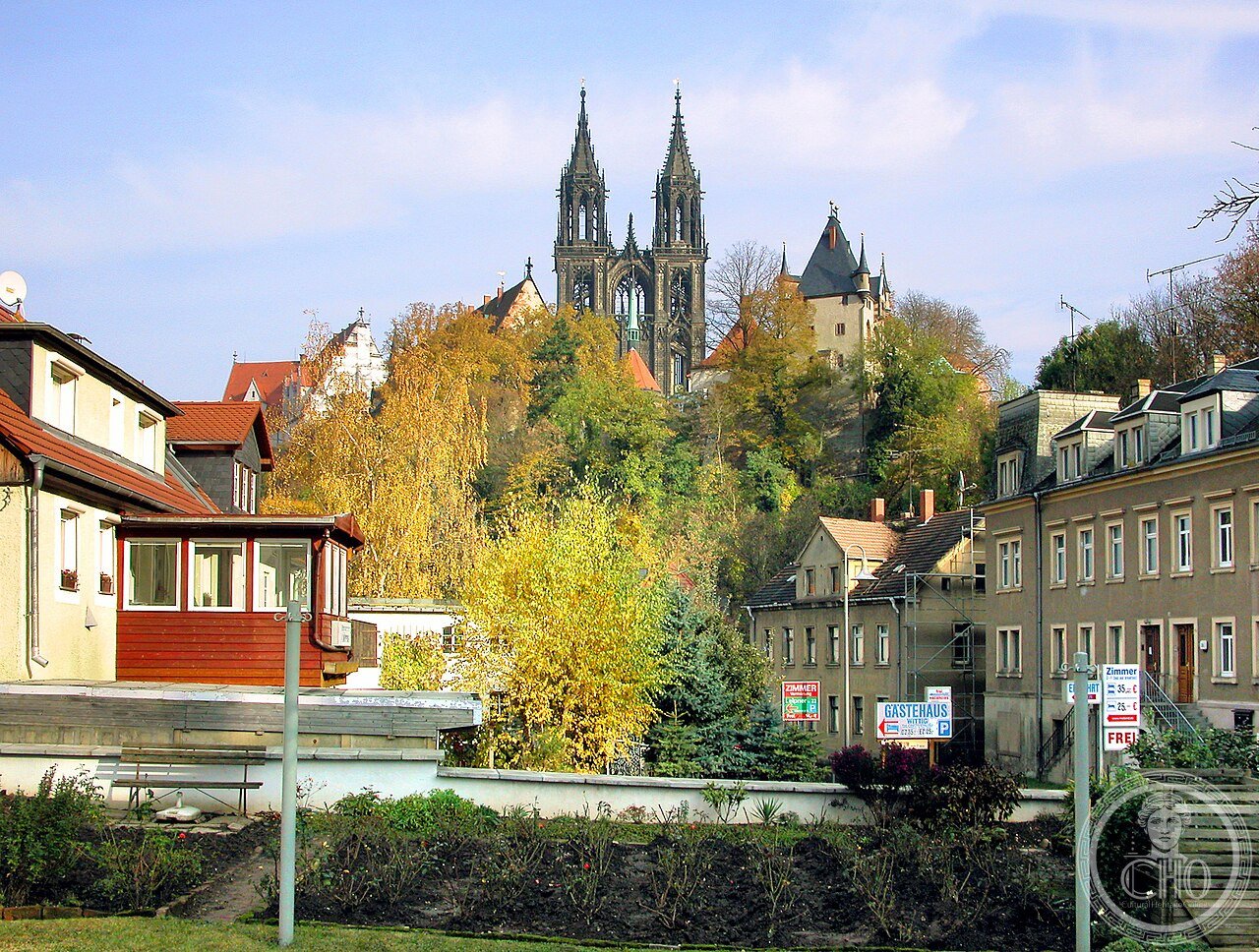
Le torri occidentali del duomo di Meissen furono iniziate nel primo Trecento, danneggiate da una tempesta nel 1413 e lasciate incompiute per quasi cinque secoli. Solo tra il 1903 e il 1909 l’architetto Carl Schäfer completò le guglie neogotiche di 81 metri che oggi definiscono lo skyline della città della porcellana.
About Meissen Cathedral
Meissen Cathedral (Dom zu Meißen) traces its origins to the Bishopric of Meissen established by Emperor Otto I in 968, replacing an earlier Romanesque church. The present Gothic hall church was built between 1260 and 1410. For centuries the building had only one prominent tower, the Höckrige Turm at the southeast corner, its name derived from an unusual bend in the spire; the lower storeys of the western towers were begun in the early 14th century but left unfinished, their wooden tops destroyed by a storm in 1413 and never fully completed until the early 20th century, when architect Carl Schäfer finally added a pair of 81-metre Neo-Gothic spires between 1903 and 1909. Inside, the cathedral holds Gothic sculptures of founder Emperor Otto and his wife Adelaide of Italy, work by the celebrated 13th-century Naumburg Master and workshop, and paintings from the studio of Lucas Cranach the Elder. In 1425, Frederick I, the first Saxon elector of the House of Wettin — the dynasty that ruled Meissen and later Saxony for centuries after acquiring the margraviate in 1089 — had the Prince’s Chapel (Fürstenkapelle) built as the dynastic burial place, making the cathedral the primary resting site for Saxon royalty and nobility. Following the Reformation, the Meissen diocese was dissolved in 1581 and the church transitioned to Protestant use, today serving the Evangelical-Lutheran Church of Saxony.
Key facts
- Diocesan foundation: established by Emperor Otto I in 968, replacing an earlier Romanesque church
- Gothic construction: present hall church built 1260-1410
- Western towers: begun early 14th century, storm-damaged 1413, left unfinished for nearly five centuries; completed 1903-1909 with 81-metre Neo-Gothic spires designed by Carl Schäfer
- Naumburg Master: sculptural work by this celebrated 13th-century workshop, alongside Gothic statues of founders Otto I and Adelaide of Italy
- Lucas Cranach the Elder: paintings from his studio held in the cathedral
- Prince’s Chapel: built 1425 by Frederick I, first Saxon elector of the House of Wettin, as the dynastic burial place
- Diocese dissolved: 1581 after the Reformation; now Evangelical-Lutheran
History
Otto I’s 968 establishment of the Meissen bishopric places the cathedral within the same broader Ottonian programme of episcopal foundation along the Elbe frontier that produced comparable sees at Merseburg and elsewhere, part of a deliberate imperial strategy to consolidate Christian and Frankish-German authority over recently subdued Slavic territories east of the river. The Wettin dynasty’s 1089 acquisition of the Meissen margraviate began one of German history’s longest-reigning noble houses, whose continuous rule over Saxony (in various territorial configurations) persisted for over eight centuries until the 1918 abdication of the last Saxon king — making the Prince’s Chapel, established in 1425 as the dynasty’s dedicated burial place, a physical record of an exceptionally long and stable dynastic continuity rare among European ruling houses.
The nearly five-century gap between the western towers’ early-14th-century beginning and their eventual 1903-1909 completion represents one of the more extreme examples of interrupted cathedral construction anywhere in Germany, the 1413 storm damage effectively freezing the towers in an unfinished state through the Reformation, the Thirty Years’ War, and the entirety of the early modern and 19th-century periods before Carl Schäfer’s Neo-Gothic completion finally realised a medieval design intention roughly five hundred years after it was first begun — a striking illustration of how genuinely long the gap between a cathedral’s initial conception and its final built form can stretch.
What you see
The Naumburg Master’s sculptural work, alongside the Gothic founder statues of Otto I and Adelaide of Italy, gives the cathedral direct access to one of German Gothic sculpture’s most celebrated workshops. The Prince’s Chapel, housing centuries of Wettin dynastic burials, offers a dense concentration of Saxon royal and noble funerary monuments within a single dedicated space. The twin 81-metre Neo-Gothic west towers, for all their relatively recent 1903-1909 completion, now form the cathedral’s defining silhouette alongside the adjoining Albrechtsburg castle on Meissen’s Burgberg.
Practical information
- Opening hours: generally open daily, check current hours before visiting; small admission fee typical, including tower access
- Address: Domplatz 7, 01662 Meißen
Getting there
Meißen has direct rail connections from Dresden (approximately 40 minutes). By car, Meißen sits on the B6/A14 road network. The cathedral stands on the Burgberg (castle hill) beside the Albrechtsburg. GPS: 51.1662° N, 13.4714° E.
Nearby
- Albrechtsburg — directly adjoining, a late Gothic castle and the original home of Meissen porcelain manufacture
- Staatliche Porzellan-Manufaktur Meissen — the historic porcelain manufactory, still in operation, with a museum and workshop tours
- Dresden — approximately 40 minutes by train; Saxony’s state capital, with its own major Baroque and Rococo heritage
Sources
- Wikipedia — “Meissen Cathedral” and “Meissen” (en.wikipedia.org)
- Religiana — “Meissen Cathedral” (religiana.com)
- From Place to Place — “Meissen Cathedral: Guided tour of the tower” (fromplacetoplace.travel)
Find it on the map
See this place and what’s around it →📷 Become a Cultural Heritage Online photographer
Share your photos of places: they stay published under your name as the author. The more they're seen, the more you get noticed — and soon a contest will reward the most appreciated photos.
Log in or sign up free to add a photo