
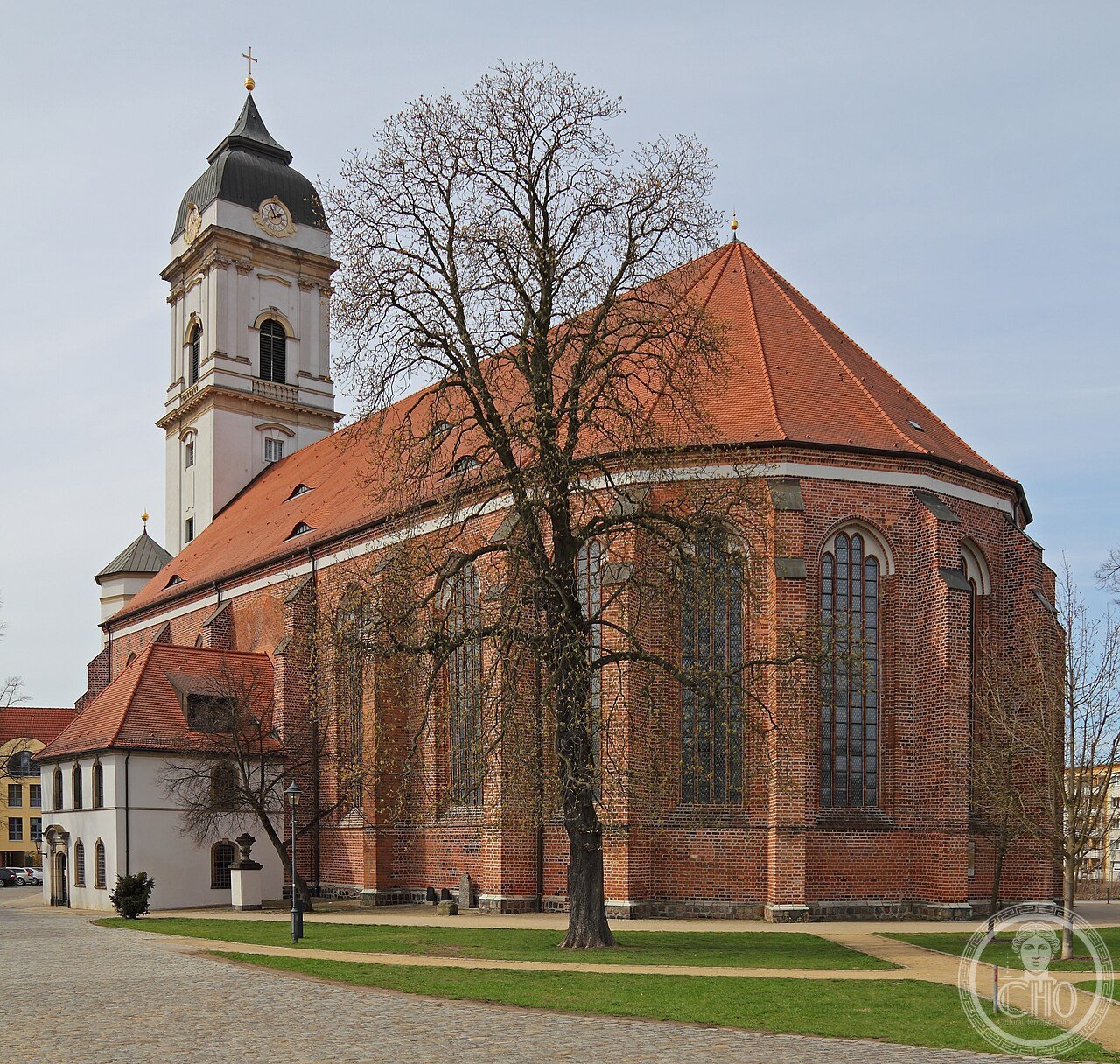
In 1432 the Hussites destroyed the church in revenge against the bishop of Lebus, one of the chief accusers of Jan Hus. The rebuilding, begun in 1446 partly as a demonstration of power, produced the cathedral we see today — reduced to rubble a second time in 1945 and restored only in 1995.
About Fürstenwalde Cathedral
Fürstenwalde Cathedral (Dom St. Marien und Johannes) stands on a site with a predecessor building already present around 1230; the city church of St. Marien became the seat of the bishops of the Diocese of Lebus (founded c. 1125) with papal confirmation in 1385. In 1432, the church was partially destroyed by Hussite forces in explicit revenge, since the Bishop of Lebus had been one of the main accusers of Jan Hus at the Council of Constance. Reconstruction, begun in 1446, was undertaken deliberately as a demonstration of institutional strength as much as practical necessity, producing the three-aisled brick church visible today, built of unplastered brick with asymmetrically arranged hexagonal-section support pillars, a stepped triple west gallery, and a west tower reaching 68 metres. Its most celebrated single object is a 12-metre sacrament house of 1517, an intricate filigree sandstone structure attributed to the sculptor Franz Maidburg. The Reformation arrived formally on 12 April 1557, when the first Protestant service was held here in the presence of Elector Joachim II, following the 1555 death of the last Catholic Bishop of Lebus. The building continued to suffer repeated disaster: lightning destroyed the tower, roof, and organ in 1576; the rebuilt tower collapsed again in 1731, its reconstruction completed in 1757 with a subsidy from Frederick the Great; and shortly before the end of World War II the cathedral was reduced to rubble and ashes, losing valuable interior elements. Exterior restoration was complete by the 1970s, a dedicated restoration guild formed in 1988, and the fully restored cathedral was rededicated in a grand ceremony on 31 October 1995.
Key facts
- Episcopal seat: Diocese of Lebus founded c. 1125; Fürstenwalde confirmed as episcopal seat by the Pope in 1385.
- 1432 Hussite destruction: in revenge against the Bishop of Lebus, an accuser of Jan Hus at the Council of Constance.
- Reconstruction: begun 1446; three-aisled brick church, hexagonal-section support pillars, stepped triple west gallery, 68-metre west tower.
- Sacrament house: 1517, 12 metres tall, filigree sandstone, attributed to sculptor Franz Maidburg.
- Reformation: first Protestant service 12 April 1557, in the presence of Elector Joachim II.
- Repeated disasters: tower/roof/organ destroyed by lightning 1576; tower collapsed again 1731, rebuilt by 1757 with Frederick the Great’s subsidy; reduced to rubble near the end of WWII.
- Post-war restoration: exterior complete by the 1970s; restoration guild formed 1988; full rededication 31 October 1995.
History
The 1432 Hussite attack on Fürstenwalde, explicitly motivated by the Bishop of Lebus’s role in condemning Jan Hus at the 1414-1418 Council of Constance, situates the cathedral within the broader, often brutally reciprocal violence of the Hussite Wars (1419-1434), during which Bohemian Hussite forces conducted retaliatory campaigns deep into neighbouring German territories against institutions and individuals associated with Hus’s condemnation and execution. The deliberate framing of the 1446 reconstruction as a demonstration of strength, rather than purely functional rebuilding, reflects how medieval ecclesiastical institutions frequently used architecture explicitly and self-consciously to project resilience and continuing authority after politically motivated destruction, turning a rebuilding project into a statement of institutional survival.
The cathedral’s subsequent history of repeated disaster and reconstruction — lightning in 1576, tower collapse in 1731, wartime destruction in 1945 — and its correspondingly repeated restoration, culminating in the carefully organised post-war effort spanning from 1970s exterior work through the 1988 formation of a dedicated restoration guild to the full 1995 rededication, gives Fürstenwalde one of the more thoroughly and recently documented restoration histories among German brick Gothic cathedrals, with the building’s present form representing a genuinely late-20th-century completion of a project whose destruction long predated its final resolution.
What you see
The 1517 sacrament house, its 12-metre filigree sandstone structure attributed to Franz Maidburg, is the cathedral’s single most significant surviving decorative element and the essential destination for visitors. The brick Gothic nave, with its distinctive asymmetrically arranged hexagonal pillars and stepped triple west gallery, offers a legible architectural record of the 1446 reconstruction campaign. The 68-metre west tower, itself twice rebuilt after 1576 and 1731 disasters, anchors the building’s visual presence over Fürstenwalde’s Domplatz.
Practical information
- Opening hours: generally open daily, check current hours before visiting; free admission.
- Address: Domplatz 10, 15517 Fürstenwalde/Spree.
Getting there
Fürstenwalde/Spree has direct rail connections from Berlin (approximately 40 minutes) and Frankfurt (Oder) (approximately 20 minutes). By car, Fürstenwalde sits on the B168/A12 road network. The cathedral stands on Domplatz in the historic centre. GPS: 52.3582° N, 14.0656° E.
Nearby
- Fürstenwalde old town — surrounding Domplatz, along the Spree river.
- Seenland Oder-Spree — the surrounding lake district, a regional outdoor recreation area.
- Berlin — approximately 40 minutes by train.
Sources
- Wikipedia — “St Mary’s Cathedral, Fürstenwalde” (en.wikipedia.org).
- Brandenburg Tourism — “Dom St. Marien Fürstenwalde/Spree” (brandenburg-tourism.com).
- Stadtgeschichte Fürstenwalde — “St. Marien Dom” (stadtgeschichte.fuerstenwalde-spree.de).
Find it on the map
See this place and what’s around it →📷 Become a Cultural Heritage Online photographer
Share your photos of places: they stay published under your name as the author. The more they're seen, the more you get noticed — and soon a contest will reward the most appreciated photos.
Log in or sign up free to add a photo