
Tra il 1514 e il 1521, Hans Brüggemann scolpì per il convento agostiniano di Bordesholm un altare di 12,6 metri con oltre 400 figure in quercia non dipinta. Dopo lo scioglimento del convento, il duca Cristiano Alberto lo trasferì nel 1666 alla cattedrale di Schleswig, dove resta uno dei capolavori scultorei più imponenti del tardo gotico tedesco.
About Schleswig Cathedral
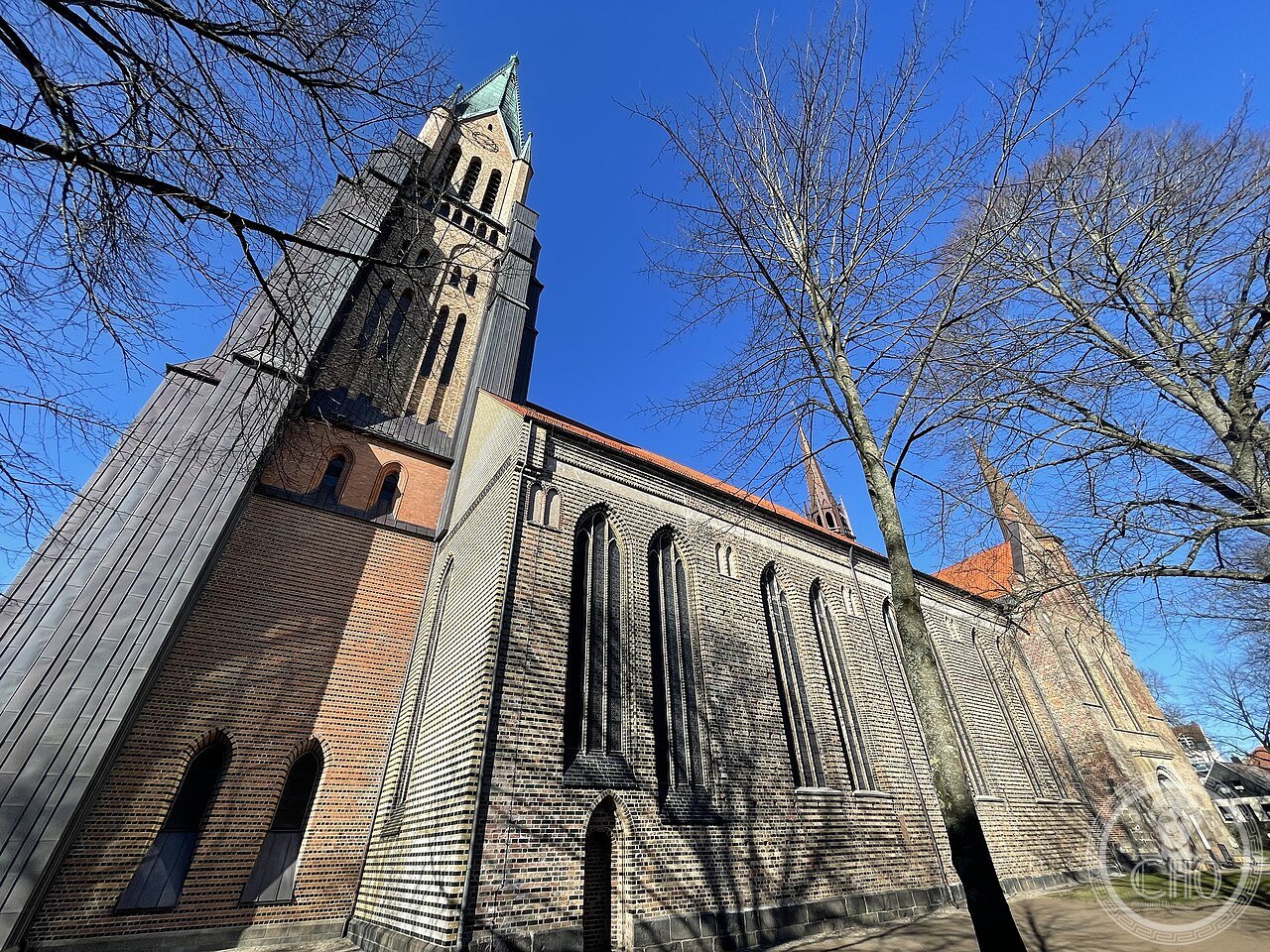
Schleswig Cathedral (Dom St. Petri, officially the Cathedral of St. Peter at Schleswig) traces its origins to the diocese established in 947, with a first cathedral built shortly afterward and a still earlier missionary church founded at nearby Haithabu (Hedeby) around 850. The present structure began as a Romanesque basilica in 1134, completed around 1200; after tower collapses in 1275, a High Gothic hall choir was built and finished by 1300, and the building continued to develop as a Late Gothic hall church through 1408, with further additions into the 16th century. A Neo-Gothic western tower, added between 1888 and 1894 at the request of King William II of Prussia, rises 112 metres, making it the second-tallest church spire in Schleswig-Holstein after Lübeck’s Marienkirche. The cathedral served as the seat of the Bishop of Schleswig until the diocese was dissolved in 1624, and today belongs to the North Elbian Evangelical Lutheran Church, seat of the Lutheran Bishop of Schleswig and Holstein. Its single most extraordinary holding is the Bordesholm Altarpiece, an oak masterwork by Hans Brüggemann carved between 1514 and 1521, standing 12.60 metres high with more than 400 finely carved, unpainted figures across sixteen scenes depicting Christ’s Passion, arrest through Ascension, some scenes visibly inspired by Albrecht Dürer’s “Kleine Passion.”
Key facts
- Diocesan origins: established 947; earlier missionary church at Haithabu (Hedeby) c. 850
- Construction: Romanesque basilica begun 1134, completed c. 1200; High Gothic hall choir built after 1275 tower collapse, finished 1300; Late Gothic hall church through 1408, additions into the 16th century
- Western tower: Neo-Gothic, built 1888-1894 at the request of King William II of Prussia; 112 metres, second-tallest church spire in Schleswig-Holstein
- Bordesholm Altarpiece: carved by Hans Brüggemann, 1514-1521; 12.60 metres high, over 400 carved oak figures across sixteen Passion scenes; moved here in 1666 after the Bordesholm priory’s dissolution
- Diocese dissolved: 1624; cathedral now Lutheran, seat of the Bishop of Schleswig and Holstein
- Ducal tombs: burial site of Frederick I of Denmark and multiple Dukes of Holstein-Gottorp
- Restoration note: a young Emil Nolde helped restore the Bordesholm Altarpiece in Flensburg in the late 19th century
History
Schleswig’s diocesan foundation in 947 places the cathedral within the Ottonian-era Christianisation of the Danish-Saxon border region, a frontier zone whose earlier missionary church at Haithabu, one of the most significant Viking Age trading towns in northern Europe, situates Schleswig at a genuinely ancient crossroads of Scandinavian and Continental European history predating the present cathedral by nearly three centuries. The building’s long, interrupted construction history — a Romanesque start in 1134, a tower collapse in 1275 forcing a High Gothic rebuild of the choir, and continued Late Gothic expansion through 1408 and beyond — reflects the kind of multi-generational, repeatedly modified building campaign typical of major medieval cathedrals, whose final form typically synthesises several centuries of shifting architectural fashion rather than a single coherent design.
The Bordesholm Altarpiece’s journey to Schleswig is itself a specific instance of a broader post-Reformation pattern: as Lutheran territories dissolved Catholic monastic institutions across the 16th and 17th centuries, valuable devotional artworks originally commissioned for suppressed religious houses were frequently relocated to surviving parish or cathedral churches rather than destroyed, preserving major works of Catholic-era religious art within newly Protestant institutional settings. Duke Christian Albrecht of Holstein-Gottorp’s 1666 decision to move Brüggemann’s altarpiece from the dissolved Bordesholm priory to Schleswig Cathedral exemplifies this pattern precisely, and the altarpiece’s subsequent 19th-century restoration — notably involving a young Emil Nolde, later one of German Expressionism’s most significant painters, before his own artistic career had developed — adds a further, more recent layer of documented craftsmanship history to the object.
What you see
The Bordesholm Altarpiece is the cathedral’s essential single destination, its scale and sheer density of carved figuration — over 400 unpainted oak figures across sixteen Passion scenes within a single 12.60-metre structure — rewarding slow, sustained viewing rather than a quick glance. The cathedral’s own architectural layering, from its 1134 Romanesque origins through the 1300 Gothic choir and the 1888-1894 Neo-Gothic western tower, gives visitors a legible seven-century building history within one structure. The ducal tombs of Frederick I of Denmark and the Dukes of Holstein-Gottorp add a further dimension of Nordic and North German dynastic history to the building’s interior.
Practical information
- Opening hours: generally open daily, check current hours before visiting; small admission fee typical for cathedral treasury/altarpiece viewing
- Address: Süderdomstraße 2, 24837 Schleswig
Getting there
Schleswig has direct rail connections from Kiel (approximately 45 minutes) and Hamburg (approximately 1.5 hours, typically with a change). By car, Schleswig sits on the B77/A7 road network. The cathedral stands in Schleswig’s historic Altstadt. GPS: 54.5137° N, 9.5694° E.
Nearby
- Gottorf Castle — former residence of the Dukes of Holstein-Gottorp, a short walk from the cathedral, housing major regional museums
- Haithabu (Hedeby) — UNESCO World Heritage Viking Age trading settlement, a few kilometres from Schleswig
- Kiel — approximately 45 minutes by train; Schleswig-Holstein’s state capital on the Baltic coast
Sources
- Wikipedia — “Schleswig Cathedral” and “Hans Brüggemann” (en.wikipedia.org)
- Structurae — “Schleswig Cathedral (Schleswig, 1408)” (structurae.net)
- Unofficial Royalty — “Saint Peter’s Cathedral in Schleswig, Germany” (unofficialroyalty.com)
- SpottingHistory — heritage documentation (spottinghistory.com)
Find it on the map
See this place and what’s around it →📷 Become a Cultural Heritage Online photographer
Share your photos of places: they stay published under your name as the author. The more they're seen, the more you get noticed — and soon a contest will reward the most appreciated photos.
Log in or sign up free to add a photo