
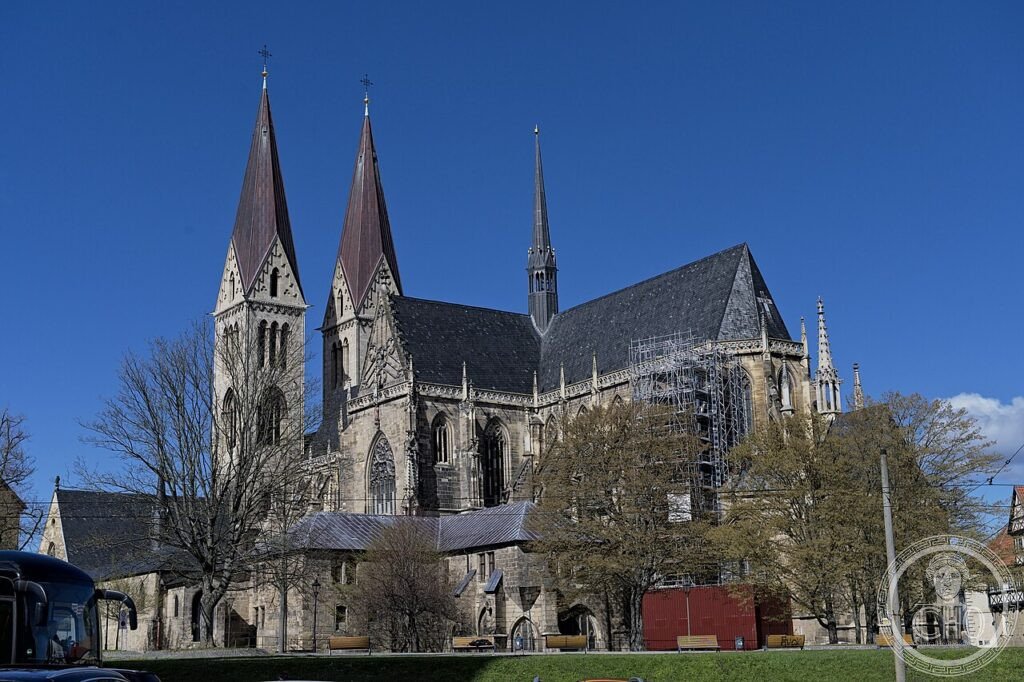
In 1204 Bishop Konrad von Krosigk came back from the Fourth Crusade with fragments of the True Cross and of the Crown of Thorns. Today the treasury of Halberstadt Cathedral holds more than 1,250 works, among them the best-preserved Romanesque tapestries in Europe — including the famous Abraham-and-the-Angel hanging, of around 1150.
At a glance
Halberstadt Cathedral (Dom St. Stephanus und St. Sixtus) traces its diocesan history back to the 9th century, with the present Gothic building’s twin towers, rising over 91 metres, still dominating Halberstadt’s skyline today. Unusually, construction began with the west facade itself, combining late Romanesque and early Gothic elements, its early Gothic main portal carrying a Last Judgment tympanum with a lion devouring its prey and a bust of Christ as World Ruler surrounded by angelic and evangelist symbols; the upper section of the facade was substantially reconstructed in the 19th century under Otto Kilburger. The cathedral’s most extraordinary holding, however, is its treasury: widely considered one of the most extensive medieval church treasures anywhere in the world, comprising more than 1,250 individual works of art, including roughly ninety ecclesiastical vestments, embroidered hangings, and altar cloths, and — its single most celebrated group of objects — a collection of Romanesque tapestries considered the oldest and best-preserved in Europe, among them the Abraham Angel carpet of around 1150. A significant portion of the treasury’s holdings, including relics claimed as fragments of Christ’s cross and crown of thorns, were brought back by Bishop Konrad von Krosigk from the Fourth Crusade in 1204.
Key facts
- Diocesan origins: 9th century; present Gothic cathedral construction began unusually with the west facade itself
- West facade: combines late Romanesque and early Gothic elements; early Gothic main portal with a Last Judgment tympanum; upper facade substantially reconstructed in the 19th century under Otto Kilburger
- Towers: over 91 metres tall, still dominating the Halberstadt cityscape
- Cathedral Treasury: over 1,250 works of art, one of the most extensive medieval church treasures in the world, including roughly 90 ecclesiastical vestments and embroidered hangings
- Romanesque tapestries: the oldest and best-preserved collection of its kind in Europe, including the Abraham Angel carpet, c. 1150
- Fourth Crusade relics: brought to Halberstadt in 1204 by Bishop Konrad von Krosigk, including claimed fragments of the True Cross and the Crown of Thorns
History
Halberstadt’s status as a diocesan seat since the 9th century gave the cathedral centuries in which to accumulate the exceptional treasury that distinguishes it today, with donations from successive benefactors gradually building a collection whose scale and diversity — combining sacred textiles, precious tapestries, and holy relics in a single institutional holding — has few parallels among surviving medieval European church treasuries. Bishop Konrad von Krosigk’s specific contribution, bringing relics and other treasures back from the Fourth Crusade (1202-1204) in 1204, situates Halberstadt directly within one of medieval European history’s more controversial episodes: the Fourth Crusade, diverted from its original intended target and culminating instead in the notorious 1204 sack of Constantinople by Latin Christian forces, produced a substantial flow of Byzantine relics, artworks, and treasures into Western European churches in the crusade’s aftermath, and Halberstadt’s own Fourth Crusade acquisitions — including relics claimed as fragments of Christ’s cross and crown of thorns — represent a direct, well-documented instance of this broader pattern of treasure redistribution following the sack.
The cathedral’s Romanesque tapestry collection, and specifically the Abraham Angel carpet of around 1150, predate the Fourth Crusade acquisitions by half a century and represent an entirely separate strand of the treasury’s development, reflecting sustained textile-art patronage and preservation across multiple distinct periods of the cathedral’s history rather than a single moment of acquisition. The unusual decision to begin the Gothic cathedral’s construction with the west facade itself, rather than the more typical practice of building east to west starting with the liturgically primary choir, reflects a specific and relatively uncommon building sequence whose precise motivations are not fully documented but which nonetheless produced one of Halberstadt’s most visually striking surviving medieval architectural elements.
What you see
The west facade’s early Gothic main portal, with its Last Judgment tympanum, rewards close attention for its combination of a lion devouring prey and a bust of Christ as World Ruler surrounded by angelic and evangelist symbols — an iconographic programme typical of major Gothic portal sculpture. The cathedral treasury, displayed in the historic rooms of the cathedral cloister, is the essential destination for visitors specifically interested in the collection’s roughly 300 most significant treasures on public display, including the celebrated Romanesque tapestries and the Fourth Crusade relics. The twin towers, over 91 metres tall, remain visible across much of Halberstadt and the surrounding countryside, anchoring the cathedral’s continuing visual dominance of the city.
Practical information
- Treasury opening hours: Tuesday-Saturday 10:00-17:00, Sunday/national holidays 10:00-16:00; closed Mondays
- Address: Domplatz 16a, 38820 Halberstadt
Getting there
Halberstadt has direct rail connections from Magdeburg (approximately 1 hour) and Halle (Saale) (approximately 1.5 hours, typically with a change). By car, Halberstadt sits on the B79/B81 road network at the edge of the Harz mountains. The cathedral stands on Domplatz in the historic centre. GPS: 51.8961° N, 11.0485° E.
Nearby
- Halberstadt historic centre — surrounding the cathedral; extensive half-timbered architecture, largely rebuilt after severe WWII damage but retaining significant historic fabric
- Quedlinburg — approximately 20-25 minutes by car or train; a UNESCO World Heritage half-timbered old town with its own significant collegiate church treasury
- Harz mountains — immediately south of Halberstadt; a major hiking and nature tourism region
Sources
- Kulturstiftung Sachsen-Anhalt / Die Domschätze — official cathedral treasury portal (die-domschaetze.de/en)
- Transromanica — “Cathedral of St. Stephan and St. Sixtus, Halberstadt” (transromanica.com)
- Halberstadt Tourismus — official visitor information (halberstadt.de/en)
- Wikipedia — “Halberstadt Cathedral” (en.wikipedia.org)
Find it on the map
See this place and what’s around it →📷 Become a Cultural Heritage Online photographer
Share your photos of places: they stay published under your name as the author. The more they're seen, the more you get noticed — and soon a contest will reward the most appreciated photos.
Log in or sign up free to add a photoIs this page about you?
This page is read by travellers and heritage enthusiasts who find it on Google. Tell us how you are connected to this place and we will take it from there.