
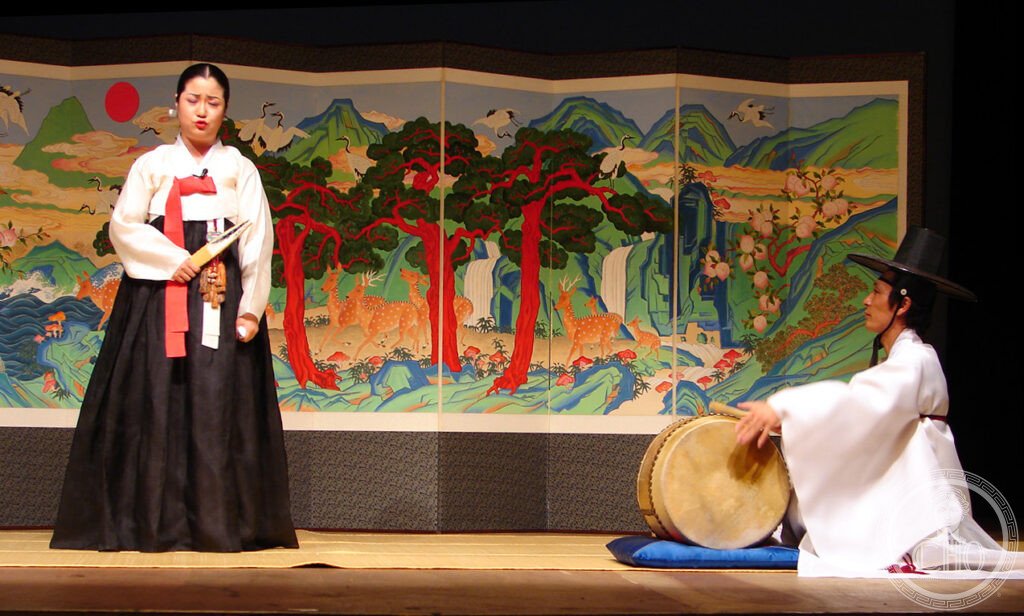
A Korean singer and drummer perform an epic story that can last eight hours or more, blending vocal music, body movement, and rhythmic percussion into a form once dismissed by elites and now celebrated as a national treasure.
At a glance
Pansori is a musical storytelling tradition performed by a single vocalist accompanied by a drummer playing the buk. The term itself comes from Korean words meaning “sound” and either “many people gathered” or “a song of varying tones.” A performance weaves narrative, music, and gesture into a sustained dramatic arc—a Gugwangdae—that unfolds across three to eight hours or longer, following the rhythms and melodies of Korean regional music.
Origins & history
Originally called “sori” and known by various other names including Taryeong, Japga, and Clown Song, pansori emerged as folk entertainment for Korea’s working classes. During the 19th century, the genre crossed social boundaries and won the patronage of the elite, establishing itself as a serious art form. Public interest waned in the mid-20th century, but South Korea has since invested heavily in preserving and honoring pansori masters as living national treasures. In contrast, North Korea has not provided systematic government support for the practice.
The practice
The pansori performer stands before an audience, voice and body moving through passages of song, dialogue, and mimetic gesture. A single drummer—the gosu—marks time with the buk, its rhythms anchoring the singer’s vocal line as it shifts between registers and emotional intensities. The dramatic content adapts to different rhythmic patterns rooted in Korea’s local musical traditions. Historically, surviving pansori narratives concluded with resolution and happiness. Contemporary performances, especially shorter excerpt pieces performed in concert settings, often emphasize the psychological and emotional trials of characters, exploring themes of sorrow and unfulfilled longing—what practitioners call “han,” the “sound of han.”
Cultural significance
Pansori represents a rare form of sustained oral narrative, where music, voice, and storytelling fuse into a singular expressive act. The genre’s elevation from street entertainment to revered national art reflects broader shifts in how Korean society values traditional knowledge and cultural continuity. The late 20th-century turn toward melancholic, excerpt-based performances has sparked debate within the traditional community about how pansori evolves while remaining true to its roots.
Key facts
- Pansori is performed by a vocalist and a buk drummer (the gosu)
- A full Gugwangdae performance lasts three to eight hours or more
- Designated Korea’s National Intangible Cultural Heritage No. 5 in 1964
- Registered as UNESCO Masterpiece of the Oral and Intangible Heritage of Humanity in 2003
- Also practiced by ethnic Koreans in China; nominated for UNESCO recognition in 2011
- Anchor community: Jeonju, South Korea
Where to experience it
Jeonju, in the North Jeolla Province region, remains the heartland of pansori tradition. South Korea’s government-supported system of living national treasures ensures that master performers continue to teach and perform the form. Information about specific performances and venues can be found through South Korean cultural organizations and UNESCO’s intangible heritage documentation.
Sources & resources
- Pansori – Wikipedia
- Pansori Epic Chant – UNESCO Intangible Cultural Heritage
- Cultural Heritage Online
Find it on the map
See this place and what’s around it →📷 Become a Cultural Heritage Online photographer
Share your photos of places: they stay published under your name as the author. The more they're seen, the more you get noticed — and soon a contest will reward the most appreciated photos.
Log in or sign up free to add a photo