
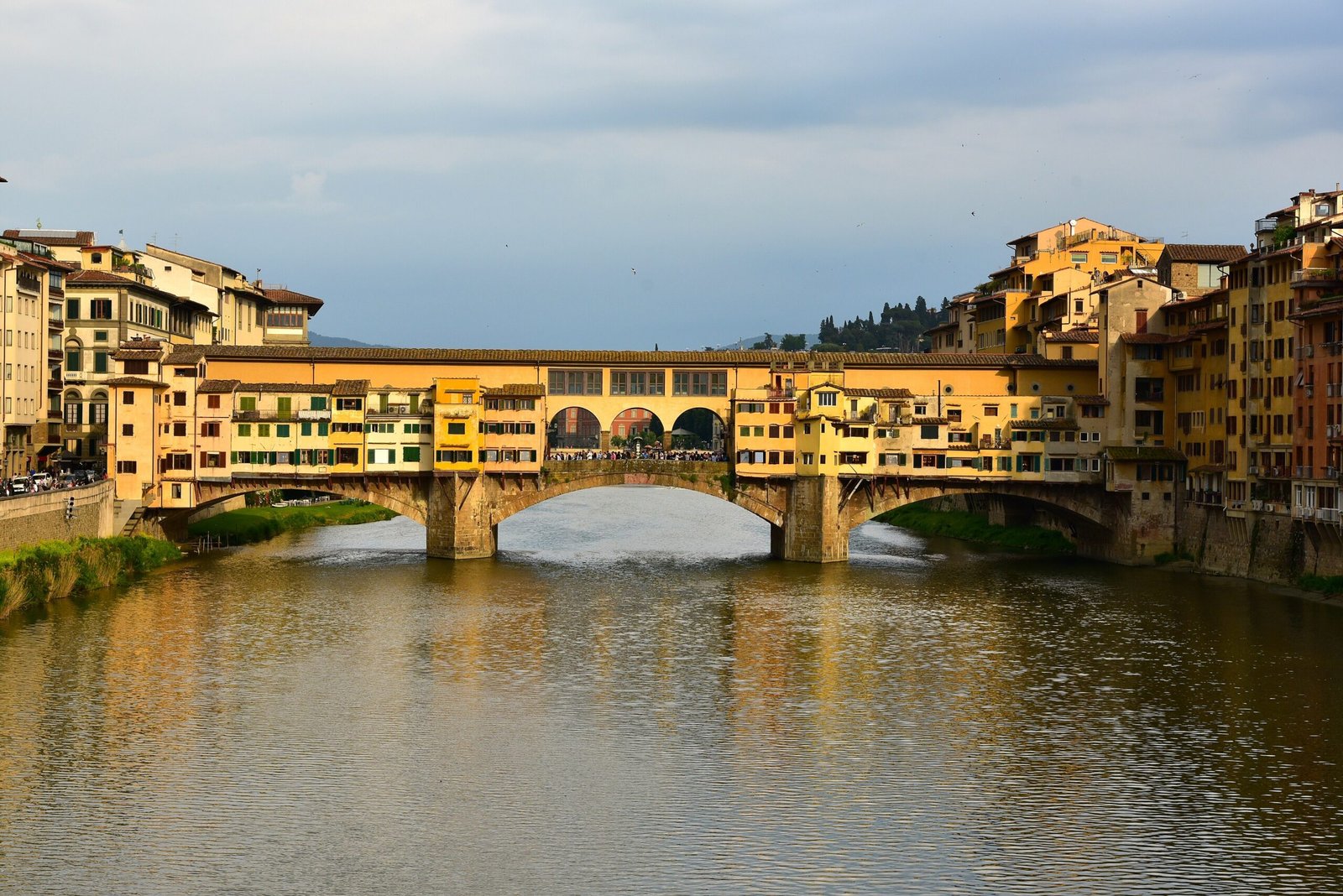
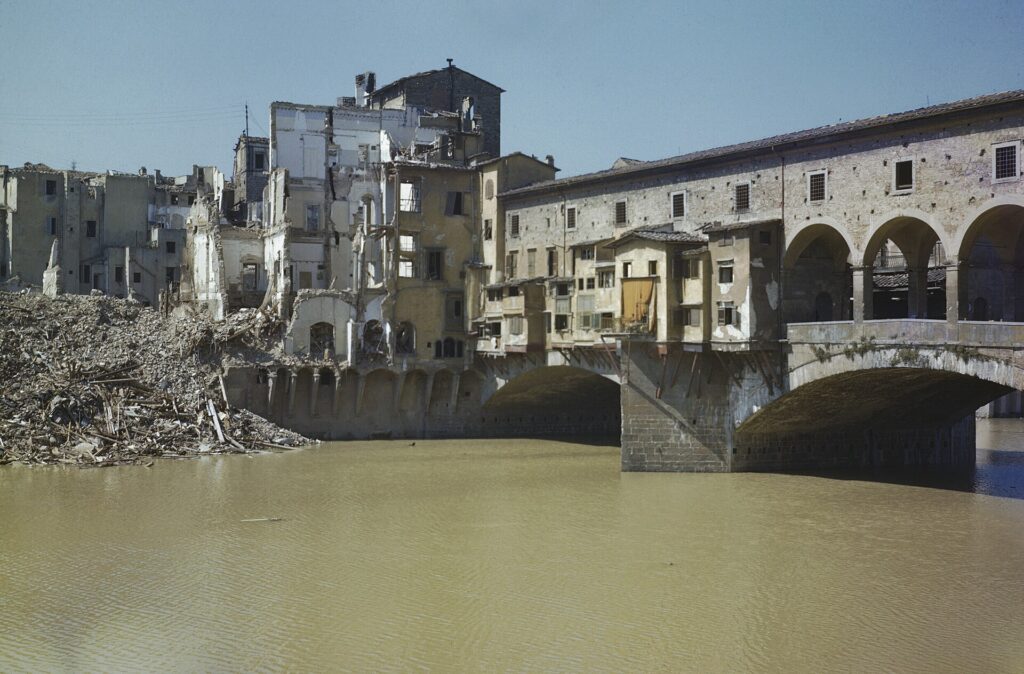
The Ponte Vecchio, meaning “Old Bridge,” is a medieval stone arch bridge spanning the River Arno in Florence, Italy. First built in Roman times and reconstructed in its present form in 1345, it is the only bridge in Florence to have survived the German retreat of August 1944 intact. Distinguished among European bridges by the continuous row of shops built along both sides, the Ponte Vecchio has housed goldsmiths, jewellers, and art dealers since the late 16th century, when Grand Duke Ferdinando I expelled the butchers and tanners who had previously occupied its stalls.
At a glance
- Type
- Medieval stone closed-spandrel segmental arch bridge
- Period
- Roman origins; current structure completed 1345; shops rebuilt after 1333 flood
- Style
- Medieval Italian bridge architecture; later Renaissance additions
- Location
- River Arno, Florence, Tuscany, Italy
- Coordinates
- 43.7689° N, 11.2503° E
Overview
The Ponte Vecchio is a medieval stone closed-spandrel segmental arch bridge over the Arno in Florence. It is the only bridge in Florence spared from destruction during World War II and is noted for the shops built along it, a practice once common on European bridges. The present tenants are jewellers, art dealers, and souvenir sellers, continuing a commercial tradition unbroken since the 14th century. The bridge connects the sestiere of Oltrarno to the historic centre on the north bank.
History
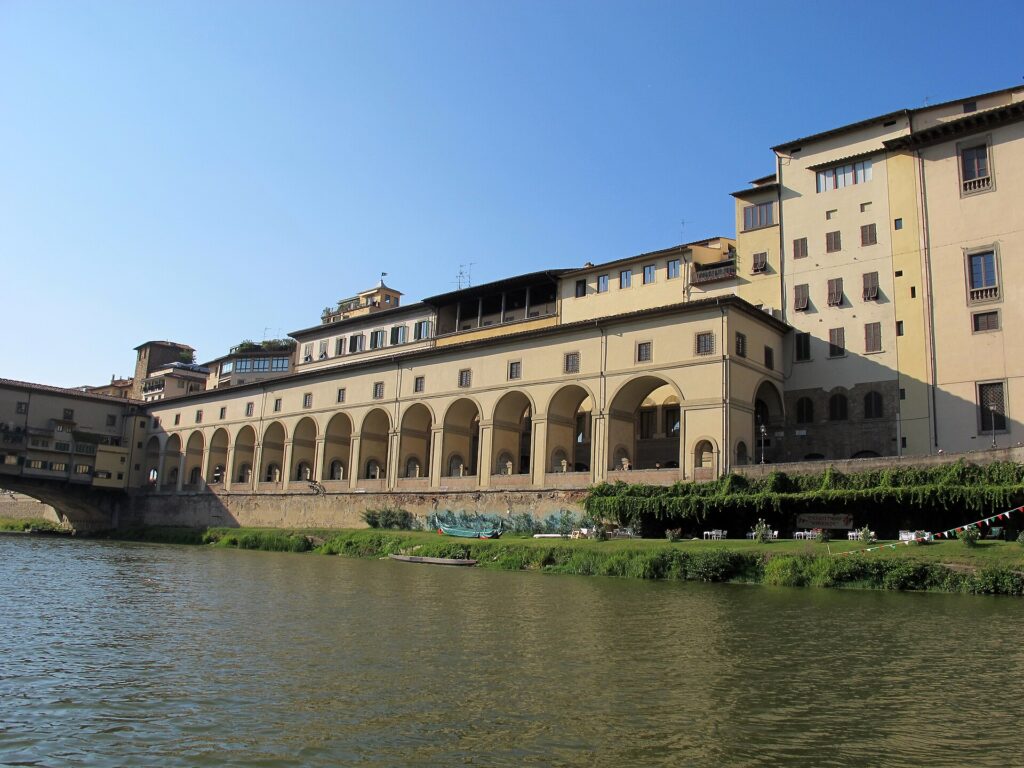
A Roman bridge stood at this narrow crossing of the Arno, and medieval documents mention a bridge here from at least 996 AD. The current structure was completed in 1345, replacing a bridge destroyed by the great flood of 1333. The shops along the bridge were originally occupied by butchers, tanners, and vegetable sellers; Grand Duke Ferdinando I de’ Medici replaced them with goldsmiths and jewellers in 1593, a trade that has continued ever since. The Vasari Corridor, built in 1565 by Giorgio Vasari for Cosimo I de’ Medici, passes along the eastern side of the bridge, connecting the Uffizi to the Palazzo Pitti.
What you see
The bridge rests on three stone arches, the widest spanning 30 metres, with the shops cantilevering over the river on timber brackets. The central section of the bridge is open to views up and down the Arno — a deliberately kept viewpoint from which the river and the surrounding hills can be seen. A bust of the goldsmith Benvenuto Cellini, placed at the bridge’s midpoint in 1900, has become a traditional meeting point adorned with lovers’ padlocks. The Vasari Corridor above is visible as a continuous arched gallery on the eastern side.
Cultural significance
The Ponte Vecchio is one of the most iconic images of Florence and of Italian urban heritage, forming part of the UNESCO World Heritage Site “Historic Centre of Florence” inscribed in 1982. Its survival of World War II is often attributed to a direct order from Hitler, though this claim remains unverified by documents. The bridge’s continuous inhabitation by artisans since the 14th century makes it a living monument to the commercial and craft traditions of the medieval city.
Practical information
- Address
- Ponte Vecchio, 50125 Florence (Firenze), Italy
- Access
- The bridge itself is freely accessible on foot at all times; the shops open regular retail hours
- Notes
- Vehicular traffic is prohibited; expect heavy pedestrian crowds in high season
Getting there
The Ponte Vecchio is in the historic centre of Florence, approximately 10 minutes’ walk south from Santa Maria Novella railway station. From the station, follow Via dei Fossi or Via della Vigna Nuova toward the river. Bus lines C3 and D stop nearby. The bridge is best visited early morning or in the evening to avoid the peak tourist flow.
Photographs
Sources & resources
See the place
Find it on the map
See this place and what’s around it →📷 Become a Cultural Heritage Online photographer
Share your photos of places: they stay published under your name as the author. The more they're seen, the more you get noticed — and soon a contest will reward the most appreciated photos.
Log in or sign up free to add a photoIs this page about you?
This page is read by travellers and heritage enthusiasts who find it on Google. Tell us how you are connected to this place and we will take it from there.