
For centuries, the craftspeople of Idrija have created exquisite bobbin lace using techniques refined through generations, producing patterns named for hearts, peonies, and cradles.
In UNESCO’s words
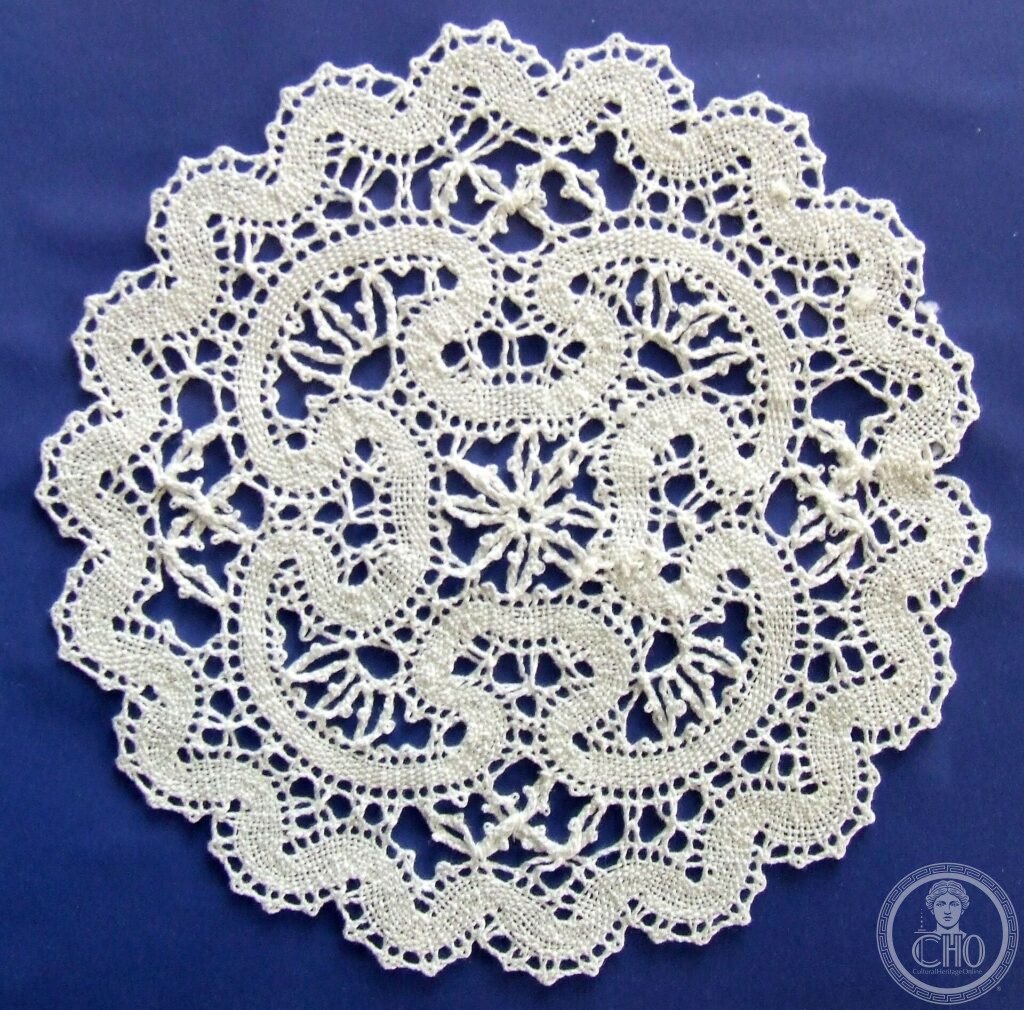
Bobbin lacemaking in Slovenia is a handicraft skill of making lace by crossing and twisting thread wound on special wooden sticks known as bobbins. Using locally recognizable patterns with local names, bobbin lacemakers make lace in bands or in finished shapes. The bobbin lacemaking process follows a specific pattern: a drawing on paper is attached to a cylinder pillow in a wicker basket or on a wooden base. The lace is used to adorn clothing and fashion accessories, church and home textiles and representative spaces, but bobbin lacemaking also serves as an inspiration for artistic creations in fields such as the contemporary visual arts, design, architecture and culinary design. It is the creative expression of all those involved in the process, including the pattern designer and the bobbin lacemaker. Bobbin lacemaking has notable therapeutic functions, and is an ecologically clean and sustainability-oriented activity. There are around 120 bobbin lacemaking societies, sections and groups in Slovenia today, which include trained bobbin lacemakers and those who are still learning. Bearers mostly comprise women, and the knowledge and skills related to the practice are most frequently passed down from grandmothers to grandchildren: the socializing of female bobbin lacemakers in neighbourhood communities is also key for transmitting related knowledge and skills.
Official description, UNESCO Intangible Cultural Heritage List — Bobbin lacemaking in Slovenia
At a glance
Bobbin lacemaking is a handicraft in which lacemakers use wooden sticks called bobbins to cross and twist thread into lace. The work follows a specific process: a paper pattern is attached to a pillow set in a wicker basket or on a wooden base. Lacemakers create lace in bands or finished shapes, using locally recognized patterns with traditional names. The finished lace decorates clothing, fashion accessories, and textiles for churches and homes, while also inspiring artists working in visual arts, design, architecture, and other fields.
Origins & history
Bobbin lacemaking has been practiced in Idrija for centuries, making the town the main and oldest Slovenian lacemaking center. The tradition evolved and enriched over time, absorbing influences from neighboring cultures—particularly from the Austro-Hungarian Empire and, after World War I, from Italy. These external influences shaped the development of the two distinct tape types that define Idrija lace today. The practice was formally recognized with protected geographical indication status in 2000.
The practice
Bobbin lacemakers work by crossing and twisting threads wound on wooden bobbins according to paper patterns attached to a pillow. The practice involves both pattern designers and lacemakers as creative participants. Today, around 120 bobbin lacemaking societies, sections, and groups operate in Slovenia, comprising trained practitioners and learners. Knowledge and skills are transmitted primarily from grandmothers to grandchildren, with women forming the majority of bearers. Female lacemakers also share knowledge within neighborhood communities.
Cultural significance
Bobbin lacemaking holds therapeutic value for those who practice it and represents an ecologically clean, sustainability-oriented activity. The tradition is a creative expression shared among pattern designers, lacemakers, and communities. Knowledge passes through family lines and neighborhood networks, making the social transmission of skills central to the practice's continuance and cultural meaning.
Key facts
- Country: Slovenia
- Inscribed: 2018
- UNESCO list: Representative List of the Intangible Cultural Heritage of Humanity
- UNESCO reference: 01378
- UNESCO vocabulary: Bobbin; Decorative arts; Lace
- Map: not shown — UNESCO’s official description of this element names no locality, and a living tradition is practised across a community, not at one address.
Where to experience it
Bobbin lacemaking thrives throughout Slovenia in around 120 societies, sections and groups where trained lacemakers and apprentices keep the tradition alive. Visitors can encounter this craft at local community workshops and lace schools, where the techniques are taught and practitioners work with their characteristic wooden bobbins and locally named patterns. Many lacemakers welcome observation, and the socializing spaces where knowledge passes from grandmothers to grandchildren offer genuine insight into how this therapeutic craft remains woven into Slovenian neighbourhoods today.
Sources & resources
- UNESCO — official element page: Bobbin lacemaking in Slovenia
- UNESCO — open data record: Intangible Heritage List, reference 01378
- UNESCO — official photograph: Photograph of this element — Franc Peternelj — Mestni Muzej Idrija, 1992
- Reference — Wikipedia (secondary): Idrija lace — consulted as a secondary reference, not as confirmation
- Cultural Heritage Online: Our archive and city guides

Sources
- S1 — Sever, Bela. Idrija in okolica. Založba Lipa, 1982. / Frucht, Richard, ed. Eastern Europe: An Introduction to the People, Lands, and Culture. ABC-CLIO, 2004. ISBN 978-1-57607-800-6.
- S2 — Habič, Peter, ed. The Karst: Land and Underground. ZRC Publishing, 1999. ISBN 978-961-6358-01-9.
Spotted an error? Write to editorial@culturalheritageonline.com and we correct it the same day.